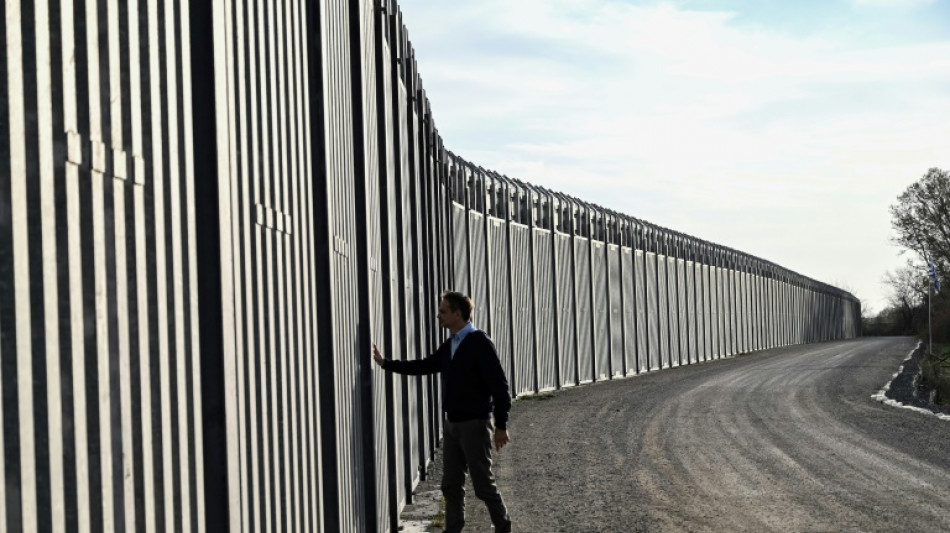
Greece border security under spotlight in election campaign / Photo: © AFP

The rocky road running past dilapidated homes ends abruptly at a thick, five-metre-high metal barrier -- the end of the European Union, and Greece's border with Turkey.
The grey waters of the Evros River, the natural border between the two countries, now flow alongside the imposing fence topped with barbed wire.
Athens erected the 37.5-kilometre (23-mile) barrier in 2020 after tens of thousands of migrants tried to break through this remote northeastern area, clashing for days with Greek security forces.
With the country headed into a tight general election next month, the conservative government has vowed to extend the barrier another 35 kilometres by the end of the year.
On Monday, Migration Minister Notis Mitarachi went so far as to tell private broadcaster Skai TV that his conservative party wanted to extend the fence across the entire 200 kilometres of the Greek-Turkish border.
Prime Minister Kyriakos Mitsotakis, fighting to hold onto power at the May 21 ballot box and facing calls to resign over the country's worst rail tragedy that killed 57 people, is pressing his tough-on-migration policy hard on the campaign trail.
It is a message that plays well in the poor, agricultural border area.
Residents vividly recall the 2020 migration scare when, in a spat with the EU, Turkish President Recep Tayyip Erdogan announced that his forces would no longer stop asylum seekers from travelling to the border.
"If the fence hadn't been built, we would have been in Kabul here!" one 50-year-old man from Feres told AFP, declining to give his name.
- 'Attempted invasion' -
"We went (to the border area) with our guns. We had to secure our houses," he added, recalling the 2020 clashes.
"We fired two or three times in the air."
Mitsotakis visited the area last Friday, hoping to find sympathetic voters as he seeks to divert attention away from the train crash and the cost-of-living crisis.
"A sovereign country must have ways to protect its borders efficiently," he said.
He likened the 2020 surge of migrants to "an attempted invasion" in which "tens of thousands of illegal migrants" sought to enter Greece "often through the use of violence".
Greek soldiers now patrol the area equipped with cameras, high-tech radar and drones.
"I have lived here for 45 years, and I can confirm that (migration) flows ceased after the wall was built," said Athanassios Pamousis, chairman of nearby Poros village.
Greece and Turkey have for years traded accusations involving the mistreatment of migrants in the area.
Turkey and rights groups accuse Greece of pushing back asylum seekers across the border.
- 'Prefer a factory' -
Athens denies this, despite numerous testimonies from alleged victims.
In October, 92 mainly Afghan and Syrian migrants were found almost naked and bruised near the river. Greece said Turkish army vehicles had left them there. Turkey denied this.
Greece says extending the barrier by the promised 35 kilometres will cost around 100 million euros ($109 million) and wants the EU to provide funding -- a move that some member states oppose.
"It is about time for the European Union to seriously consider providing European funds for these types of projects, because after all, we are contributing towards European security," Mitsotakis said Friday.
Nikos Chatzimagioglou, the owner of a perfume shop in the nearby town of Feres, calls the construction of the barrier "a good cause."
"Every day, foreigners would go by. Not just one or two, but groups of 50 or a hundred. If you are not from here, you cannot understand," he said.
Mitsotakis' main opponents, the leftist Syriza party, accuse the prime minister of using anti-migrant rhetoric to court voters from nationalist and far-right rivals.
Citizen Protection Minister Takis Theodorikakos says some 265,000 migrants were barred from entering the country illegally last year.
But Chatzimagioglou says the main problem in the area is not migration, but poverty.
"If you ask me if I prefer a wall or a factory, I prefer a factory," he told AFP.
(L.Barsayjeva--DTZ)