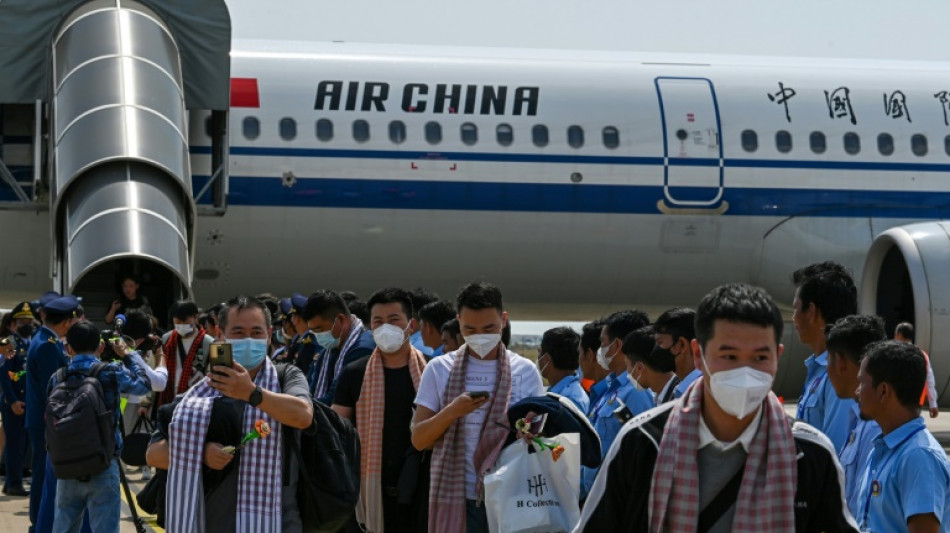
ADB says developing Asia's growth to accelerate after China reopening / Photo: © AFP

The Asian Development Bank raised its 2023 growth forecast for developing Asia on Tuesday, after China's abrupt loosening of Covid-19 restrictions and reopening of its borders brightened the region's prospects.
The Philippines-based lender expects economic growth of 4.8 percent this year, up from its 4.6 percent projection in December. That compares with growth of 4.2 percent last year.
Developing Asia refers to 46 members of the ADB, stretching from Kazakhstan in Central Asia to the Cook Islands in the Pacific.
China, the world's second-largest economy, accounts for about half of the region's growth. It began to emerge in December from a strict zero-Covid strategy that hammered economic activity.
"Developing Asia's economic prospects are markedly improving on the rapid reopening in the People's Republic of China," the ADB said in its flagship outlook report.
"This will support growth in regional exporters of commodities, manufactured intermediates and final goods," it said.
"Regional tourism will also benefit, notably in Cambodia, Maldives, Palau and Thailand, where the PRC (People's Republic of China) was the main source of tourists up to 2019."
The ADB forecasts China's gross domestic product to grow five percent this year and 4.5 percent in 2024, compared with three percent last year.
That was one of its weakest rates in 40 years owing to the pandemic and a real estate crisis.
Headline inflation for developing Asia, including food and energy prices, is expected to ease to 4.2 percent this year and 3.3 percent in 2024, compared with last year's 4.4 percent.
The ADB said China was expected to experience "benign inflation" as its consumer spending takes time to recover from the lockdowns, and as global price pressures ease and developed economies slow.
Excluding China, regional inflation is forecast at 6.2 percent this year and 4.4 percent in 2024, which the ADB pointed out was higher than in advanced economies, but lower than in emerging markets outside Asia.
But the ADB warned that an escalation in Russia's invasion of Ukraine could fuel inflation and lead to further interest rate hikes.
South Asia is forecast to record the fastest pace of growth in the region, with India expected to expand by 6.4 percent, compared with an estimated 6.8 percent last year, on "healthy domestic demand".
(L.Møller--DTZ)