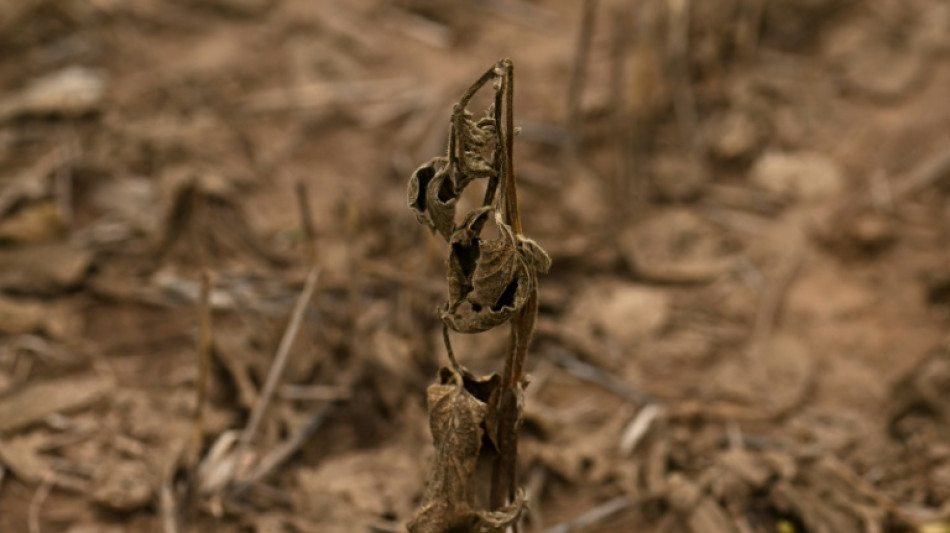
Historic drought adds to Argentina's economic woes / Photo: © AFP

Argentina's already fragile economy is now taking a beating from nature, as the worst drought in almost 100 years decimates critical soy, wheat and corn production.
Soy and wheat crops were halved this year, while corn yield was cut by more than a third, according to official projections, slashing Argentina's exports in a sector crucial for the public purse.
Adding to inflation of nearly 100 percent year-on-year and a burdensome debt of $44 billion with the International Monetary Fund (IMF), the drought could not have come at a worse time for Latin America's third biggest economy.
What's more, "the true situation will only become clear once the harvesters enter the fields," agronomist Jaime Mestre told AFP.
With rainfall 50 percent lower than usual, whatever is there to be harvested will likely be of lower quality.
- Lack of water -
While in Washington last week for a meeting with US President Joe Biden, President Alberto Fernandez pleaded for clemency in the face of the worst drought "since 1929" as the IMF executive board met.
The United States is the nation with the most voting rights at the IMF, which subsequently announced a $5.4 billion disbursement to Argentina as part of its loan program.
The IMF insisted, however, that Argentina needed "a stronger policy package... to safeguard stability, address setbacks and secure program objectives" against the backdrop of "an increasingly severe drought, rising inflation (and) weak reserve coverage."
Rosario Stock Exchange economist Tomas Rodriguez Zurro estimates the overall loss to the economy of Argentina's poor grain-growing season will be about $20 billion -- almost three percentage points of GDP.
In the agricultural zone of Lima, some 100 kilometers (62 miles) northwest of the capital Buenos Aires, many of this year's soy crop will simply be left in the field, added agronomist Jaime Mestre.
Low yield and poor quality means it is economically unfeasible to even send in the harvester.
The soy "could not develop due to lack of water and high temperatures," Mestre said of the drought that has now lasted three years.
Soy contributes about $10 billion to the treasury annually -- a major income generator for Argentina, in the grips of an unusually harsh La Nina weather cycle.
According to the Rosario Stock Exchange, the soy sector will have its lowest production figures in 23 years and generate $7.3 billion less than in 2022.
- Difficult conditions -
Mestre said soil moisture around Lima was down to about five percent -- not enough for planting the next wheat crop that must go into the ground in just a few weeks' time.
In the fields, the corn cobs are brown and crackly, the maize kernels small and irregular.
This means Argentina may not meet "export standards" with what it is able to harvest, said Mestre.
"This is not a problem that will be solved if it starts to rain today," he added.
"It (also) has to do with the conditions of the country," said Mestre -- pointing to a lack of access to credit and inflation "that changes costs every day."
The country's more rural interior will feel the pain the most, he added.
Argentina recorded 5.2 percent economic growth in 2022, a slowdown compared to 2021 but still tallying a second consecutive year of expansion, the first such two-year period of growth since 2010-2011.
Inflation, however, remained high at 94.8 percent, preventing the country from reaping the benefits of this upturn.
The soaring inflation means most goods cost double what they did this time last year, and marks the return of near triple-digit inflation for the first time since the early 1990s.
A week ago, Fitch Ratings downgraded Argentina's foreign currency debt to one level above default.
(B.Izyumov--DTZ)