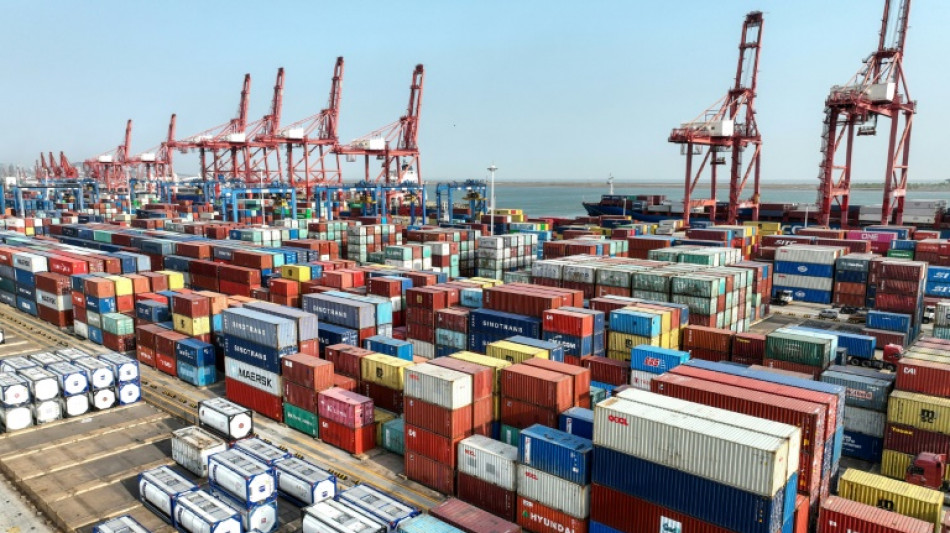
China's economy expected to rebound as zero-Covid era fades / Photo: © AFP

China is expected to announce an economic rebound on Tuesday, when Beijing releases its first quarterly GDP figures since abolishing growth-sapping Covid restrictions late last year.
The Asian giant's virus containment policy -- an unstinting regime of strict quarantines, mass testing and travel curbs -- strongly constrained normal economic activity before it was abruptly ditched in December.
The disclosures on Tuesday will give the first snapshot since 2019 of a Chinese economy unencumbered by public health restrictions, with analysts polled by AFP expecting an average of 3.8 percent year-on-year growth in the period from January through March.
But the world's number two economy remains beset by a series of other crises, from a debt-laden property sector to flagging consumer confidence, global inflation and the threat of recession elsewhere.
"The recovery is real, but still in its early stage," said Larry Hu, chief China economist at the investment bank Macquarie.
Any rebound "will be gradual, largely due to the weak confidence" of consumers, which in turn makes companies "reluctant" to hire more staff, he said.
China's economy grew by just three percent in the whole of last year, one of its weakest performances in decades.
It posted a 4.8 percent expansion in the first quarter of 2022, though growth pulled back to just 2.9 percent in the final three months of the year.
- Property perils -
A creeping crisis in the property sector -- which together with construction accounts for around a quarter of China's GDP -- continues to "pose challenges to economic growth", said Rabobank analyst Teeuwe Mevissen.
Real estate was a key driver of China's recovery from the initial wave of the pandemic in 2020, when Beijing managed to stop the coronavirus from spreading widely.
But weak demand has since plagued a sector already afflicted by falling home prices and crippling debts that have left some developers struggling to survive.
The situation appears to have eased slightly in recent weeks as official support helped prices stabilise in March, according to figures released on Saturday by the National Bureau of Statistics.
Economists will also be watching keenly on Tuesday for March's retail data, the main indicator of household consumption.
Retail sales finally ticked up in January and February following four successive months of contraction, according to official figures.
But nearly 60 percent of urban households still prioritise saving money over investing or spending it, up from 45 percent before the pandemic, according to a survey by China's central bank.
Consumer confidence "remains well in negative territory" despite the heartening abolition of Beijing's Covid curbs, said Harry Murphy Cruise, a macroeconomist focusing on the Asia-Pacific region at the ratings agency Moody's.
"Households have long memories and will take time to forget the economic pain of recent years," he told AFP.
- Global tensions -
Beijing has set a comparatively modest growth target of around five percent this year, a goal the country's Premier Li Qiang has warned could be hard to achieve.
While many experts tend to take China's official figures with a grain of salt, most expect Beijing to hit that mark.
An AFP analysts' poll predicted that the Chinese economy would grow by an average of 5.3 percent this year.
That is roughly in line with the International Monetary Fund's forecast of 5.2 percent.
Still, analysts warned that wider global trends could yet weigh on China's recovery.
They include geopolitical tensions with the United States, the threat of recession in other major economies and galloping global inflation.
(M.Dylatov--DTZ)