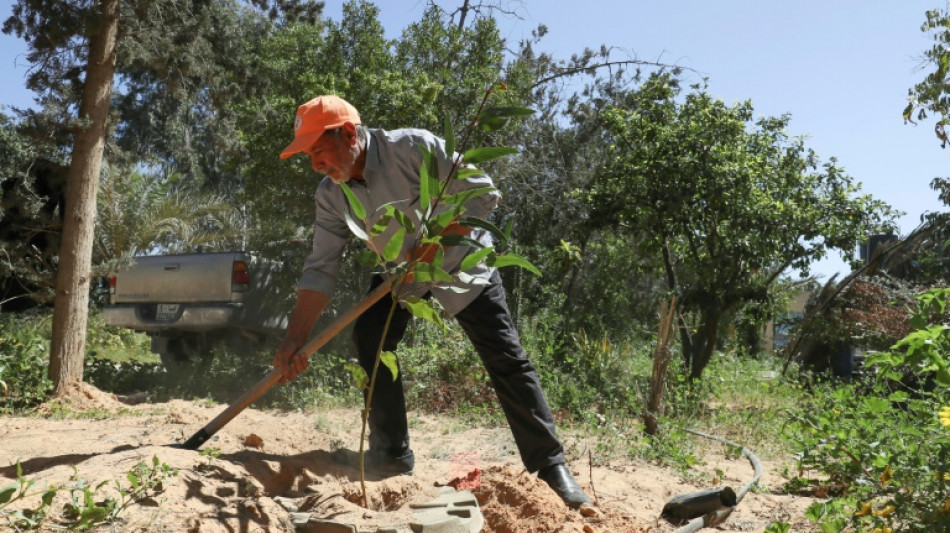
Libya green group battles to save remaining forests / Photo: © AFP

War-ravaged Libya is better known for its oil wealth than its forests, but environmentalists hope to save its remaining green spaces from logging, development and the impacts of climate change.
The "Friends of the Tree" group works to raise awareness about green areas around the capital Tripoli that are quickly disappearing because of drought, human activity and desertification.
"Man has destroyed forests" and much of the vegetation, said the group's leader Khalifa Ramadan, who has been working in agriculture and gardening for 40 years.
At his farm in Tajura, an eastern suburb of Tripoli, Ramadan has planted eucalyptus, palm and laurel trees, which the group plans to replant around the capital.
The group meets weekly to launch media campaigns and carry out activities to confront "the dangers facing Tripoli and other coastal cities", said Ramadan.
Rainfall is scarce in the largely desert country, which is only starting to recover from the years of bloody conflict that followed the 2011 uprising which toppled dictator Moamer Kadhafi.
The group, which includes dozens of agronomists, horticulturists and volunteers, ultimately would like to revive a "green belt" project from the 1950s and '60s that has withered during decades of dictatorship, war and turmoil.
Back then, Libyan authorities dipped into the country's wealth to plant forests across an area stretching from Tripoli to the port city of Misrata, 200 kilometres (125 miles) to the east.
Strict laws at the time aimed to control urban expansion and soil erosion and to stop the desert from sweeping into Tripoli, while also opening new areas for agriculture.
- 'Criminal acts' -
Today Libyan state institutions, weakened by rivalries and continued insecurity, have struggled to bring stable governance, including on protecting the environment.
In recent years, at least 1,700 criminal cases have been identified involving activities such as unauthorised logging and illegal construction, says the agricultural police.
In Garabulli, a coastal area east of Tripoli -- famed for its pristine white sands and its centuries-old eucalyptus trees, acacias and wild mimosas -- tree trunks litter the ground next to some illegal constructions, recently demolished on judicial instruction.
"The green belt has become the target of numerous violations over the past few years," said General Fawzi Abugualia, spokesman for the agriculture police.
The police unit is ill-equipped to deal with all these challenges, but has nevertheless managed to score some points, he said.
With help from other security services, the agriculture police "have put a stop to these criminal acts", he said, referring to the destruction at Garabulli.
They have managed to seize back more than 8,000 hectares (20,000 acres) of land in the area that had been misappropriated by builders to construct private homes or seaside resorts.
- Falling water tables -
But Libya and its forests face other, more long-term challenges -- especially water scarcity driven by climate change and population pressures.
Abderrahman Mohamad, a volunteer who works alongside Ramadan, said the groundwater had dropped dramatically, particularly around Tripoli.
"A few decades ago, you had just to dig 40 or 60 metres deep to find potable water," said the 65-year-old man. "Now you need to go deeper, to around 100 or 160 metres, to find it."
According to the World Resources Institute, Libya along with the other North African nations of Algeria, Morocco and Tunisia, is among the world's 30 most water-stressed countries.
Ramadan remains determined to do what he can to bring change and green more areas of the troubled country.
"We must teach people to preserve trees and encourage them to plant," he said, adding that this serves to "stabilise soils, temper the climate, clean the air and attract rain".
(L.Svenson--DTZ)