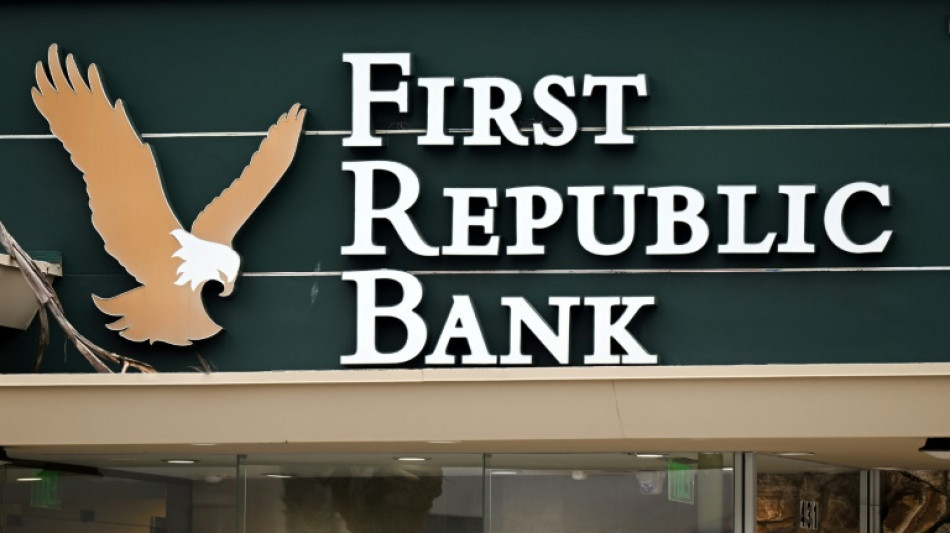
JPMorgan to buy First Republic after regulators seize control / Photo: © AFP/File

US financial authorities seized California's troubled First Republic Bank on Monday and sold it to JPMorgan Chase, hoping to bring to a close a two-month banking crisis that has spooked the financial system.
First Republic, the second-largest bank by assets to collapse in US history, has been in free fall after disclosing last week that it lost more than $100 billion in deposits in the first quarter.
The San Francisco-based lender has been in turmoil since the March bankruptcies of regional banks Silicon Valley Bank and Signature Bank sparked fears of contagion.
After the bank failed to produce a satisfactory rescue plan and with its stocks continuing to nosedive, the authorities stepped in, soliciting bids last week from potential buyers, and then taking possession of it.
As part of the deal struck early Monday, the California regulator appointed the Federal Deposit Insurance Corporation (FDIC), an agency in charge of guaranteeing bank deposits, as the receiver of First Republic, to be immediately sold to JPMorgan Chase.
The agreement means JPMorgan will recover all of the bank's deposits, as well as "almost" all of its assets, according to a FDIC statement.
The federal agency estimates it will have to pay about $13 billion to cover First Republic's losses, but the bank's 84 branches will be able to reopen Monday as usual.
"Our government invited us and others to step up, and we did," Jamie Dimon, JPMorgan's CEO, said in a statement after the deal was announced.
- Snowball effect -
The government's takeover and sale of First Republic comes two months after the liquidation of Silvergate Bank -- a favorite among the cryptocurrency crowd -- and the swift demise of Silicon Valley Bank (SVB), after it took on excessive interest-rate risk.
New York-based Signature Bank also closed a few days after SVB.
The collapses led to a snowball effect as concerned investors looked for signs of weakness in the broader banking sector in the United States and Europe.
Swiss banking giant Credit Suisse became the highest-profile casualty when it was pushed by regulators to merge with its rival, UBS.
To avert yet another banking collapse, authorities reached a deal with 11 major banks in March to extend a $30 billion lifeline to First Republic.
But this was not enough to reassure investors.
By Friday's close, First Republic was worth only $654 million, down from more than $20 billion at the start of the year, and $40 billion at its peak in November 2021.
At first glance, First Republic appeared to be well-positioned: it was known to have a wealthy clientele who deposited large sums.
But the string of banking defaults rattled customers, and a majority of First Republic's loans were fixed-rate mortgages, which have lost value due to soaring interest rates.
Observers are closely watching for any broader implications of the latest financial institution's collapse.
With its assets standing at $233 billion at the end of March, First Republic is the second-largest bank to fall in US history -- excluding investment banks, such as Lehman Brothers -- after Washington Mutual's bankruptcy during the financial crisis of 2008.
That lender too was acquired by JPMorgan, the largest bank in the United States.
"First Republic was identified as a problem bank as early as mid-March and the announcement of its closure is not a new reason to worry," Nicolas Veron, an economist at the Peterson Institute for International Economics said ahead of the takeover announcement.
"If another bank proved to be fragile, that would be another problem," he added.
Soon after First Republic's seizure was announced, the US Treasury moved to try to allay concerns.
"The banking system remains sound and resilient, and Americans should feel confident in the safety of their deposits and the ability of the banking system to fulfill its essential function of providing credit to businesses and families," a Treasury spokesperson said.
(V.Sørensen--DTZ)