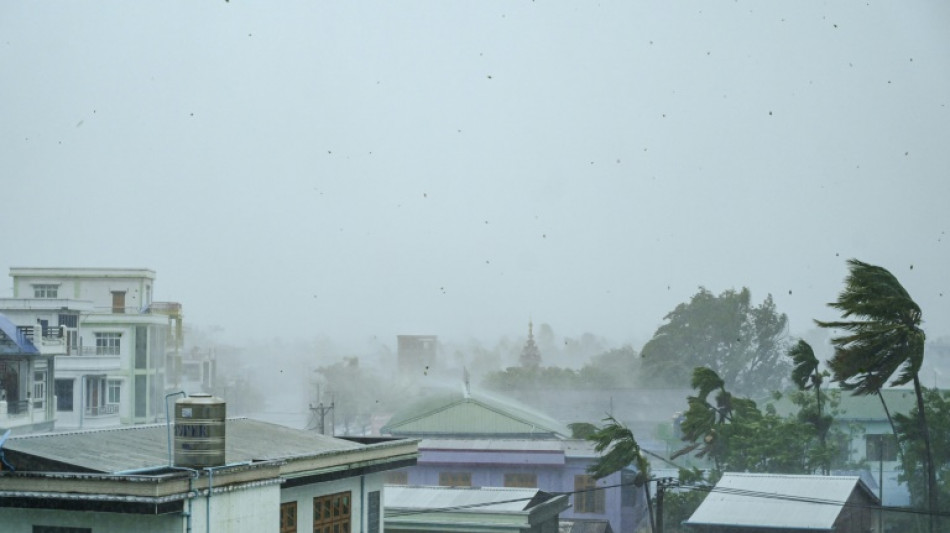
Climate change makes cyclones more intense, destructive: scientists / Photo: © AFP

Climate change does not make cyclones, such as that battering Bangladesh, more frequent but it does render them more intense and destructive, according to climatologists and weather experts.
These immensely powerful natural phenomena have different labels according to the region they hit, but cyclones, hurricanes and typhoons are all violent tropical storms that can generate 10 times as much energy as the Hiroshima atomic bomb.
They are divided into different categories according to their maximum sustained wind strength and the scale of damage they can potentially inflict.
- Cyclones, hurricanes and typhoons -
"A cyclone is a low-pressure system that forms in the tropics in an area hot enough for it to develop," Emmanuel Cloppet, from French weather office Meteo France, told AFP.
"It is characterised by rain/storm clouds that start rotating and generate intense rains and winds, and a storm surge created by the wind," he added.
These huge weather phenomena -- several hundreds of kilometres (miles) across -- are made more dangerous by their ability to travel huge distances.
Tropical cyclones are categorised according to wind intensity, rising from tropical depression (under 63 kilometres per hour (39 miles per hour)), through tropical storm (63-117 kph) to major hurricane (above that).
They are termed cyclones in the Indian Ocean and South Pacific, hurricanes in the North Atlantic and Northeast Pacific and typhoons in the Northwest Pacific.
Meteorological agencies monitoring them use different scales to categorise them, depending on the oceanic basin in which they occur.
The most well-known scale for measuring their intensity and destructive potential is the five-level Saffir-Simpson wind scale.
- More powerful cyclones -
"The overall number of tropical cyclones per year has not changed globally but climate change has increased the occurrence of the most intense and destructive storms," according to the World Weather Attribution (WWA), a group of climate scientists and climate impact specialists whose goal is to demonstrate reliable links between global heating and certain weather phenomena.
The most violent cyclones -- categories three to five on the Saffir-Simpson scale -- that cause the most destruction have become more frequent, the WWA said.
Climate change caused by human activity influences tropical cyclones in three major ways -- by warming the air and oceans and by triggering a rise in sea levels.
"Tropical cyclones are the most extreme rainfall events on the planet," the WWA said in its publication "Reporting Extreme Weather and Climate Change".
Since the atmosphere is warmer, it can hold more water, so when it rains it pours.
"A rise in air temperature of three degrees Celsius (5.4 degrees Fahrenheit) can potentially produce a 20-percent increase in the quantity of rain generated by a cyclonic event," said Cloppet.
It is these intense torrential downpours that lead to sometimes fatal floods and mudslides, as was the case of Cyclone Freddy, which killed hundreds of people in Malawi and Mozambique earlier this year.
Climate change is also warming the oceans. This warm water fuels cyclones and gives them their strength.
"Climate change therefore creates the conditions in which more powerful storms can form, intensify rapidly and persist to reach land, while carrying more water," the WWA said.
- Shifting north -
The fierce winds produced by cyclones generate storm surges which can cause coastal flooding.
These storm waves are higher now than in previous decades because of the sea level rise triggered by climate change.
Scientists also expect to see cyclones in places they have not happened before because global heating is expanding the regions where tropical sea water conditions occur.
"It's as if the tropics were spreading," Cloppet said.
"Areas that aren't really affected now could be hit much harder in future."
The WWA agreed: "As ocean waters warm, it is reasonable to speculate that (tropical) storms will shift further away from the Equator."
"A northward shift in cyclones in the western North Pacific, striking East and Southeast Asia, (is) a direct consequence of climate change," it said.
As a result, they could strike in relatively unprepared locations that have not, in the past, had reason to expect them.
(P.Vasilyevsky--DTZ)