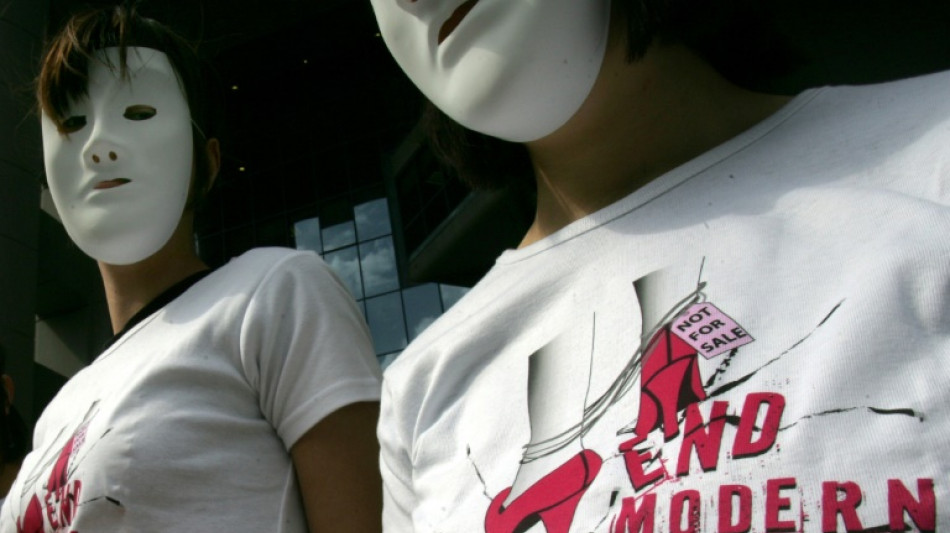
'Modern slavery' most common in North Korea and Eritrea: study / Photo: © AFP

North Korea, Eritrea and Mauritania have the highest prevalence of modern slavery in the world, according to the 2023 Global Slavery Index published Wednesday, which noted a "worsening" situation globally since its last survey five years earlier.
The report said an estimated 50 million people were "living in situations of modern slavery" in 2021, an increase of 10 million over 2016, when the problem was last measured.
The figure includes some 28 million people in forced labour and 22 million living in a forced marriage.
The situation is worsening "against a backdrop of increasing and more complex armed conflicts, widespread environmental degradation" and impacts from the coronavirus pandemic, among other factors, the investigation said.
Compiled by the human rights charity Walk Free, the report defines modern slavery as encompassing "forced labour, forced or servile marriage, debt bondage, forced commercial sexual exploitation, human trafficking, slavery-like practices, and the sale and exploitation of children."
Slavery's core principle entails "the systematic removal of a person’s freedom" -- from the right to accept or refuse labour to the liberty to determine if, when and whom to marry.
By this benchmark, reclusive and authoritarian North Korea has the highest prevalence of modern slavery (104.6 per 1,000 population), according to the report.
It is followed by Eritrea (90.3) and Mauritania (32), which in 1981 became the last country in the world to make hereditary slavery illegal.
The 10 countries with the highest prevalence of modern slavery have some common characteristics, including "limited protections for civil liberties and human rights".
Many of the countries are in "volatile" regions experiencing conflict or political instability, or home to a large populaton of "vulnerable people" such as refugees or migrant workers.
- 'Mirror held to power' -
Also in the top 10 globally were Saudi Arabia, the United Arab Emirates and Kuwait, where migrant workers' labour rights are restricted by the "kafala" sponsorship system.
Other countries in the top 10 are Turkey, "which hosts million of refugees from Syria", Tajikistan, Russia and Afghanistan.
While forced labour is more common in low-income countries it is "deeply" connected to demand from higher-income countries, the report said, noting that two-thirds of all forced labour cases are linked to global supply chains.
The report said G20 countries -- made up of the EU and the world's 19 top economies -- are currently importing $468 billion worth of goods that are at risk of being produced with forced labour, up from $354 billion in the previous report.
Electronics remain the highest value at-risk product, followed by garments, palm oil and solar panels, in a sign of high demand for renewable energy products.
"Modern slavery permeates every aspect of our society. It is woven through our clothes, lights up our electronics, and seasons our food," the group's founding director Grace Forrest said.
"At its core, modern slavery is a manifestation of extreme inequality. It is a mirror held to power, reflecting who in any given society has it and who does not," she added.
(P.Hansen--DTZ)