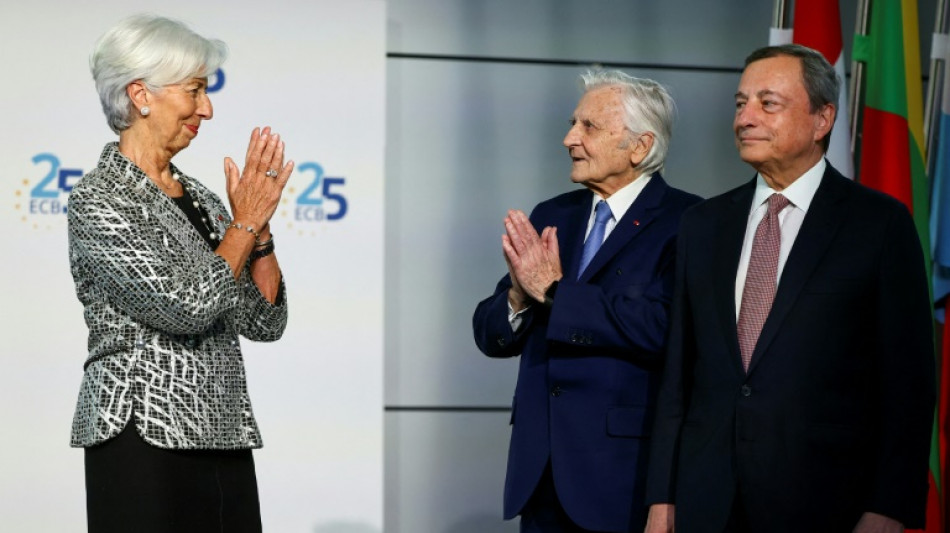
ECB vows to win inflation fight on 25th birthday / Photo: © AFP

European Central Bank president Christine Lagarde pledged Wednesday to reduce high inflation in the eurozone as the institution that safeguards the euro marked its 25th anniversary.
"For the ECB, our immediate and overriding priority is to bring inflation back down to our two percent medium-term target in a timely manner," Lagarde told around 200 guests at an event to mark the occasion.
"And we will do so," she said, while warning that "there will be more challenges ahead which the ECB will need to address. We must continue to provide stability in a world that is anything but stable".
The ECB laid out a blue carpet for the birthday party at its imposing steel-and-glass tower in Frankfurt, Germany's financial capital.
The event featured renditions of music by French composer Claude Debussy and a mango-flavoured cake cut by Lagarde and two of her predecessors, Jean-Claude Trichet and Mario Draghi.
German Chancellor Olaf Scholz was also among the guests.
"Last year we have seen the highest inflation rates since the creation of the euro. The consequences are being felt by citizens all over Europe," Scholz said.
"It is good to know that when we are celebrating this special occasion here tonight, the ECB is actively fighting inflation."
Inflation in the eurozone surged to record highs over the past year as Russia's invasion of Ukraine drove up energy prices, and as the recovery from the Covid pandemic caused widespread supply chain woes.
The closely watched indicator stood at seven percent in April -- down from a peak of 10.6 percent in October but still well above the ECB's two-percent target.
- Success and challenges -
The ECB came into being in 1998, a few months before the introduction of the euro the following year.
Since the single currency was established, the eurozone's GDP per capita has more than doubled and unemployment has fallen to record lows.
And despite recent highs, inflation has averaged 2.05 percent over the ECB's quarter of a century in existence -- not far off the central bank's target.
But some critics are focusing on what they see as the bank's latest missteps, namely that it was too slow to start raising interest rates since last year, believing that high inflation was temporary.
Ultimately, policymakers were forced to embark on an unprecedented campaign of monetary tightening, lifting key rates by 3.75 percentage points since July last year, with more increases expected.
The central bank has battled myriad challenges over the years -- from the eurozone's sovereign debt crisis, which rumbled through the 2010s, to a long phase of inflation that was well below its target.
The latter prompted the central bank to expand its monetary policy arsenal beyond interest rates, and it reached for exceptional measures such as huge purchases of government and private debt.
- 'Irreversible' -
There have also been some widely criticised mistakes.
With the eurozone in a rough patch in 2011, Trichet hiked rates -- a move his successor, Draghi, was forced to undo as soon as he assumed the presidency that year.
Draghi also faced reproach, in his case for his management style during the 2007-2008 debt crisis, which critics said led to divisions in the ECB's governing council, whose membership is made up mostly of national central bank governors.
Lagarde has, however, largely managed to heal the wounds among rate-setters, according to analysts.
"The ECB has been able to innovate and adapt to each crisis it has faced, and this is what we should remember before pointing out mistakes or internal tensions," said Frederik Ducrozet, chief economist at Pictet Wealth Management.
The ECB chief herself is in little doubt that the euro still has a bright future.
Despite several crises, "the fundamental promise of the euro has held true," she said on Wednesday.
"And thanks in no small part to our monetary union, we have been able to weather it all –- and come out just a bit stronger each and every time."
"We can state one thing very clearly today," Scholz added. "The euro area is able to defend its currency against all challenges. The euro is irreversible."
(T.W.Lukyanenko--DTZ)