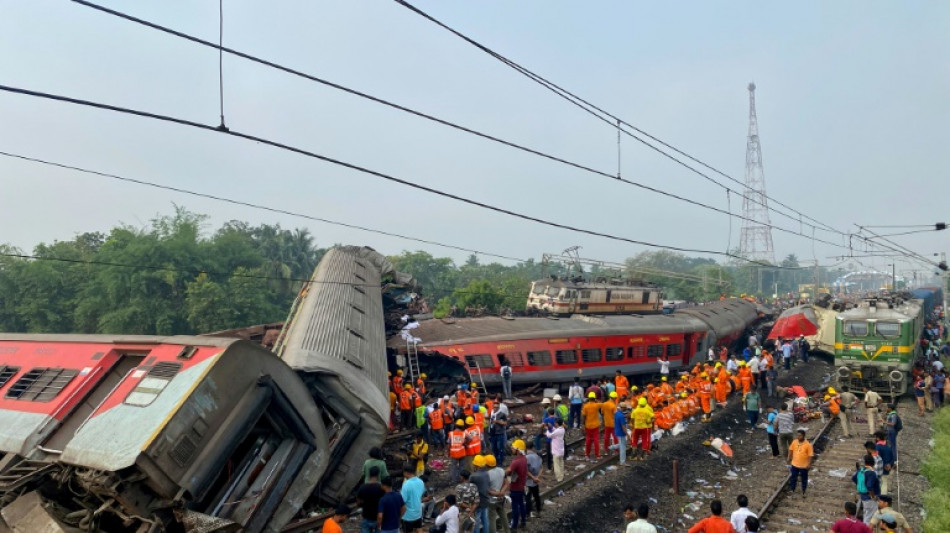
Smashed carriages and corpses: India's train disaster / Photo: © AFP

Carriages perched on top of each other and lines of bodies collected by rescue workers: as dawn broke on Saturday, it revealed the horror of one of India's deadliest railway crashes.
Involving two passenger trains and another carrying goods, the accident saw one train ram so hard into another that carriages were lifted high into the air, twisting and then smashing off the tracks.
Another carriage had been tossed entirely onto its roof, crushing the passenger section.
On the ground -- and squashed into the ripped metal wreckage and what were once benches in the carriage -- travellers' belongings lay scattered: a suitcase, a child's shoe and piles of clothes.
At least 288 people were killed and more than 850 injured in the crash on Friday night near Balasore, in the eastern state of Odisha, officials said, with many fearing the death toll could rise.
Overnight, images broadcast on local television stations showed long lines of bodies laid out with white sheets covering some, as rescue workers carried them away on stretchers.
Teams using metal cutting tools prised open gaps in the torn sides of carriages in a desperate search to reach those trapped inside, pulling out survivors and bodies.
Rescue teams dressed in orange overalls and wearing face masks, including officers from India's National Disaster Response Force, carried those they could extract to get aid.
Throughout the night, the death toll jumped repeatedly, as emergency services added up the number of bodies collected: from 50, to over 100, to nearly 300.
Sudhanshu Sarangi, director general of Odisha Fire Services, speaking at the site to AFP, warned of "serious injuries".
The near-constant sound of ambulance sirens wailed in the background, rushing those pulled out of the wreckage alive to hospital.
With so many hurt, buses also carried the injured to medical centres.
From a distance, residents stood watching the efforts.
In nearby hospitals, volunteers lined up to give blood, with medics overwhelmed by the scale of the need.
Huge crowds gathered at the entrance of Bhadrak District Hospital, standing in shock as ambulance after ambulance arrived.
Dazed and bloodied passengers waited for help, as doctors rushed to stem the bleeding and support those most critically injured.
(N.Loginovsky--DTZ)