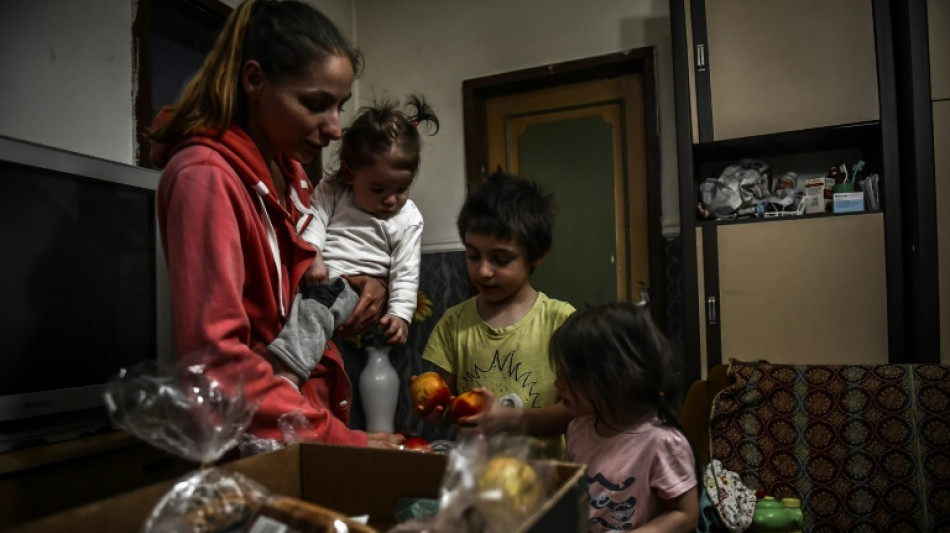
'Savings running out': high inflation hits Hungarians / Photo: © AFP

Antal Palya looks for the cheapest cuts of chicken at a Budapest market. Others in Hungary, home to the European Union's highest inflation rate, now need food aid. For some in the middle-class, even poverty looms.
"We dip into our savings to get by, but they're running out," Palya, a 58-year-old mechanic, said while shopping at the Bosnyak square market.
Others shoppers also said they now worry, for the first time, about how to pay monthly household bills and sudden large one-off expenses.
Inflation soared across the world after Russia invaded Ukraine last year, but Hungary stands out among the 27 EU nations.
Inflation soared above 25 percent in January. While it has been slowing since then, it was three times higher than the EU's average of 8.1 percent in April.
In May, Hungarian inflation stood at 21.5 percent, official data showed on Thursday, with food prices rising by 33.5 percent and energy prices up 37.2 percent.
"I have to be very careful about what I buy now," said Boglarka Toth, a 26-year-old laboratory assistant as she compared prices at the Bosnyak market.
Foods that used to be considered ordinary, such as cottage cheese and sour cream, have become luxuries to some, said a market trader.
Low incomes are hit hardest, but sky-high inflation is also dragging the middle class into poverty, according to Zoltan Pogatsa, a political economist and University of Western Hungary lecturer.
"People are selling the valuables they still have, but from a certain point on, they have nowhere to fall back on," Pogatsa said.
Aid workers say an increasing number of people are seeking help.
"The line separating people who are truly homeless and those who are not yet but are at the end of their efforts, is starting to blur," said Andras Molnar of the Budapest Bike Maffia, which delivers sandwiches to those in need.
- 'Anti-market' measures -
An Ipsos survey published in May, based on answers of 23,000 adults in 29 countries, found that 31 percent of Hungarians were either finding it quite or very difficult to manage financially, compared to 28 percent globally.
Hungary's economy rallied for years but now is in recession with three quarters of negative growth in a row.
Prime Minister Viktor Orban has blamed EU sanctions against Russia over its invasion of Ukraine for the price increases in the central European country of 9.7 million, calling it "sanctions inflation".
"Inflation would fall if we would choose the path of peace instead of war," he said in last week's radio interview, urging a ceasefire.
Vowing to bring down inflation to a single digit by the end of 2023, Orban has also accused retailers of overpricing and excess profit-taking.
Last year he slapped windfall special taxes on sectors from retail to banking and introduced price caps on a range of basic foodstuffs.
From this month a government decree ordered grocery chains to offer weekly discounts on products like milk, poultry and bread.
But economists are sceptical about the effectiveness of the measures, described by some as "anti-market", and point to Hungary's inflation surge beginning well before Russia's invasion.
The volatility of the forint has not helped.
The local currency hit historic lows against the euro and dollar in 2022, contributing to the rising prices as imports became more expensive, said Peter Akos Bod, an economist at Corvinus University in Budapest and a former central bank head.
- 'We don't rebel' -
Rather than helping people, the windfall taxes and other newly introduced taxes are aimed at shoring up budget holes after vast state handouts helped Orban secure a fourth straight election win last year, Bod and other economists say.
But so far neither high inflation nor taxes, economic recession and an EU freeze on bloc funding for Hungary over rule of law and corruption concerns have damaged the poll standings of Orban's ruling Fidesz party.
"Hungarians deserve the pain. We don't rebel," said pensioner Maria Kemenesi, 72, at Bosnyak square market.
Near a fishmonger's stall, Sandor Bata, 56, said his wife tells him to pick up processed fish fingers in the shop rather than pricey salmon fillets.
"It's not the same taste but at least it's fish, kind of," said the labourer.
(W.Uljanov--DTZ)