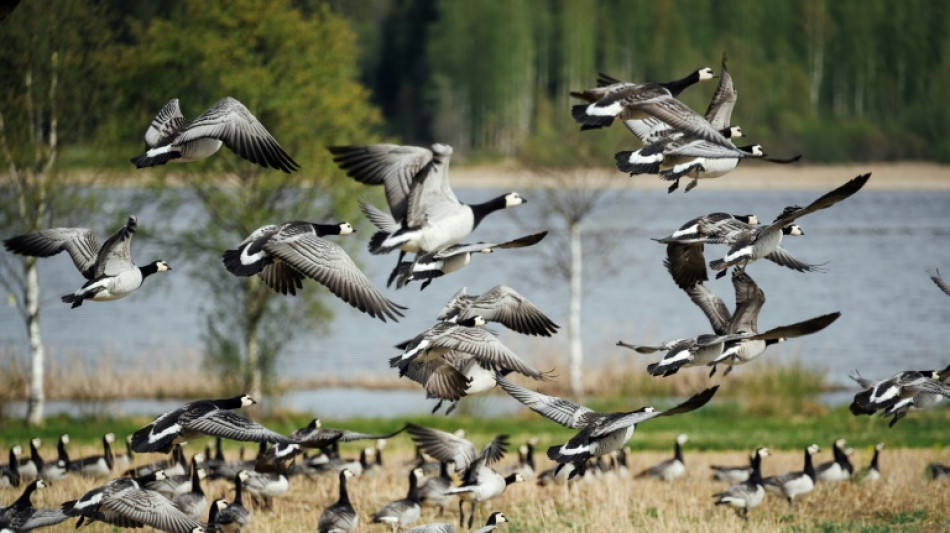
Climate warming pits geese against farmers in Finland / Photo: © AFP

With a cacophony of honks sounding like a hailstorm, tens of thousands of hungry geese blanket a lush green field in Finland with their black flocks.
"There's probably around 20 to 30 hectares behind me, it is easily eaten in a day," cattle farmer Kari Pekonen tells AFP.
In Finland's eastern Karelia region, home to boreal forests and wetlands, climate change is pushing local farmers into conflict with wildlife.
"Many farmers in this region have completely lost faith in the fairness of society," Pekonen says.
Two decades ago, few Barnacle geese stopped in Finland to feed during their migration north across the Arctic, where they nest, from their wintering areas in the Netherlands, Germany and beyond.
But now they number hundreds of thousands in Finland.
This has led to harsh competition for arable land between the geese and farmers.
Of his 250 hectares of grassland meant to feed his cows, Pekonen says the geese now eat around 85 percent, causing him to lose around two-thirds of his income.
He points to the ground and says the grass should be up to his shins by now.
But instead, all that remains is stubble.
"It is an unsustainable burden for this region," he says.
The third generation in his family to raise beef cattle, Pekonen has had to give up many of his cows -- from 300 two years ago he now has fewer than a hundred.
This year will determine what he will do in the future.
- Migration changing 'radically' -
To safeguard their crops without harming the birds, farmers have tried solar-powered laser cannons that scare the geese away, drones acting as birds of prey, and even loudspeakers blasting the geese's own panic screams.
But results have been mixed, experts say, as the geese quickly learn to ignore the threats.
Like many migratory birds, the medium-sized black-and-white Barnacle geese are particularly vulnerable to climate change.
Each spring, the geese travel from their wintering areas in continental Europe to lay eggs in the tundra of the Arctic islands of Novaya Zemlya in Russia and Svalbard in Norway.
In spring, the geese prefer to feed as close as possible to their northern nesting areas before departing on their final leg across the Arctic Ocean.
Northern Europe's cold springs meant the geese used to prepare for the journey further south. But warming temperatures are pushing the flocks northward.
"The migratory stop-over sites of Barnacle geese have changed radically," explained Teemu Lehtiniemi, research director at conservation group BirdLife.
Although there are various reasons for the new route, like the decline in agriculture on the Russian side of Karelia, an important factor is the warming climate.
"Thanks to global warming, the best place to prepare for the final trip is moving further and further north," Lehtiniemi said.
Barnacle geese faced extinction in the 1970s as their numbers dwindled to around 10,000 largely due to hunting.
Since then, the species has been protected by international agreements and their numbers have skyrocketed to over a million.
- Millions in damages -
When the springs were colder, the geese prepared for the trip across the Arctic south of the Baltic Sea, where farmland is abundant.
But in Finnish Karelia there is less arable land so the pressure on farmers is greater.
Like many others, Pekonen wants to see an end to the geese's protected status and for hunting to resume.
"No one has the resources to keep chasing them away," he said. "In spring it is an impossible task, as you also have to do the farming."
But Lehtiniemi said he did not consider it a viable solution, adding: "There will be geese in the future and there will be lots of them and they need somewhere to feed."
Since the species is protected, the state has to pay compensation for any damage to agriculture -- over 3 million euros a year in eastern Finland alone.
The Natural Resources Institute Finland is considering designating certain fields exclusively for geese.
Pekonen said many farmers in the area have already thrown in the towel.
"It's up to everyone to think about whether they are prepared to work for a third of their salary. Why should we do it?"
"Let's see when the hunger comes and teach the people a lesson."
(W.Uljanov--DTZ)