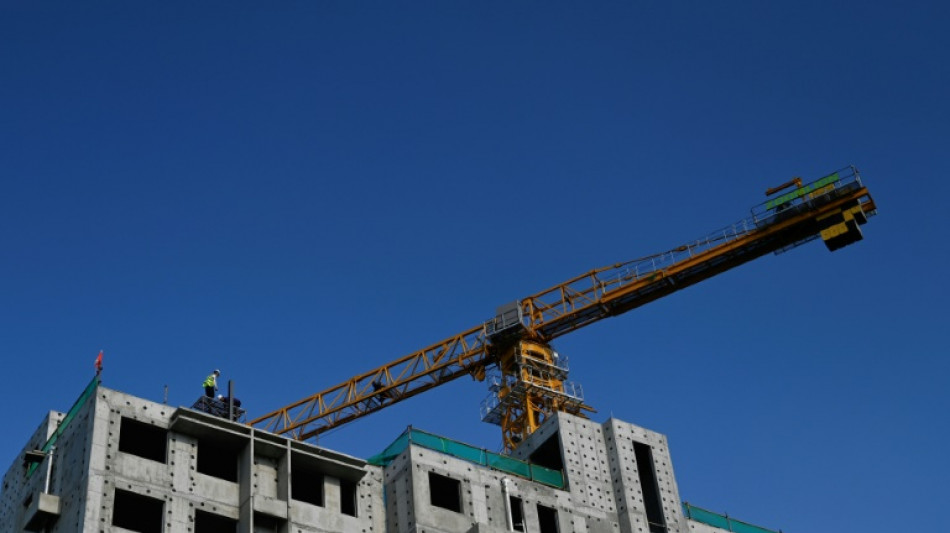
China's property sector crisis fuels fears of contagion / Photo: © AFP/File

Troubled Chinese property giant Country Garden risks defaulting on its bond payments next month, which could have disastrous consequences for the world's second-largest economy.
The firm's debt woes come two years after the unravelling of its competitor Evergrande.
Here is why Country Garden's plight is being closely monitored by markets:
- How important is Country Garden? -
Country Garden was China's largest private developer in terms of sales last year.
It has extensive operations in small cities, which host about 60 percent of its projects.
But that is where recent drops in China's property prices have been most pronounced and where customers have limited purchasing power.
At the end of 2022, Country Garden listed more than 3,000 active construction sites, including around 30 abroad, mainly in Australia, Indonesia and the United States.
Any prolonged suspension of work at the sites could threaten social unrest, as Chinese homeowners often pay for new properties even before the building is fully constructed.
Country Garden has four times as many projects as its competitor Evergrande, whose stalled development led to protests and payment strikes last year.
- What is its current situation? -
At the end of 2022, Country Garden had amassed colossal debt estimated by the group at around 1.152 trillion yuan ($157 billion).
Other estimates of its overall debt are as high as 1.4 trillion yuan, according to Bloomberg.
Also at the end of 2022, the developer had cash totalling 147.5 billion yuan ($20.2 billion today).
Last week, Country Garden was unable to make two bond payments.
It now risks a default as other bond maturities are expected in September.
Adding to the firm's pressure, 31 billion yuan ($4.2 billion) in bonds will expire in 2024, said rating agency Moody's.
Evergrande, once China's top property developer, had nearly $340 billion in debt and $2 billion in cash at the end of 2022.
- What are the consequences? -
Property and related industries are major contributors to China's GDP.
The setbacks faced by Country Garden and Evergrande have further weakened a sector that was battered by the Covid pandemic and the general economic slowdown in China.
This situation is fuelling mistrust among potential buyers, further aggravating the financial situation of developers.
State-backed company Sino-Ocean announced Monday that it had defaulted on an interest payment and expects record half-yearly losses this month.
In another sign of the market troubles, real estate prices fell in July at the fastest pace in a year, according to official figures published on Wednesday.
China's debt problems are likely to worsen as "recessionary and deflationary pressures pile up, (and) Chinese enterprises struggle to make profits," warn analysts at SinoInsider, a US-based consultancy that focuses on the Chinese economy.
- Risks to the financial system? -
During the sector's boom years, many Chinese property developers enlisted trust firms or asset managers to finance their projects.
Beijing-based conglomerate Zhongzhi -- and its galaxy of financial companies -- is one of the most important players in the market, alone managing more than one trillion yuan in assets.
Its clients include businesses and wealthy individuals who have entrusted it with their savings.
But Zhongzhi has recently found itself unable to issue some payments, causing "significant losses" to investors, noted Nomura analyst Ting Lu.
Concerned investors gathered Wednesday to demand accountability outside the Beijing location of one of the firm's subsidiaries, Zhongrong International Trust, Bloomberg reported.
Any default by the Zhongzhi conglomerate risks exposing some of China's "massive financial and debt 'iceberg'", said SinoInsider.
"More of the 'iceberg' is likely to be uncovered going forward."
(W.Uljanov--DTZ)