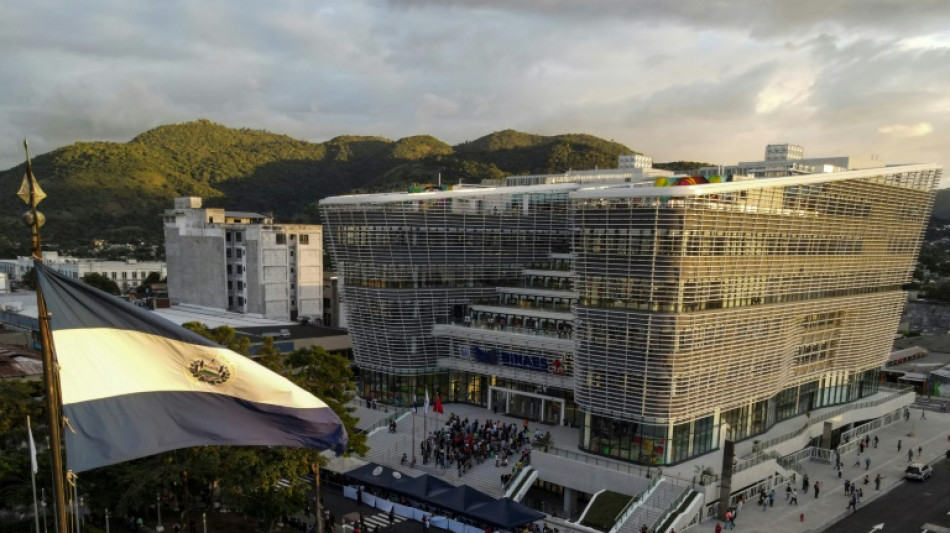
China's influence in C.America advances at a gallop / Photo: © AFP

Anchored in the heart of colonial San Salvador, a towering and expansive library was inaugurated this week by President Nayib Bukele, the latest sign of China's growing influence across Central America.
With the Chinese ambassador at his side, Bukele toured the seven-story building, erected at a cost of $54 million paid for by China.
The building sprawls over 24,000 square meters (260,000 square feet), and contains gamer and robotics areas, interactive digital screens and both a digital library and shelves containing 360,000 books, the government said on Tuesday.
A day later, the son of Nicaraguan President Daniel Ortega, Laureano Ortega, inspected 250 Chinese-made buses and thanked Beijing for the "special relationship" he asserted was lifting the nation out of poverty.
"The new politics of the region has accelerated China's influence and put distance between the United States and Central America, from the leftist authoritarian Ortega regime to the right-wing authoritarian Bukele regime," Evan Ellis, a researcher at the US Army War College Strategic Studies Institute, told AFP.
Since Costa Rica switched diplomatic relations from Taipei to Beijing in 2007, China has steadily gained ground in Central America, establishing relations with Panama (2017), El Salvador (2018), Nicaragua (2021) and most recently Honduras earlier this year.
"China's efforts in Central America have mostly been driven by an interest in isolating Taiwan," Margaret Myers, a specialist in China and Latin America at the Inter-American Dialogue, told AFP.
In Central America, only Guatemala and Belize are among the dwindling 13 nations that still maintain diplomatic ties with Taiwan, a self-governing island that China considers part of its territory.
"Central America is part of this isolation effort," said Salvadoran economist Cesar Villalona.
- 5G and stadiums -
Nicaragua on Thursday ratified a free-trade agreement with China, while El Salvador and Honduras pursue their own trade accords with the Asian giant.
Still, commercial trade ties are heavily tilted in China's favor.
In Costa Rica, for example, imports from China have reached $3.35 billion while its annual exports total only $400 million. El Salvador imports $2.8 billion while exporting $48 million, official trade figures show.
"China is very far. Our productive capacity is poor, and shipping costs and insurance rates make it hard to compete on cost. In Nicaragua, the deficit will grow" with the free-trade pact, said Enrique Saenz, a Nicaraguan economist living in exile in Costa Rica.
But although these small economies are not commercially important to China, they are along key trade routes.
Panama, crucial due to its cross-isthmus canal, has had Chinese companies involved in the construction of maritime terminals on the waterway, of which China is the world's second largest client, after the United States.
China's largest banks have a presence in Panama's financial center and dozens of Chinese companies offer goods in the Colon Free Zone (at the Atlantic terminus of the canal), Panama's former vice foreign minister, Luis Miguel Hincapie, told AFP.
Myers stressed that Central American countries "represent a notable market for Chinese tech exporters."
Laureano Ortega, in whose country Chinese companies are planning road, airport and energy projects, spoke of a 5G technology plan after recently visiting the Shenzhen headquarters of the telecommunications giant Huawei, accused by Washington of spying for Beijing.
In addition to the library, China will build a 50,000-seat soccer stadium in El Salvador, larger than one it built in Costa Rica, and also a shipping wharf on the Pacific coast, all at little or no cost.
- Facing a 'debt trap'? -
Earlier this month, US President Joe Biden warned Costa Rica's president and several other Latin leaders gathered in Washington not to fall into a "debt trap" -- a veiled reference to China.
"The trap is already in place," Honduran Minister of the Presidency, Rodolfo Pastor, told AFP, referring to his country's huge debt with organizations and foreign banks.
For Pastor, the relationship with the United States over the last 40 years has not helped the region to "get out of poverty or trigger development".
"We have to bet on something new," Pastor said, criticizing the results of the historical influence of the United States in the region.
(M.Dylatov--DTZ)