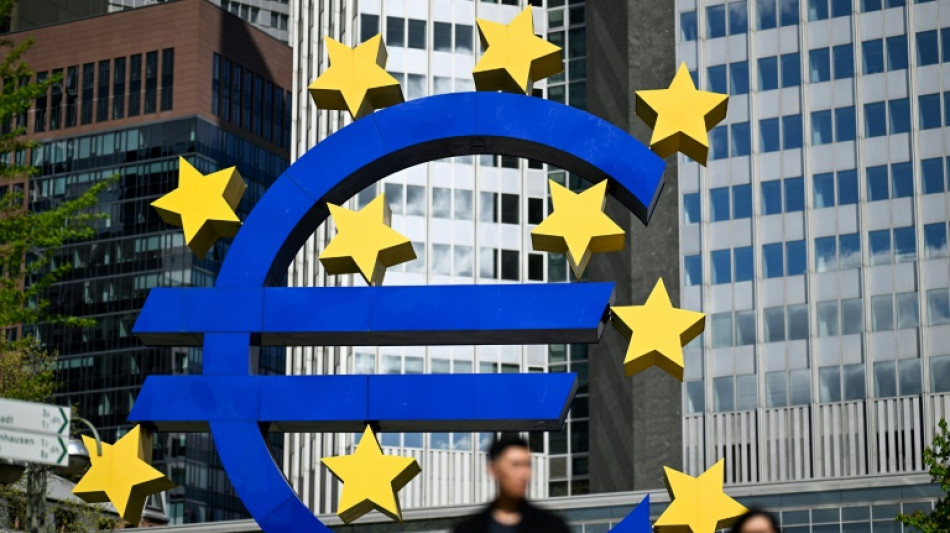
ECB makes first rate cut since 2019 but sees 'bumpy road' / Photo: © AFP/File

The European Central Bank cut interest rates for the first time since 2019 on Thursday as eurozone inflation gradually eases, but president Christine Lagarde said the path ahead was unclear and warned of a "bumpy road".
The key deposit rate was lowered a quarter point to 3.75 percent, bringing it down from a record high.
Following an unprecedented streak of eurozone rate hikes beginning in mid-2022 to tame runaway energy and food costs, inflation has been slowly coming down towards the ECB's two-percent target.
Thursday's cut, the first since September 2019, came after the central bank kept rates on hold since October and will provide a much-needed boost for the beleaguered eurozone economy.
The move marks the ECB diverging from the US Federal Reserve, which has also hiked rates aggressively but is not expected to start cutting for months due to stronger-than-expected data.
All eyes are on what happens next but the path ahead has been complicated by recent stronger-than-expected inflation and growth data, which has lowered the chances of a rapid easing cycle.
At a press conference following the rate decision, Lagarde insisted that the Frankfurt-based institution was not "pre-committing to any particular rate path".
"What is very uncertain is the speed at which we travel and the time that it will take," she said. "We know its going to be a bumpy road."
- Sticky inflation -
The ECB's updated forecasts released Thursday highlighted the challenges.
The central bank hiked its inflation projections for this year and next, saying it no longer expects the indicator to hit the two-percent target in 2025, as previously anticipated, but rather to come in at 2.2 percent.
It also raised its growth forecast for 2024, although lowered it slightly for next year.
It came after data released last week showed inflation in the 20 countries that use the euro rose in May, and faster than expected -- to 2.6 percent on year.
The eurozone economy also expanded faster than expected in the first quarter as it emerged from recession.
While inflation has eased, Lagarde noted that it still remained high, pointing to the fact that "wages are still rising at an elevated pace, making up for the past inflation surge."
But she also said that some indicators suggested that wage growth would ease over the course of the year.
The eurozone economy is expected to continue recovering, Lagarde said.
But she also warned of risks ranging from a weaker world economy to escalating trade tensions, and noted that the conflicts in Ukraine and the Middle East are "major sources of geopolitical risk".
- Divergence worries -
With data volatile and uncertainty clouding the horizon, the chances of another cut at the ECB's next meeting in July are now viewed as low.
Instead, some analysts believe policymakers are hoping to reduce rates every other meeting -- so once a quarter, as the bank meets every six weeks -- at the same time as they release their regularly updated projections.
ING economist Carsten Brzeski believed the central bank could follow this path but also cautioned things could turn out differently.
"It wouldn't take a lot of negative inflation surprises for the ECB to tread more carefully or even reverse today's cut," he said.
In the United States, stronger-than-expected data pushed back expectations of when the Fed -- which holds its next meeting on June 11-12 -- will begin reducing borrowing costs, fuelling speculation the ECB might also stay its hand.
But eurozone rate-setters have stressed they plot their own course.
For the ECB, "there may be some pauses on the way back down for rates in order to limit the scope of any divergence with the Federal Reserve," predicted Lindsay James, from Quilter Investors.
(M.Dylatov--DTZ)