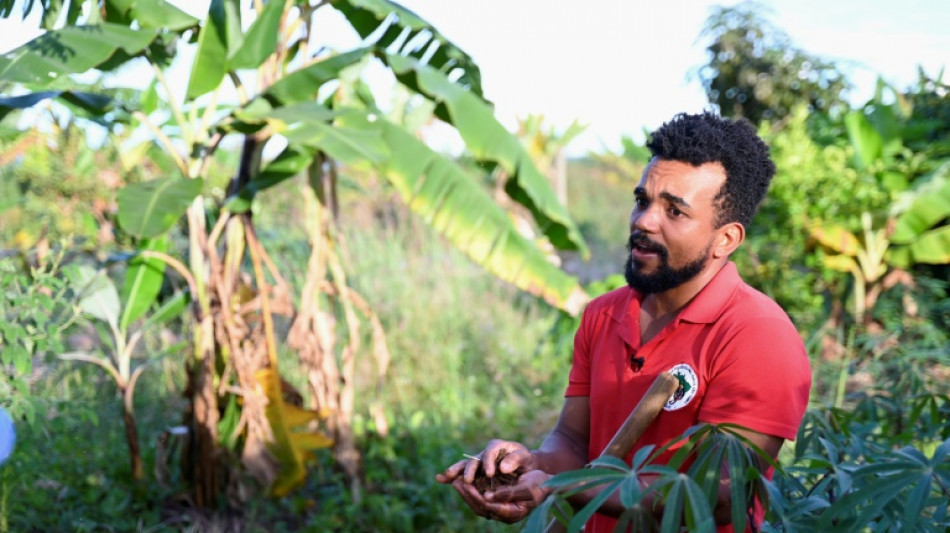
Disputes flare in Brazil between landowners, occupiers / Photo: © AFP

At the heart of Brazil's savannah, Adonilton Rodrigues toils on a small plot he illegally occupies as part of a movement battling the country's old land-ownership inequalities.
Deep-rooted tensions over who controls the land have surged as the country's increasingly powerful agricultural lobby fights such occupations both in Congress and on the ground.
"Without occupation there is no pressure and without pressure we have no land to produce," said Rodrigues.
He is a local leader of the Landless Rural Workers Movement (MST), which for 40 years has taken over land around the country.
The group, a powerful symbol of the country's left, says it occupies only land that is unused, subject to a legal dispute, or where landowners are accused of modern slavery.
However, the agribusiness lobby, which increased its political power under far-right former president Jair Bolsonaro, is on a mission to crack down on the occupations.
Congress, now home to a powerful "rural bench" that pushes agricultural interests, is mulling a proposal that would see occupiers like Rodrigues excluded from receiving government benefits.
The MST "is a factory for property invasion," deputy Alberto Fraga, from Bolsonaro's Liberal Party, told AFP.
He said if the occupations did not stop, the party would present a bill to classify them as "terrorism."
- Walking a tightrope -
Leftist President Luiz Inacio Lula da Silva has long been an ally of the MST, and during his first two terms (2003-2010) he financed land allocations benefiting more than 600,000 families, according to the Institute for Agrarian Reform (Incra).
Since returning to power he has launched a program to provide nearly 300,000 families with new land or regularize the land that they occupy.
But Lula has been walking a tightrope between his old allies and the political realities in Congress where his party does not have a majority.
He has been accused of making too many concessions to the agricultural lobby, such as signing a bill into law relaxing rules around the use of pesticides.
"Congress today is a stronghold of the extreme right," said Ceres Hadich, national coordinator of MST, adding that part of the body is connected via "umbilical cord" to agribusiness and large landowners.
Brazil -- a major exporter of soy, meat and corn -- has "one of the largest concentrations of (agricultural) land on the planet," said Sergio Sauer, a professor at the University of Brasilia.
Colonial-era land inequalities have left 61 percent of the vast nation in the hands of a tiny percentage of landowners, locking out many small-scale farmers and Indigenous communities.
And conflicts are growing more fierce.
The Pastoral Commission, linked to the Catholic Church, recorded more than 2,200 violent episodes on disputed land in 2023, from threats to murders, destruction of property and expulsions. This was the highest number since records began in 1985.
- The murder and the militia -
The recent murder of an Indigenous Brazilian leader involved in the occupation of ancestral land in the northeastern state of Bahia has highlighted a growing aggression against occupiers.
A large group of landowners and farmers banded together in early 2023 in Bahia under the name "Invasion Zero" to protect their properties from occupation.
The group is being investigated by police for the shooting of the Indigenous leader and has been labeled a militia.
One of its leaders, Luiz Uaquim, has denied the group's involvement in the murder.
"We are faced with a criminal group that invades properties, destroys everything," he said in a statement on Instagram.
"We are working together with the parliamentary fronts to put an end to these invasions once and for all."
For the farmer Rodrigues, the landless have no other choice.
He lives with 80 other families on 17 hectares (42 acres) they first began occupying in 2012 outside the capital Brasilia.
The land forms part of a 1,700-hectare farm and has been subject to a decade of legal litigation.
"Justice is very slow, isn't it? And the issue of agrarian reform doesn't move forward unless there's a fight for the land," Rodrigues said.
(B.Izyumov--DTZ)