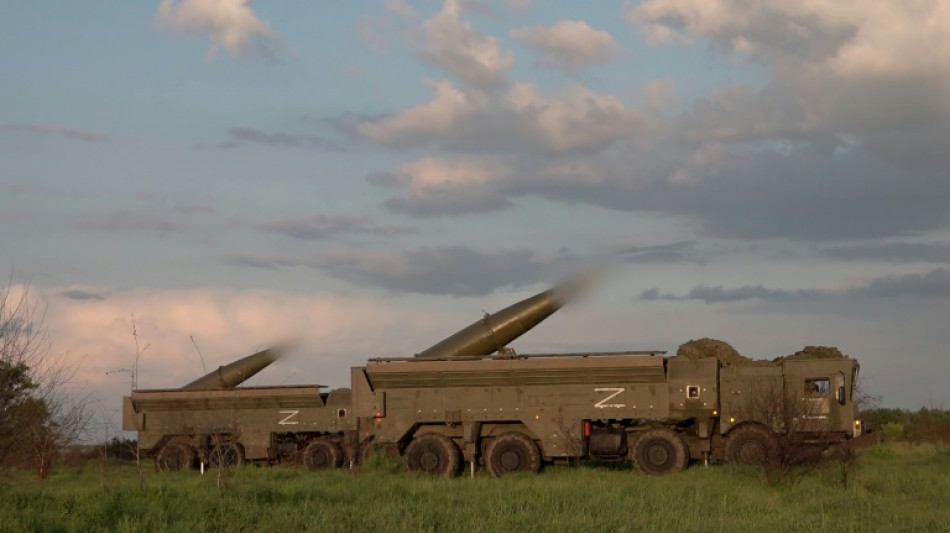
Nuclear arms spending soars as global tensions swell: studies / Photo: © Russian Defence Ministry/AFP

Nuclear-armed countries hiked spending on atomic weapons arsenals by a third in the past five years as they modernised their stockpiles amid growing geopolitical tensions, two reports showed on Monday.
The world's nine nuclear-armed states jointly spent $91 billion on their arsenals last year, according to a new report from the International Campaign to Abolish Nuclear Weapons (ICAN).
That report, and a separate one from the Stockholm International Peace Research Institute (SIPRI), indicated that nuclear weapons states are dramatically scaling up spending as they modernise and even deploy new nuclear-armed weapons.
"I think it is fair to say there is a nuclear arms race under way," ICAN chief Melissa Parke told AFP.
Wilfred Wan, head of SIPRI's weapons of mass destruction programme, meanwhile warned in a statement that "we have not seen nuclear weapons playing such a prominent role in international relations since the Cold War".
SIPRI's report showed that the total estimated number of nuclear warheads in the world actually declined somewhat to 12,121 at the start of this year, from 12,512 a year earlier.
But while some of that included older warheads scheduled to be dismantled, it said 9,585 were in stockpiles for potential use -- nine more than a year earlier.
And 2,100 were kept in a state of "high operational alert" on ballistic missiles.
Nearly all of those were held by the United States and Russia, but China was for the first time believed to also have some warheads on high operational alert, SIPRI said.
"While the global total of nuclear warheads continues to fall as Cold War-era weapons are gradually dismantled, regrettably we continue to see year-on-year increases in the number of operational nuclear warheads," SIPRI director Dan Smith said.
- Nuclear weapons spending jump -
The spending surge reported by ICAN appeared to back that up.
The report showed that in 2023 alone, nuclear weapons spending worldwide jumped by $10.8 billion from a year earlier, with the United States accounting for 80 percent of that increase.
The US share of total spending, $51.5 billion, "is more than all the other nuclear-armed countries put together", said ICAN.
The next biggest spender was China, at $11.8 billion, followed by Russia, spending $8.3 billion.
Britain's spending meanwhile rose significantly for the second year in a row, swelling 17 percent to $8.1 billion.
Spending for 2023 by the nuclear-armed states -- which also include France, India, Israel, Pakistan and North Korea -- jumped more than 33 percent from the $68.2 billion spent in 2018, when ICAN first began collecting this data, it said.
Since then, the nuclear armed states have spent an estimated total of $387 billion on the deadly weapons, the report showed.
- 'Investing in Armageddon' -
Parke slammed "the billions of dollars being squandered on nuclear weapons" as "a profound and unacceptable misallocation of public funds".
She highlighted that that money was more than what the World Food Programme estimates is needed to end world hunger.
"And you could plant a million trees for every minute of nuclear weapons spending," she said.
"These numbers are obscene, and it is money that the state says is going towards weapons that... will never be used," she said, pointing to the nuclear deterrence doctrine.
The investments are not only wasteful but also extremely dangerous, she warned.
"What happens when deterrence fails?"
Geneva-based ICAN won the 2017 Nobel Peace Prize for its key role in drafting the Treaty on the Prohibition of Nuclear Weapons, which took effect in 2021.
Seventy countries have ratified it to date and more have signed it, although none of the nuclear weapons states have come on board.
"Instead of investing in Armageddon, the nine nuclear-armed states should follow the example of almost half the world's countries and join the treaty... and make a real contribution to global security," said Alicia Sanders-Zakre, a co-author of Monday's ICAN report.
(V.Sørensen--DTZ)