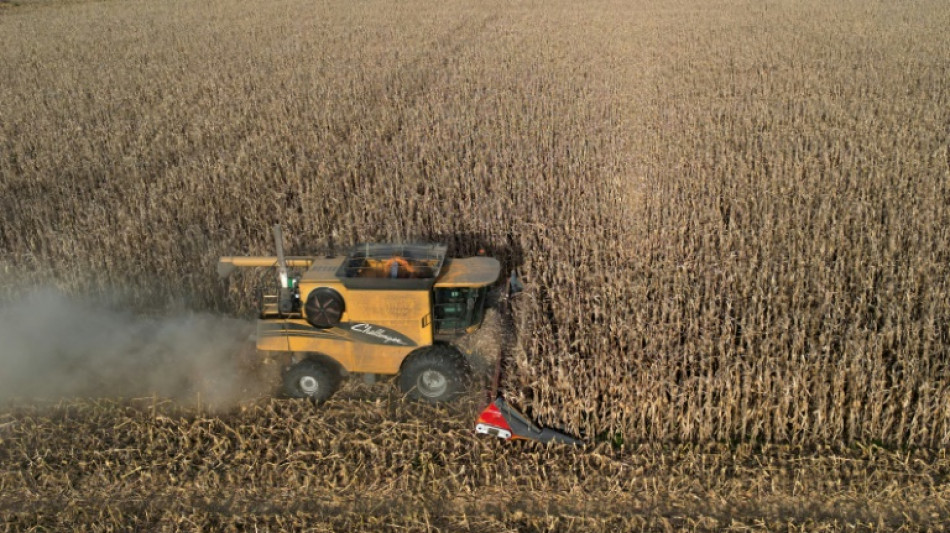
Argentina has surplus harvest, but farmers want more from Milei / Photo: © AFP

In the pampas, Argentina's vast and fertile grasslands outside Buenos Aires, grain silos overflow with this year's harvest -- but nobody is selling just yet.
Though the country's farmers largely gave their votes to President Javier Milei in the November election, they now want him to deliver on promises to slash taxes and ease exchange rate controls.
Until then, their bumper harvest will sit.
"The silos are full. One sells just enough to cover expenses," Ricardo Semino, a farmer from Lobos, 110 kilometers (68 miles) southwest of Buenos Aires, told AFP as he finished harvesting his corn and wheat fields.
"Those who can wait, do so."
After the country's worst drought in a century saw agricultural exports plummet, leading to a shortfall of $20 billion in revenue, the industry is expecting an excellent harvest in 2024.
The latest estimate from the Rosario Board of Trade indicates that the grain harvest could yield 131.1 million tons, a sharp rise from the 82.2 million tons gathered in the previous year.
But farmers say that low global prices and the delay in freeing up the exchange rate at which producers can sell their goods abroad have complicated the seemingly good news.
Agriculture is a major part of Argentina's economy, accounting for 55 percent of the country's exports. It is among the world's largest food producers, ranking third in soybeans behind only Brazil and the United States.
Argentina usually sells about 70 percent of its agro-industrial production, while the rest goes into storage.
Agricultural exports are estimated at $29.3 billion this year, falling short of the average $32 billion a year over the past five years.
- Unsold crops -
The combination of increased production and unfavorable economic conditions has left Argentina's fields dotted with "silo bags" -- basically, tons of harvested soybeans and grains wrapped in plastic.
Semino says sending grain to actual silos is a bit of a crapshoot.
"Usually you speculate when you send (the grain) to the silo plant," he explained.
"Nowadays the silo plants, which belong to big companies, give you the possibility to deliver the grain and you can sell it within five, six, seven months or a year."
The Rosario Board of Trade estimates that there are some 35.6 million tons of unsold grains in the country, valued at almost $10.6 billion.
Despite Milei's campaign promises, he raised taxes on exports of soybean meal and oil from 31 to 33 percent upon taking office. Taxes also increased on fuel.
Reforms to exchange rate controls have not been forthcoming, and no timeline has been set. Inflation, though trending down, was still at 276.4 percent in May year-on-year.
Argentina has half a dozen dollar exchange rates. Exporters get a preferential rate, but still far less than the value of the peso on the parallel informal market (1,300 pesos to the dollar) -- which is the rate producers use to pay for farming supplies.
Six months into Milei's tenure, all of that translates into uncertain costs for farmers.
In the past year, "the price of a tractor went from $170,000 to $250,000," Semino said.
Nevertheless, support for Milei persists in the countryside, with Semino explaining that a devaluation of the peso in December did help farmers.
- 'Moving forward' -
And despite all the uncertainty, the future still seems brighter.
Cristian Russo, head of estimates at the Rosario Board of Trade, said strong rains had boosted projections for the wheat harvest, with a 40 percent higher yield expected next season.
The agricultural sector does not stop production, no matter what happens in government, Semino explained.
"You get used to always moving forward," he said. "Nobody is going to leave a field fallow because they are waiting for another government. You have to plant it and get the most out of it."
(O.Zhukova--DTZ)