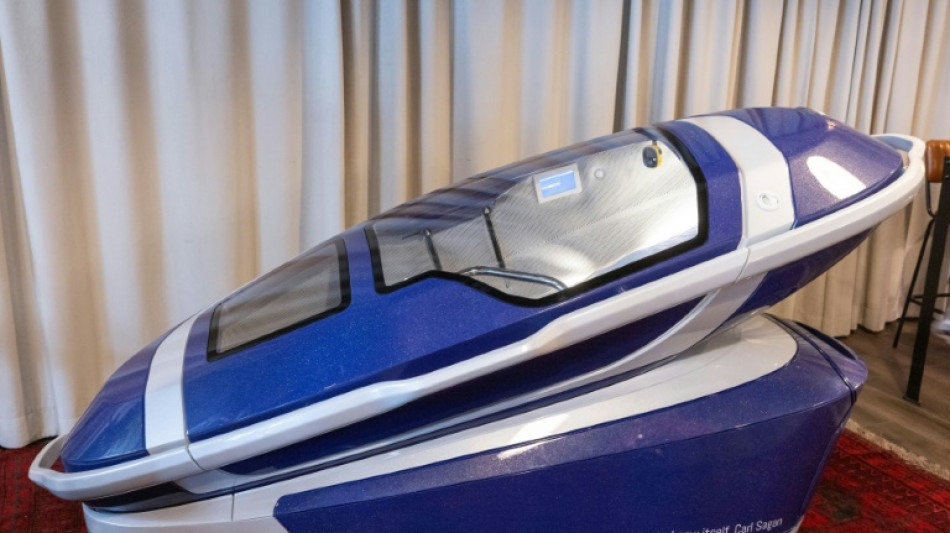
Multiple arrests after US woman uses machine-assisted suicide in Switzerland / Photo: © AFP

Swiss police said Tuesday they arrested several people after a US woman used a controversial suicide pod to end her life.
The space-age looking Sarco capsule, which replaces the oxygen inside it with nitrogen, causing death by hypoxia, was used on Monday at a forest location near the German border.
The portable human-sized pod, self-operated by a button inside, providing death without medical supervision, has raised a host of legal and ethical questions in Switzerland. Active euthanasia is banned in the country but assisted dying has been legal for decades.
Switzerland's interior minister Elisabeth Baume-Schneider told lawmakers on Monday that the Sarco was "not legal".
Police in the northern Schaffhausen canton said several people had been taken into custody and face criminal proceedings.
- 'Peaceful, fast, dignified' -
The Last Resort organisation, an assisted dying group, presented the Sarco pod in Zurich in July, saying they expected it to be used for the first time within months, and saw no legal obstacle to its use in Switzerland.
In a statement to AFP, The Last Resort said the person who died was a 64-year-old woman, who was not named, from the midwestern United States.
She "had been suffering for many years from a number of serious problems associated with severe immune compromise", the statement said.
"The death took place in open air, under a canopy of trees, at a private forest retreat."
The association's co-president Florian Willet was the only other person present, and described the woman's death as "peaceful, fast and dignified", according to the statement.
- Several arrests -
The cantonal public prosecutor's office "has opened criminal proceedings against several people for inducement and aiding and abetting suicide... and several people have been placed in police custody," a police statement said.
The public prosecutor's office had been informed by a law firm on Monday that an assisted suicide had taken place at a forest hut in Merishausen.
The police, the forensic emergency service and the public prosecutor's office "went to the crime scene".
The Sarco suicide capsule was secured and the deceased taken away for an autopsy.
"Several people in the Merishausen area were taken into police custody," the statement said.
The Dutch newspaper De Volkskrant said one of its photographers had been arrested by Schaffhausen police.
- Sarco: 3D-printable capsule -
Tested in a workshop in Rotterdam, the Sarco was invented by Philip Nitschke, a leading global figure in right-to-die activism.
The 3D-printable capsule cost more than 650,000 euros ($725,000) to research and develop in the Netherlands over 12 years. Future Sarcos could cost around 15,000 euros.
In a statement, Nitschke said he was "pleased that the Sarco had performed exactly as it had been designed to do: that is to provide an elective, non-drug, peaceful death at the time of the person's choosing".
To use the Sarco, the person wishing to die must first pass a psychiatric assessment.
The person climbs into the purple capsule, closes the lid, and is asked automated questions such as who they are, where they are and if they know what happens when they press the button.
In July, Nitschke explained that once the button is pressed, the amount of oxygen in the air plummets from 21 percent to 0.05 percent in less than 30 seconds.
The Sarco monitors the oxygen level in the capsule, the person's heart rate and the oxygen saturation of the blood.
Nitschke's Exit International organisation, which owns the Sarco, is a non-profit group funded by donations. The only cost for the user is 18 Swiss francs ($21) for the nitrogen.
- Suicide law -
In July, Willet said Switzerland was "by far the best place" for the Sarco to be used, due to its "wonderful liberal system".
Swiss law generally allows assisted suicide if the person commits the lethal act themselves.
But interior minister Baume-Schneider, taking questions in parliament on Monday, said: "The Sarco suicide capsule is not legally compliant in two respects.
"Firstly, it does not meet the requirements of product safety law and therefore cannot be placed on the market. Secondly, the corresponding use of nitrogen is not compatible with the purpose article of the Chemicals Act," she said.
Fiona Stewart, who is on The Last Resort's advisory board, said the group was acting on legal advice, which "since 2021 has consistently found that the use of Sarco in Switzerland would be lawful".
(S.A.Dudajev--DTZ)