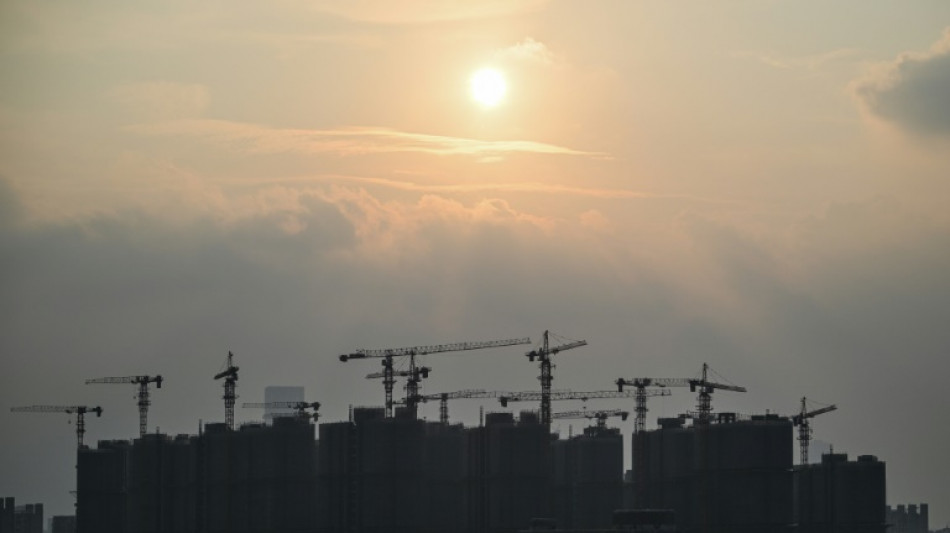
China admits economy facing new 'problems', vows to fix property sector / Photo: © AFP

Chinese President Xi Jinping and other top leaders admitted Thursday that the world's number two economy was facing new "problems" and vowed to resolve a long-running crisis in the housing sector.
Beijing has this week unveiled a raft of measures to boost its ailing economy, which it has targeted to grow five percent this year -- an objective analysts say is optimistic given the many headwinds it faces.
On Thursday, the ruling Communist Party convened a meeting of its top body, the Politburo, to "analyse and study the current economic situation".
"Some new situations and problems have emerged in the current running of the economy," the Xinhua news agency reported after the meeting, which was attended by Xi.
"We must view the current economic situation comprehensively, objectively and calmly, face difficulties squarely, (and) strengthen confidence," it added.
Politburo members agreed on the need to "further improve the focus and effectiveness of policy measures" aimed at lifting the economy.
They also vowed to "respond to the people's concerns" about the economic malaise.
Beijing would "adjust housing purchase restriction policies, lower interest rates on existing mortgage loans... and promote the construction of a new model for real estate development", Xinhua said.
- 'Positive step' -
Thursday's readout suggested that more substantial support for the economy may be on the way, said Julian Evans-Pritchard, head of China economics at Capital Economics, in a note.
"But concrete details are lacking and so it's difficult to judge the scale of any additional fiscal support at this stage," he said.
The state media readout also suggested rate cuts could be larger than previously anticipated, said Evans-Pritchard: "falling inflation and private-sector deleveraging mean that rate cuts alone won't dramatically boost domestic demand".
Also on Thursday, the government vowed to improve care for the elderly and young, and push to boost jobs, particularly among the youth.
Zhiwei Zhang, president and chief economist at Pinpoint Asset Management, said the meeting "touched on the key issues that need to be addressed, such as the stabilisation of the property sector, and the promotion of the private sector".
"The Politburo meeting stated that fiscal and monetary policies should become more forceful, but didn't provide quantitative guidance on the size of fiscal stimulus," he said in a note.
Overall, however, Zhang said he regarded the messages from Thursday's meeting as a "positive step to address the economic challenges that China face".
- Splash the cash -
Meanwhile, Bloomberg reported officials were considering pumping more than $140 billion into the country's large state-run banks, in the first major capital injection of its kind since the 2008 global financial crisis.
The measure -- aimed at giving the banks more room to lend to businesses -- would be implemented mainly through the issuance of "new special sovereign bonds", the report said, citing sources familiar with the matter.
The details have not yet been finalised, it added.
This week's announcements, which include key rate cuts and policies intended to encourage home purchases, have been welcomed by investors, with stocks in Shanghai and Hong Kong up more than nine percent so far this week.
But more work is needed if leaders are to achieve their five percent goal this year, analysts warned.
Recent economic data has been disappointing, with second-quarter growth coming in lower than expectations at 4.7 percent.
Youth unemployment climbed in August to 18.8 percent -- its highest level this year -- according to official figures released last week.
This week's stimulus measures represent a "shift towards a more aggressive easing stance, given the sustained weakness in domestic growth", said Chaoping Zhu, global market strategist at JP Morgan Asset Management.
"The sense of urgency may convince investors that more policy support is on its way," added Zhu.
(Y.Leyard--DTZ)