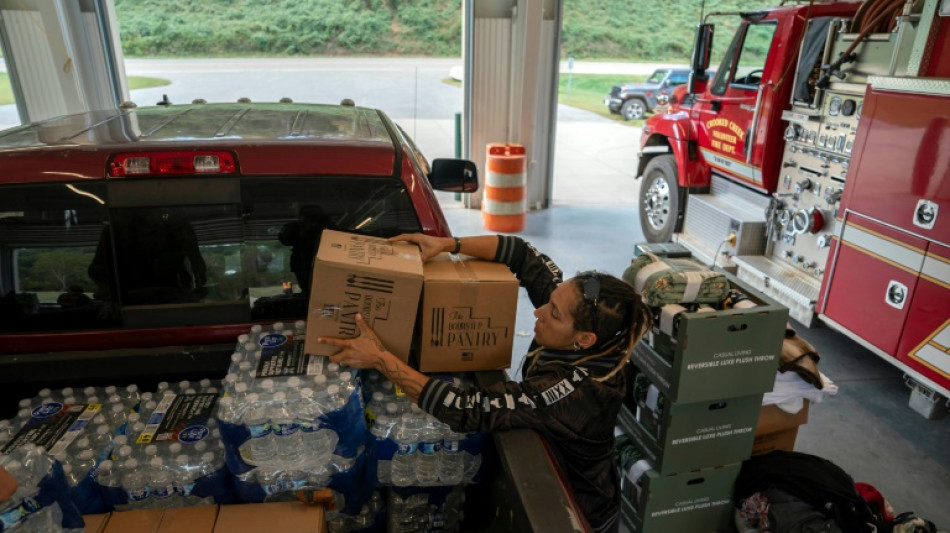
Drowned by hurricane, remote N.Carolina towns now struggle for water / Photo: © AFP

Nicole Crane, exhausted, tearful and unwashed after a week of searching for a neighbor swept away by the raging waters of Hurricane Helene, dreams of taking a shower.
But she and the other 100,000 residents of the US town of Asheville, North Carolina are without fresh drinking water, forced to rely on bottled water -- or in some cases on river or spring water.
Dog teams finally found her neighbor's body the day before, "so not having fresh water has been low priority," she told AFP on Saturday, as a tanker nearby distributed the precious commodity.
As the region struggles to recover from the storm that killed at least 226 people across the US northeast, dumping a deluge onto the North Carolina mountains, one fundamental issue is of immediate concern: getting access to water.
Flood damage severely disrupted Asheville's water system.
Crane, clad in a red tank top, the lines in her face a reflection of despair, described her desperate search for her neighbor -- a man she last saw "on his roof, going down the river."
Now, knowing his final fate, she struggles to hold it together.
"I smell bad right now, and I'm exhausted and hungry," she told AFP, breaking into tears.
She had heard that showers are available some 30 miles (50 kilometers) away, but that's just too far. "I'm going to come back," she said, "and get some water so I can wash my face."
- River water -
A stone's throw away, Jessica Pickering and her husband Michael open the valves of a 6,200-gallon (23,500-liter) tanker, financed by the NGO World Central Kitchen, to fill the bottles and jerrycans of the grateful residents who pass by.
Shelley Hughes, 64, and her son Owen, 27, load heavy buckets of water into the trunk of their car.
"The big adventure of the day," laughs Shelley, "is finding water for the toilet" -- both for her family and for less mobile neighbors.
Thousands of residents are using a more primitive approach: scooping water from a nearby river to pour it into their toilet bowls.
Packs of bottled water, distributed by volunteers in church and school parking lots throughout the region, are used for drinking, cooking and washing up.
The water crisis, in a region crippled by the deadliest hurricane to hit the United States since Katrina in 2005, could be a daily feature of people's lives for some time.
The city of Asheville is coordinating work to restore normal water supplies.
But a top city official refused to give a date for a return to normal.
And "I'm not going to give a timetable on when I would give a timetable," the official, Ben Woody, said in a briefing published on Facebook.
The city had protectively installed backup water pipes in 2004, but Helene swept them all away during its devastating passage on September 27, a cataclysm rendered even more intense by climate change, scientists say.
- Spring water -
Far from the city, in one of the scores of steep valleys in the surrounding mountains, octogenarian Clyde Hollifield and his wife Adrienne live in a small white house under a canopy of trees, miles from any store.
A spring on the far side of a nearby stream normally provides them with fresh drinking water, delivered to them by a small pipe. But torrential floodwaters swept that away, too.
"It was like a tsunami," said Hollifield, who wears a long white beard.
Using scraps of wood, he has cobbled together a makeshift bridge to support a new water pipe.
Their neighbor Juniper Odell arrives. She and her husband rely on water they also pipe from a spring, but that too was damaged by Helene. The Odells, do-it-yourselfers by necessity -- like so many in these reclusive areas -- repaired it themselves.
On Saturday morning, 79-year-old Randall Melton drove from his nearby home to collect a few gallons. What for?
"To make coffee," he said simply.
(N.Loginovsky--DTZ)