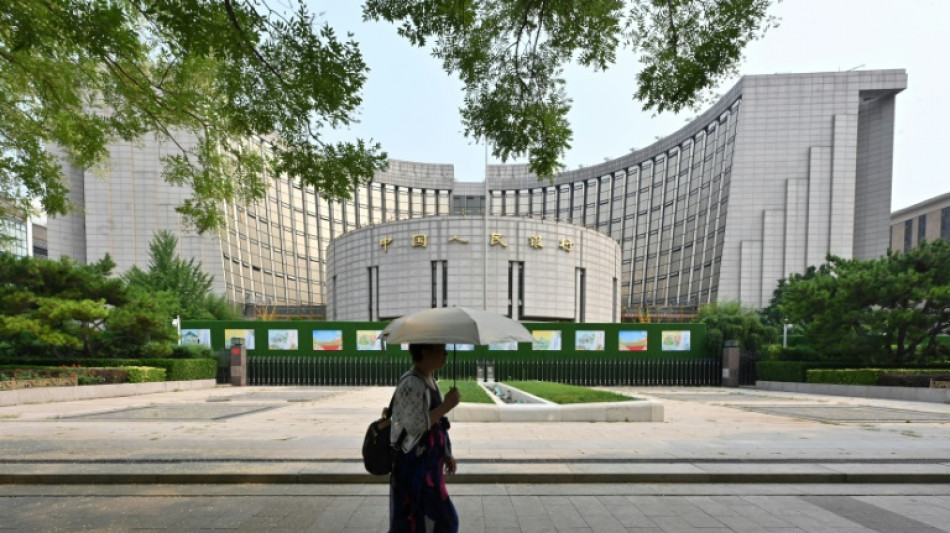
China opens $71 bn 'swap facility' to boost markets / Photo: © AFP/File

China's central bank boosted support for markets Thursday by opening up tens of billions of dollars in liquidity for firms to buy stocks as part of a raft of measures by Beijing to kickstart the country's flagging economy.
Authorities last month unveiled several stimulus policies -- from interest rate cuts to relaxing home-buying rules -- after struggling since the end of Covid restrictions to reignite growth and get business activity back on track.
The news lit a fire under mainland and Hong Kong equities on renewed hopes that officials would finally get a grip on the issues that have dogged the economy for years, particularly a property debt crisis and tepid consumer spending.
That euphoria was dampened Tuesday as a much-anticipated news conference ended with just a pledge to meet the country's annual growth target but no more measures and no detail on those already announced.
But on Thursday the central bank fleshed out plans to encourage "the healthy and stable development of the capital market" by opening up a "swap facility" worth 500 billion yuan ($70.6 billion) that will allow firms to access cash to buy stocks.
Companies will be allowed to use equities, bonds and other assets as collateral for "high-grade liquid assets such as treasury bonds and central bank bills", it said.
The programme may be "further expanded depending on the situation", it added.
Shanghai shares rose more than one percent in early trade and Hong Kong added more than two percent.
The measures were first announced last month alongside a raft of stimulus measures that triggered a blistering rally that sent markets up more than 20 percent.
- 'Fully confident' -
People's Bank of China (PBoC) chief Pan Gongsheng said at the time the plans would "significantly enhance" firms' ability to access funds to buy stocks.
Beijing also last month slashed interest on one-year loans to financial institutions, cut the amount of cash lenders must keep on hand and pushed to lower rates on existing mortgages.
China faces multiple issues including a prolonged crisis in the property sector, chronically low consumption, high unemployment among young people, and elevated local government debt.
In a bid to shore up the housing market -- once a key driver of growth -- several major cities including Shanghai, Guangzhou and Shenzhen have also eased restrictions on buying homes.
Analysts say more direct state support is needed to boost consumption and achieve the government's official national growth target of about five percent for this year.
Top economic planner Zheng Shanjie this week said Beijing was "fully confident" that it would hit that goal.
"We are also fully confident in maintaining stable, healthy and sustainable development," he added.
An analyst told AFP the central bank had been "doing much of the heavy lifting in the latest wave of stimulus".
"The PBoC recognises the urgency needed to address the economic issues in China," Heron Lim, an economist at Moody's Analytics, said.
"But the PBoC actions are only one part of the equation in boosting sentiment," he said. "What is required now is the action plan for fiscal support to come through."
Traders are hoping that plan comes on Saturday, when Finance Minister Lan Fo'an is set to hold a briefing on fiscal policy in Beijing.
China's State Council said Lan will outline "countercyclical adjustment of fiscal policy to promote high-quality economic development".
(N.Loginovsky--DTZ)