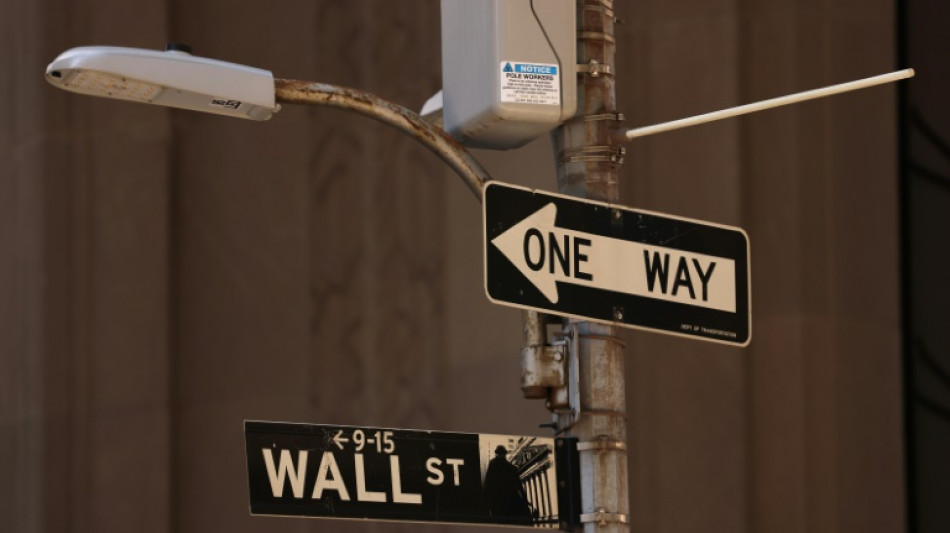
Lower rates, surging stock market fail to ignite US IPO market / Photo: © AFP

Public listings on Wall Street have seen a slow comeback in 2024 despite a resilient US economy, a long-awaited interest rate cut by the central bank and stock valuations hitting record highs.
Experts say the lackluster IPO activity is due to competition from venture capitalists and a rate cut that was slow to come.
While initial public offerings (IPOs) typically pick up in the fall, the market was "more muted than anticipated" this year, said research group Renaissance Capital.
The IPO market's "slow rebound" continued in the third quarter this year, the group added, as investors look towards 2025.
Even though IPOs jumped nearly 30 percent from a year ago during the first nine months of 2024, the surge came from a low base of comparison, said Mark Roberts, managing partner at The Blueshirt Group.
The fall of 2023 looked like a potential turning point for the market -- with British chip designer Arm, online marketing platform Klaviyo and German footwear brand Birkenstock all going public in a matter of weeks.
But the fledgling trend was short-lived.
- Unusual trend -
The lower level of activity has endured although the world's biggest economy has proven resilient and so far avoided slipping into a recession.
"Even more important than the state of the economy, with the stock market at record highs, you would expect a lot more IPO activity," said Jay Ritter, a finance professor at the University of Florida who focuses on public listings.
The beginning of a rate easing cycle by the Federal Reserve, which announced the first rate cut on September 18, was also expected to spur IPO activity.
But Matt Kennedy, senior strategist at Renaissance Capital, said the cut came too late and few were able to seize the opportunity.
Some deals did come through, the most notable of them being jet engine maintenance company StandardAero.
It raised over $1 billion in early October.
Others chose to stay on the sidelines or pull back, with aluminum recycler Novelis scrapping its IPO plans altogether, citing "current market conditions."
Roberts of The Blueshirt Group said the private sector is "significantly more upbeat" than a year ago and he expects more IPO activity in 2025.
- Upbeat about 2025 -
Experts say companies are not rushing to IPO because they can get funding elsewhere.
A public listing is an arduous and lengthy process which requires companies to disclose a lot of information on their financials, operations and strategy, whereas a funding round limits the sharing to a handful of investors.
"There's so much private equity and venture capital dry powder, so much money available for them to be investing that they're willing to pay high prices," said Ritter.
In early July, private equity companies and venture capital funds held a record $2.6 trillion of uncommitted capital, looking for investment opportunities in unlisted stocks.
Generative artificial intelligence powerhouse OpenAI had no trouble raising $6.6 billion in its latest funding round in early October, a tally that would have been the 12th biggest US IPO ever had they chosen to list on Wall Street.
"You can understand why they feel no desire to go public in that kind of environment," Ritter added. "It wouldn't necessarily make sense for them to file for an IPO."
In the past, existing shareholders might have pressured businesses to go public.
However, founders, employees or venture capitalists are now able to monetize shares more easily than a few years ago, thanks to startup platforms catered to unlisted companies.
Forge Global and Hiive are some of the options available -- as well as Nasdaq Private Market, run by Nasdaq, which also owns one of two main US stock exchanges.
(V.Sørensen--DTZ)