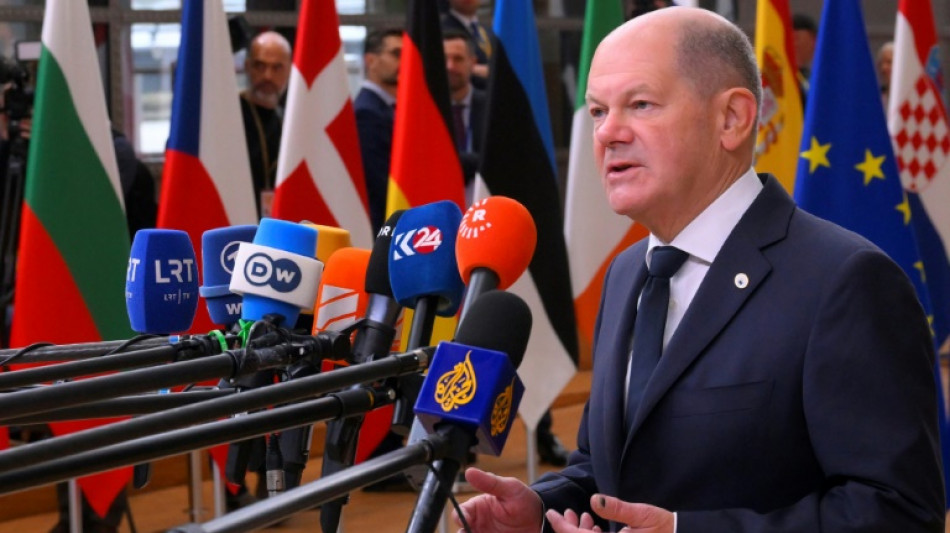
EU leaders urge new laws to speed up migrant returns / Photo: © AFP

EU leaders called Thursday for urgent new legislation to increase and speed up migrant returns on Thursday, after a summit in Brussels that crystallised a rightward shift in the bloc's rhetoric.
The heads of the bloc's 27 nations said that day-long talks saw "in-depth" discussions on migration -- an issue that has shot up the political agenda following hard-right gains in several countries.
"The European Council calls for determined action at all levels to facilitate, increase and speed up returns from the European Union," the leaders wrote in conclusions to their summit, asking the European Commission to submit new legislation to that effect.
New ways to prevent and counter irregular migration should also be considered, the text read, in an apparent reference to a much-discussed proposal to create return centres outside the European Union, which did not get an outright mention.
"We recognise that we need to think out of the box in order to address this pressing concern," Greek Prime Minister Kyriakos Mitsotakis told reporters before the talks.
Italy's hard-right Prime Minister Giorgia Meloni hosted a mini-summit just ahead of the main event to discuss a common approach with 10 like-minded countries, including Denmark, the Netherlands, Hungary and Greece.
In a nod to the growing influence of immigration hawks, EU chief Ursula von der Leyen was also present.
But divisions remained on the next steps, with no concrete plans laid out in the final text.
German Chancellor Olaf Scholz dismissed the idea of return centres, saying they were not a viable answer to the migration challenges of a large country.
"If we all followed the rules we have together, we would already be much further ahead," he said.
Germany is among nations that want an early implementation of a landmark migration pact struck this year, which hardens border procedures and requires countries to take in asylum seekers from "frontline" states or provide money and resources.
But others say the package, set to come into force in June 2026, falls short.
- 'Innovative solutions' -
The call to speed up returns echoed a proposal backed by a majority of states that earlier this year called for the EU to explore "innovative solutions" to deal with migration, as Meloni posted on X on Thursday.
That was followed by a letter from von der Leyen this week that promised action and said the bloc will draw lessons from a deal Italy struck with Albania to send some migrants there.
Yet some countries, including Spain, poured cold water on the more radical ideas, also noting the need for regular immigration routes amid a workforce shortage and an ageing population, a diplomatic source said.
"Safe and legal pathways" were "key for regular and orderly migration", the final statement said.
Disagreements caused a previous effort to overhaul migrant return rules to fail in 2018.
"All these solutions of 'migration hubs', as they are called, have never shown in the past to be very effective, and they are always very expensive," Belgian Prime Minister Alexander De Croo told reporters.
- 'New wind' -
The general hardening in tone comes despite a drop in detected irregular border crossings into the European Union, which fell by more than 40 percent this year after reaching an almost 10-year peak in 2023.
"There is a new wind blowing in Europe," said Dutch politician Geert Wilders, whose nationalist populist party came top in general elections in the Netherlands last year.
Wilders was in Brussels to attend another event: a meeting of the far-right Patriots for Europe group in the European Parliament.
Hard-right parties often riding anti-immigrant sentiment performed strongly in European Parliament elections in June, and have topped recent national and regional votes in Austria and Germany.
France also tilted to the right after a snap parliamentary election this summer.
Germany tightened border controls in September in response to several suspected Islamist attacks.
And this month Poland said it would partially suspend asylum rights, accusing Russia and Belarus of pushing migrants over the border to destabilise the country.
Ukrainian President Volodymyr Zelensky also attended Thursday's meeting to present Kyiv's "victory plan" to defeat Russia, and EU leaders discussed other topics, including the conflicts in Gaza and Lebanon.
(A.Stefanowych--DTZ)