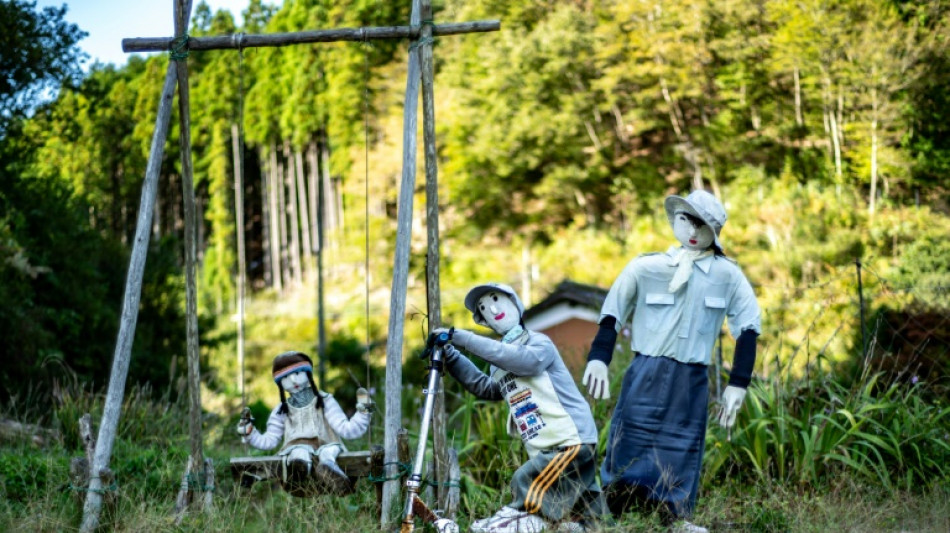
'Our pride': Lone child brings hope to Japan's puppet village / Photo: © AFP

Riding his tricycle with cheerful abandon, Kuranosuke Kato is the only child in his tiny, depopulated Japanese village overrun by life-sized puppets.
The two-year-old wasthe first baby in two decades for Ichinono, one of more than 20,000 communities in Japan wherethe majority of residentsare aged 65 and above, according to the internal affairs ministry data.
Revitalising rural areas is one of Prime Minister Shigeru Ishiba's key campaign pledges as he fights to retain a majority in a general election on Sunday.
Ishiba has called Japan's low birth rate a "quiet emergency", one that is starkly evident in places like Ichinono, a bucolic hamlet home to fewer than 60 people.
"If the village is left as it is now, the only thing that awaits us is extinction," said 74-year-old Ichiro Sawayama, head of its governing body.
Many developed nations are facing the same demographic timebomb, but Japan, which allows relatively low levels of immigration, already has the world's second-oldest population after Monaco.
Silence pervades the air in Ichinono, where residents have handcrafted stuffed mannequins to create a semblance of a bustling society.
Some puppets ride swings while others push a cart of firewood, smiling eerily at visitors.
"We're probably outnumbered by puppets," Hisayo Yamazaki, an 88-year-old widow, told AFP.
Rice harvesting and sake brewing used to keep Ichinono afloat. Most families in the village used to have children, Yamazaki recalled.
But "we were afraid they would become unmarriageable if they remained stuck in a remote place like this", so they were encouraged to attend city colleges.
"Out they went, and they never came back, getting jobs elsewhere. We're now paying the price," she said.
- Pastoral living -
One family in Ichinono is a bit different: 33-year-old Rie Kato and 31-year-old Toshiki Kato moved from big city Osaka to Ichinono in 2021, then they had Kuranosuke.
The couple decided to ditch urban life for the countryside as the pandemic allowed for more flexible working.
As the youngest resident by far, their son is adored by the other villagers, who bring him home-cooked meals and collectively look after him.
The toddler is "our pride", village head Sawayama beams, while widow Yamazaki says he is "practically my great-grandchild -- such a sweet thing".
The Katos say it is a good thing that he is growing up with the community of Ichinono instead of the anonymity of an Osaka apartment.
"Just by being born here, our son benefits from the love, support and hope of so many people -- even though he has achieved absolutely nothing in life yet," laughed his father Toshiki.
His mother Rie said neighbours in the tight-knit village sometimes ask her a favour or invite her to play the croquet-like sport gateball. The family also helps harvest edamame beans with their neighbours.
"I feel like my self-worth, as an individual, is recognised here," she said. "I'm sure that's how Kuranosuke will feel about himself growing up."
- 'Recreate' Japan? -
But Ichinono's insularity can be a turn-off for outsiders.
Outdated rules still exist on paper requiring aspiring newcomers to be vouched for by at least three long-term residents, and proffer sacks of rice or cash.
Those edicts -- meant to "keep the village cohesive" -- are no longer applied to avoid scaring people away, Sawayama said.
While rural decline is a global phenomenon, Japan's topography may worsen the problem, said Taro Taguchi, a community development professor at Tokushima University.
"Probably nowhere do people live on hillsides as much as in Japan," due to a large population and the scarcity of flat farmland, he told AFP.
But the "higher risk of natural disasters and greater proximity to vermin" on mountains make them less attractive when people can choose where they live.
Prime Minister Ishiba has vowed to "recreate Japan" with policies including doubling subsidies for struggling regions.
But Taguchi cautioned that similar subsidies were often approved by the central government in the past to fund "flashy" revitalisation projects like fancy cafes.
"These initiatives did little to support locals' livelihoods," he said.
While working remotely in the IT sector Toshiki Kato has launched a side project refurbishing century-old houses.
"My humble hope is to help add some new value to these homes, and keep Ichinono's death at bay even just a year longer," he said.
tmo/kaf/stu/lb/hmn
=
(U.Stolizkaya--DTZ)