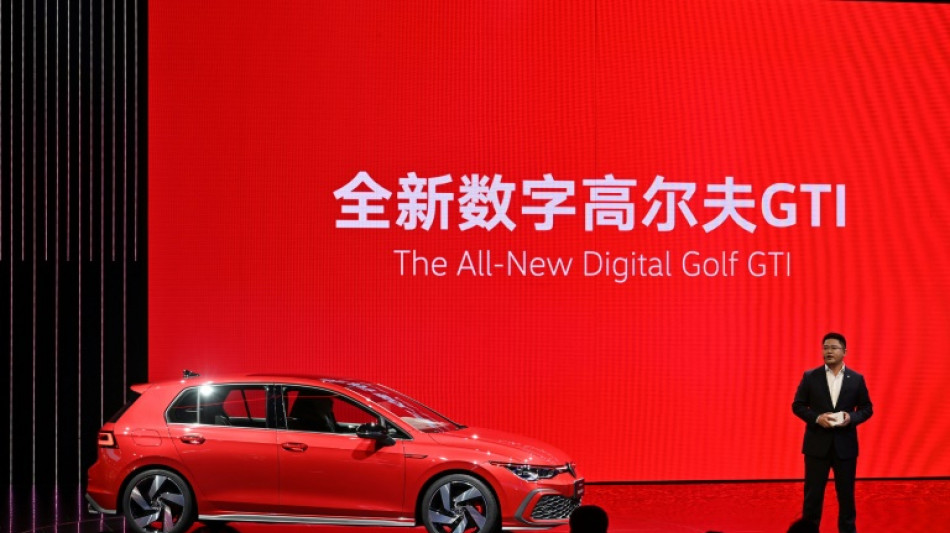
Volkswagen to sell operations in China's Xinjiang / Photo: © AFP/File

German car giant Volkswagen said Wednesday it would sell its operations in China's Xinjiang region, where Beijing has been accused of widespread human rights abuses including forced labour.
The firm will sell its factory in Xinjiang's capital Urumqi as well as a test track in Turpan to a Chinese company, a spokesperson said, citing "economic reasons" for the decision.
VW has lost ground in China -- its most important market, where it makes around a third of its sales -- with business in the country in 2023 growing modestly but at a slower rate than the previous year.
The German manufacturer has fallen behind domestic competitors in China, losing its title as the best-selling auto brand to BYD.
The move also comes as Volkswagen is seeking to push through a major cost-cutting drive, and is weighing up closing factories in Germany for the first time.
Rights campaigners have for years accused Beijing of a crackdown against Uyghurs and other Muslim minorities in Xinjiang, including through forced labour and detention camps.
Beijing denies allegations of abuse and insists its actions in Xinjiang have helped to combat extremism and enhance development.
The northwestern region is home to several factories that supply multinational companies, including big-name Western brands.
VW has long come under scrutiny over its factory in the city of Urumqi, which opened in 2013 and in which it has a stake via its partner SAIC.
This year, Germany's Handelsblatt financial daily reported that forced labour may have been used to build VW's test track in Turpan in 2019.
VW said previously it had seen no evidence of human rights violations in connection with the project but vowed to investigate any new information that came to light.
Its operations will be sold to Chinese firm Shanghai Motor Vehicle Inspection Center (SMVIC), the car giant said Wednesday.
- 'Difficult decision' -
Ferdinand Dudenhoeffer, director of the Center Automotive Research institute in Germany, said that VW had "bowed to public sentiment" in deciding to end its operations in Xinjiang.
"It was a difficult decision for VW, because China and its image in China are very important for the company," the auto industry expert told AFP.
Some in China would be unhappy with the move and at a time "German carmakers are already losing market share, this is of course tricky", he added.
In a commentary, top-selling German tabloid Bild noted that VW had faced pressure from the government in Berlin and the capital markets to pull out of Xinjiang.
"For too long, the company turned a blind eye to the human rights situation," it said.
Beijing stands accused of incarcerating over one million Uyghurs and other Muslim minorities in a network of detention facilities across Xinjiang.
Campaigners and Uyghurs overseas have said an array of abuses take place inside the facilities, including torture, forced labour, forced sterilisation and political indoctrination.
A UN report in 2022 detailed "credible" evidence of torture, forced medical treatment and sexual or gender-based violence -- as well as forced labour -- in the region.
But it stopped short of labelling Beijing's actions a "genocide", as the United States and some Western lawmakers have done.
Calls had grown louder for VW to reconsider its business activities in Xinjiang after German chemicals giant BASF announced this year that it would accelerate its exit from two joint ventures there.
An external audit commissioned by VW last year found no evidence of forced labour among the plant's 197 employees.
But the consultancy that wrote the report acknowledged "the challenges in collecting data" for audits in China.
The Turpan test track was not part of the audit.
In response to the VW forced labour report, China urged companies not to be "blinded by lies" about its rights record in Xinjiang.
(U.Beriyev--DTZ)