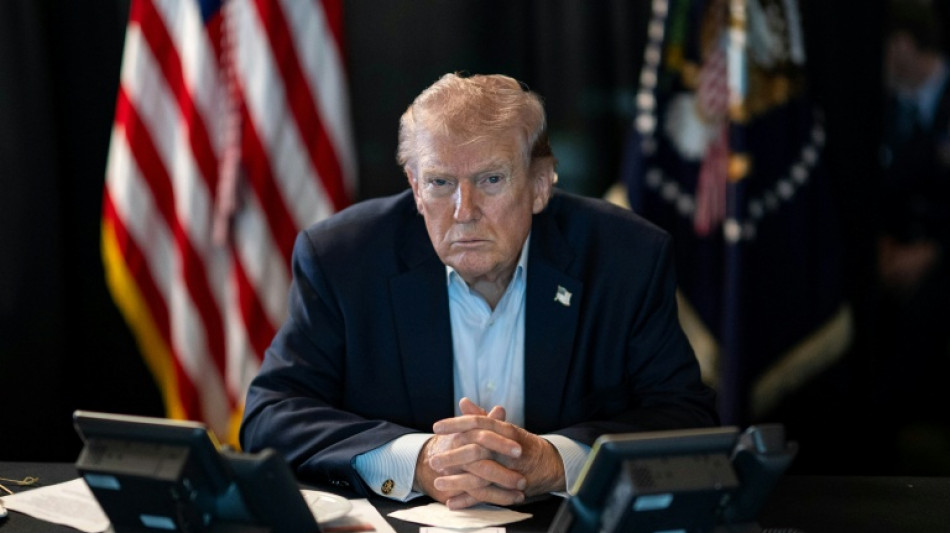
Oil extends gains and stocks dive as Middle East war spreads / Photo: © The White House/AFP

Oil prices extended gains while the dollar and equities tumbled Tuesday as investors kept tabs on the widening war in the Middle East.
The US and Israeli attacks on the Islamic republic have upended regional energy flows, with the crucial Strait of Hormuz -- through which about a fifth of global oil transits -- effectively closed off. The war has also fuelled fears of a fresh energy crisis that could ramp up inflation.
Market moves have been comparatively mild amid hopes that the crisis will be short-lived and not cause a major problem for the global economy.
But analysts warned that the longer it goes on the more painful it would be as supply chains are hit and prices surge.
US President Donald Trump said the war, which began Saturday with a strike that killed Iran's supreme leader Ayatollah Ali Khamenei, was going "substantially" ahead of schedule but warned it could go on for more than four weeks.
He also for the first time laid out objectives -- destroying Iran's missiles, navy and nuclear programme, and stopping its support for armed groups across the region -- which notably did not include toppling the Islamic republic.
The US State Department urged Americans to leave all of the Middle East from Egypt eastward.
Iran has responded by unleashing missiles and drones across the Middle East, including at Saudi Arabia, Qatar and Dubai, while threatening explicitly to drive up global energy costs.
That sent oil prices soaring nearly 14 percent Monday before slightly easing, while European natural gas prices spiked almost 40 percent after Qatar's state-run energy firm said it had halted liquefied natural gas production.
Meanwhile, a general in Iran's Revolutionary Guards threatened to "burn any ship" seeking to navigate the Strait of Hormuz.
"We will also attack oil pipelines and will not allow a single drop of oil to leave the region. Oil price will reach $200 in the coming days," he warned.
Crude surged again Tuesday, with Brent up more than four percent and back above $80 a barrel, and WTI climbing more than three percent.
The Dutch TTF natural gas contract, considered the European benchmark, shot up more than 33 percent.
The rise in energy costs could give most central bankers a headache as they look to bring down inflation while also cutting interest rates to support their economies.
"A spike in energy prices creates a dilemma for central banks," said Rodrigo Catril at National Australia Bank. "Stagflation makes central banks very uncomfortable, a longer-lasting energy shock is inflationary and at the same time it weakens growth."
And Chris Weston at Pepperstone added: "With the Strait of Hormuz temporarily constrained, the longer the disruption persists, the greater the risk that additional facilities and infrastructure across the Gulf region may be forced offline."
Equity markets mostly retreated to extend Monday's losses in most of Asia, while the dollar gained on a push into safe havens.
Seoul, which has surged more than 40 percent this year on the back of a tech rally, led the retreat by diving more than seven percent as investors returned from a long weekend.
Chipmakers Samsung and SK hynix, which have soared this year on the back of the AI tech rally, were at the forefront of the selling. Samsung sank 9.9 percent and SK hynix 11.5 percent.
Kim Dae-jong, professor of business at Sejong University, told AFP: "South Korea is a highly export-dependent economy, and signs of a widening war in the Middle East have added to market uncertainty.
"The country also relies entirely on energy imports, ... making some impact all but inevitable."
Tokyo shed more than three percent while Hong Kong, Shanghai, Sydney, Wellington, Taipei and Jakarta were also sharply lower.
Europe also tumbled at the open, with London, Frankfurt and Paris off more than one percent.
Airlines were again among the biggest losers, with Tokyo-listed Japan Airlines down more than six percent, Cathay Pacific down 2.8 percent in Hong Kong and Qantas losing 1.8 percent in Sydney.
Air France-KLM shed three percent in Amsterdam.
"As long as oil flows continue, this remains a volatility event, not a systemic one -- but it confirms that geopolitics is now structurally embedded in the investment cycle," said Monica Defend at Amundi Investment Institute.
"In the short term, it feeds inflation risk, US dollar strength, and asset-class dispersion. Energy volatility, inflation uncertainty and regional dispersion are returning as defining market features."
- Key figures at around 0815 GMT -
West Texas Intermediate: UP 3.7 percent at $73.83 per barrel
Brent North Sea Crude: UP 4.3 percent at $81.06 per barrel
Tokyo - Nikkei 225: DOWN 3.1 percent at 56,279.05 (close)
Hong Kong - Hang Seng Index: DOWN 1.1 percent at 25,768.08 (close)
Shanghai - Composite: DOWN 1.4 percent at 4,122.68 (close)
London - FTSE 100: DOWN 1.3 percent at 10,641.69
Euro/dollar: DOWN at $1.1645 from $1.1688 on Monday
Pound/dollar: DOWN at $1.3340 from $1.3399
Dollar/yen: DOWN at 157.29 yen from 157.31 yen
Euro/pound: UP at 87.32 pence from 87.23 pence
New York - Dow: DOWN 0.2 percent at 48,904.78 (close)
(I.Beryonev--DTZ)