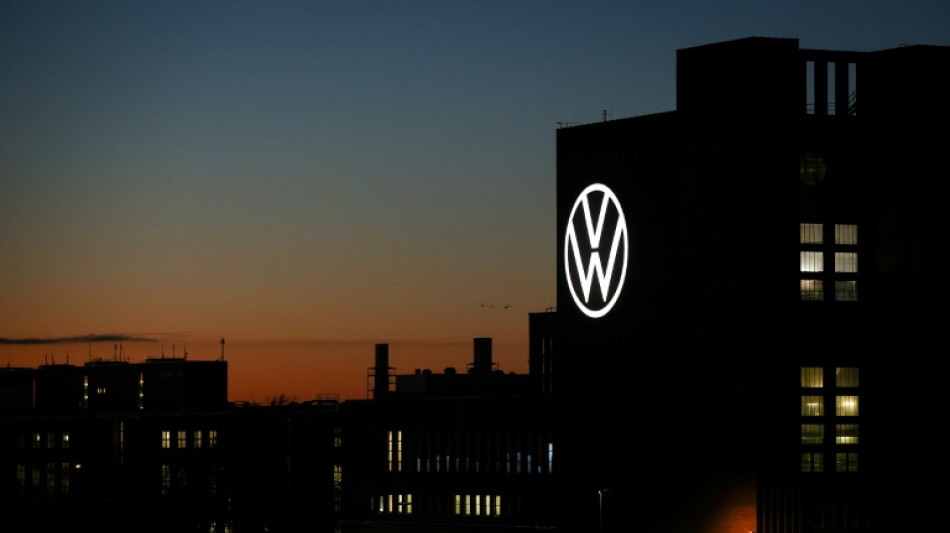
Volkswagen says cutting 100,000 jobs by end of decade / Photo: © AFP

German car giant Volkswagen said Thursday that management and unions had agreed to cut a total of 100,000 jobs by the end of the decade, the biggest-ever restructuring in the global auto industry.
The company said it had approved a plan involving the reduction of around 50,000 jobs, on top of another 50,000 already agreed.
"It is essential to systematically align workforce levels with economic realities," said the 10-brand group, which apart from its namesake also includes brands such as Audi and Porsche.
Hit by US tariffs, patchy demand for electric cars and above all fierce competition in and from China, Europe's largest carmaker is in trouble.
The total 100,000 cuts will be the largest restructuring ever carried out in the global automotive industry, amounting to about 15 percent of the carmaker's staff worldwide.
It eclipses the 50,000 job cuts General Motors made after it declared bankruptcy in 2009.
Volkswagen further said both management and unions agreed that the long-term future of four German plants -- in Hannover, Emden, Zwickau and Neckarsulm -- could not be guaranteed, while adding that alternative uses for the plants were being looked at.
The plants closing would mark the first time Volkswagen had shuttered full-scale factories in its home country.
"If this plant really were shut down, you could put a big black spot on the map," Martin Lehmann, who has worked at the Zwickau facility since 2012, told AFP.
"The plant and the jobs outside it, our suppliers, they're the motor of the entire region."
- 'Nonsense, rubbish, hogwash' -
The approval of the plans by Volkswagen's supervisory board, made up of both labour and shareholder representatives, marks progress in delicate negotiations between the two sides.
"The supervisory board has unanimously approved the executive board's future plan presented today," CEO Oliver Blume said. "This is a strong signal for the future of the Volkswagen Group."
Unions and management had very publicly rowed before signing off on the plans.
Unions charged bosses had not been straight with workers after the figure of 100,000 possible job cuts surfaced in the media before being communicated internally.
A report on Tuesday in business weekly WirtschaftsWoche that management was looking at ways of working around the supervisory board provoked further fury from the powerful IG Metall union, which called the idea "nonsense, rubbish, hogwash".
Volkswagen said Thursday the company had agreed to curb the supervisory board's power, potentially diluting the influence of unions that sit on it.
"The supervisory board has asked the executive board to develop a model for an evolved decision-making and group structure," the statement said, adding that approval thresholds would be "adjusted accordingly" to align with standard practice.
Under the provisions of the 1960 law that privatised Volkswagen, two-thirds of the supervisory board must approve "the establishment or relocation" of plants, a statute widely interpreted as giving labour -- which holds half the seats -- blocking powers over plant closures.
A similar move at other German carmakers would ordinarily require a simple majority.
In a joint statement, IG Metall union and VW supervisory board members Christiane Benner and Daniela Cavallo said they and the state of Lower Saxony -- a VW shareholder that hosts six plants -- had brokered a good compromise.
"Workers' representatives, together with the state of Lower Saxony, have once again taken responsibility and prevented a dangerous escalation of the conflict," they said.
"We've given up on no plant and, contrary to media reports, no plant closure has been approved."
(U.Kabuchyn--DTZ)