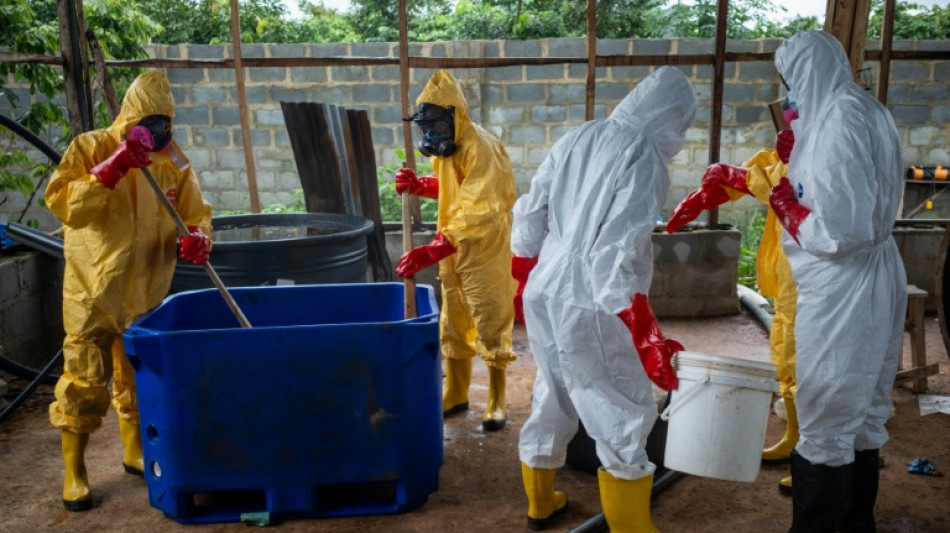
Mexican cartels target Australia with their African meth / Photo: © AFP/File

The Mexican "tourists" told immigration officers in Johannesburg they had come to see the "Big Five" of South Africa's game parks -- the elephants, rhinos, lions, leopards and buffaloes that draw millions every year.
But police believe they were really chemists sent by the Mexican Sinaloa crime cartel to set up an industrial-scale methamphetamine laboratory on a game farm near the country town of Swartruggens, one of at least seven discovered across southern Africa in the last two years, AFP has learned.
Investigators say the crystal meth lab is one of a network established by the Sinaloa cartel to supply Australia and New Zealand, the most lucrative meth markets on the planet, where prices are 65 to 100 times higher than in the United States.
The Swartruggens lab was capable of producing five tonnes of the highly addictive drug a month -- worth around $1 billion wholesale in Australia and much more on the streets -- when it was busted in May, they added.
Brigadier Devon Naicker, head of the South African Narcotics Enforcement Bureau (SANEB), told AFP that "in one specific case in Australia... we're looking at whether the methamphetamine came from the Swartruggens laboratory because it went through the port of Durban, and the way it was packaged."
He said the investigation is still going on, "which is why I can't disclose what methods we used to determine" that haul came from the farm two and a half hours northwest of Johannesburg.
South Africa is the "perfect place" to produce methamphetamine, a security source told AFP.
It has huge expanses to hide the labs, global sea and air connections and "corruption, which plays a big role", he said.
Nearly a third of the country's trade is with China and India, where the crucial and highly restricted chemicals used to make meth are sourced.
The Australian police confirmed that it had "identified increased targeting of Australia's illicit drug market by Mexican cartels".
But "due to operational sensitivities, we won't be commenting on Mexican cartels operating in South Africa," it added.
However, a seizure in January showed the drug is not just being smuggled in by sea, with a 32-year-old woman arrested at Sydney airport on a flight from South Africa with 39 kilogrammes (86 pounds) of powdered meth in her bags.
The Australia market is huge, with "methamphetamine the most consumed illicit drug" there after cannabis, according to a 2024 report compiled with the US Drug Enforcement Agency (DEA).
Police in both Australia and New Zealand have previously established that local chapters of the Comancheros biker gangs were sourcing drugs from the Sinaloa cartel.
- Tell-tale cartels trademarks -
Police are starting to uncover the supply chain the Sinaloa cartel has woven across southern Africa to feed Australian demand for the drug.
The same modus operandi is being seen in Nigeria, where four Mexicans have been arrested in busts of meth labs there so far this year.
But the numbers are far higher in South Africa, with 16 Mexicans arrested in swoops on labs since 2024.
The first lab bearing the cartels' hallmarks was discovered in the farming town of Marble Hall northeast of Johannesburg in 2020.
By the time the Swartruggens lab was raided in May, the sheer scale of the operation pointed strongly to the Sinaloa syndicate.
Five of the 13 people arrested were Mexican, all chemists, according to the police. They believe they began cooking crystal meth shortly after their arrival on three-month tourist visas in March 2025.
Two Mozambicans and a Zimbabwean were also held alongside four South Africans, three of them members of the Afrikaner family who owned the extensive game reserve.
The cartels "seem to approach farmers who are struggling" but not always, a source close to the case told AFP.
The Afrikaner family bought the game farm in 2024. The parents had been before the courts for renting out land where the hypnotic sedative mandrax (methaqualone) was being illegally made for the local market.
Meth labs are almost always found on isolated farms within easy reach of major roads, police say. The Swartruggens farm was close to the N4 national route.
- Meth labs' giveaway 'stink' -
They "need a continuous delivery of chemicals" to make the precursors "and you're also going to need to get your final substance away from the laboratory" quickly, said Naicker, who heads the drugs arm of the elite "Hawks" force.
That entails "multiple consignments that came in with these trucks," he said.
The Sinaloa cartel uses the so‑called P2P method, based on phenyl‑2‑propanone -- which was previously unknown in South Africa -- with chemicals imported from China and India, another investigator said.
"But making the precursors really stinks," Naicker told AFP. "You can smell it kilometres away if the wind's blowing in that direction."
Last month police seized five tonnes of the solvents, catalysts and reagents the cartels use in a raid on a lab at Musina on the border with Zimbabwe. This was carried out with help from the US Drug Enforcement Administration and the US Department of Homeland Security.
They had previously tracked a suspicious container that entered South Africa through the port of Durban in April 2023 to five storage units full of chemicals and equipment in Midrand, halfway between Pretoria and Johannesburg.
And earlier this month Naicker said they busted an industrial-scale lab which "looks like a Mexican set-up" at a farm in Klipvoor about 175 kilometers north of Johannesburg.
The large reaction tanks they found there -- each with a capacity of several hundred litres -- are further markers of the cartels, experts say. "This is industrial equipment, but handmade. You can't find it in any store," a source close to the investigation said.
"We think they bring in their own boilermakers to build all these kettles. That's how distinctive it is."
- Mexicans teaching the locals -
Naicker said "high-level" Mexicans often come in to set the labs up and "leave (other) Mexicans behind to run the thing -- chemist-trained individuals who understand the chemistry... to continue the manufacturing of methamphetamine."
In other cases they "would set it up, teach individuals how to go about doing the production, and only come up and check up on them.
"Locals would continue with the manufacturing like we found in the lab in Krugersdorp," which South African police dismantled in February 2024.
A security source said the Mexicans being caught "are at the bottom of the chain", like those arrested at Swartruggens in May, even though they were technically "knowledgeable".
The five told police that they were blindfolded and taken hostage when they arrived in South Africa. But an investigator poured scorn on their claims, saying they "were provided with anything that they wanted" to make their "stay comfortable".
"What kidnapper is going to give hostages... expensive food and booze?"
- Nigeria labs set up for export -
A worryingly similar pattern is being seen in Nigeria, where meth labs suspected of being linked to the Sinaloa and Jalisco New Generation cartels have begun to reappear a decade after the authorities thought they had driven the Mexicans out.
Like South Africa, Nigeria has vast tracts of remote country to hide labs and porous ports and airports through which to traffick merchandise.
The largest meth lab ever discovered there was raided in May in rural Ogun State, where three Mexicans accused of being linked to cartels and seven Nigerians were arrested.
Another Mexican was held in a raid in June in Oyo State.
"The industrial-scale production found in the two laboratories confirms that they were targeting the international market, especially Europe, Southeast Asia and Oceania," Femi Babafemi, of the National Drug Law Enforcement Agency (NDLEA), told AFP.
The lab in Ogun State was in a forest and locals in Abidagba and the neighbouring village of Iroto initially welcomed the outsiders.
"We heard rumours that they were going to build a housing estate there," said 59‑year‑old Florence Banjo. "I was happy they were finally going to pave the road that leads to our village."
- 'Lot of capacity to corrupt' -
Five of the 28 meth labs busted in Nigeria since 2016 have involved Mexicans, said NDLEA spokesman Babafemi.
He said the Mexicans first appeared a decade ago. "They came to transfer technical expertise to their local collaborators. After they were flushed out, the local collaborators took over."
Babafemi said the surge in cartel activity in Africa is partly because they are under pressure from the United States and Latin American governments.
"We need to be seriously concerned about the expansion" of the cartels "outside their main stronghold", said Vanda Felbab-Brown, director of the Brookings Institution's Initiative on Nonstate Armed Groups.
She said Africa is "a rife operating environment for the Mexicans, and they have a lot of capacity to corrupt individuals."
Their meth is more potent and lethal than the version of the drug that was traditionally smuggled into Australia by criminal groups from China and Myanmar, she added.
In Mozambique, once considered merely as a transit country for drugs, two Mexican nationals were arrested at Maputo airport in April. A large quantity of chemicals used to make meth were later found at the home of their suspected local accomplice.
- Blowback for Africa -
The large-scale production and transit of the synthetic drugs in Africa is also fuelling consumption there, worrying authorities across the region.
"Middlemen are often paid in drugs rather than cash alone and subsequently need to place that product within local markets," said Antonio De Vivo, head of the Maputo office of the United Nations Office on Drugs and Crime (UNODC).
Former drug addict Paulo Ferrao, 27, who works at a detox centre near Maputo, has seen the damage the crystal meth is already doing there.
"We're receiving more methamphetamine cases, which means heroin is no longer enough for the people behind drug trafficking," Ferrao said.
clv-nr-xx-sft/dp/fg
(L.Barsayjeva--DTZ)