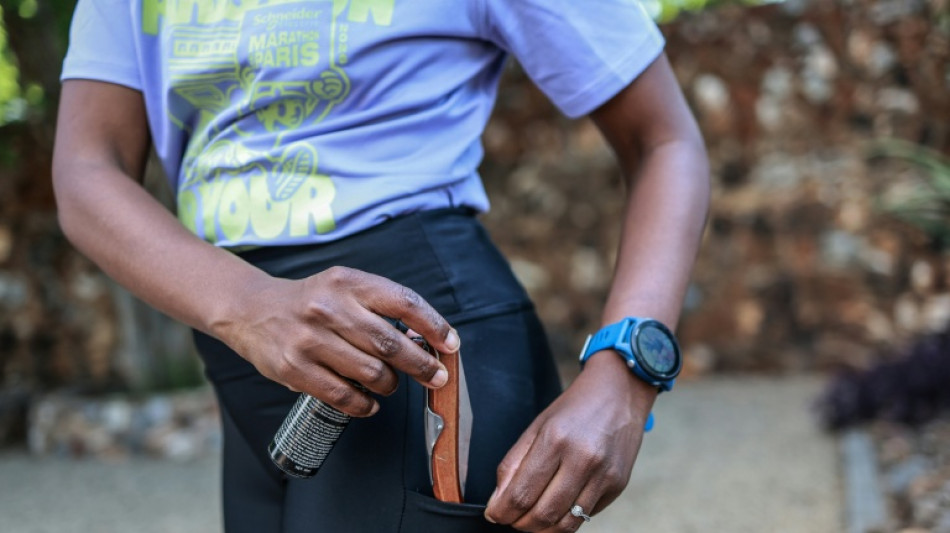
S.African women runners arm themselves after string of killings / Photo: © AFP

Before lacing up her running shoes, Nancy Masha checked the knife and pepper spray she carried to protect herself on her daily jog, a ritual born of fear after the murder of a fellow runner sent shock waves across South Africa.
Masha is among those taking extra precautions after nine women, including avid runner Elizabeth Moselakgomo, were found murdered in Johannesburg's East Rand in two months -- some of them partially naked and battered.
"Our runner was brutally killed. I needed a way to protect myself because I am a woman and also a runner," Masha, 39, who usually runs alone, told AFP.
Moselakgomo, 38, left home on September 9 for a run and never returned, leaving behind her eight-year-old daughter.
Her body was found three days later in the same area around Kempton Park where eight others were discovered since mid-July, prompting police to investigate whether a serial killer or killers were responsible, and fuelling anxiety and anger across the country.
Two days after Moselakgomo's body was found, Masha started carrying pepper spray and a knife on her daily runs.
"Her murder really traumatised me," the mother-of-two said. "We run in awkward spaces and at awkward times. But I won't stop running."
Masha said she had once taken part in a marathon with Moselakgomo, whom she described as "bubbly".
- National disaster -
The discovery of the bodies has triggered vigils, protests and solidarity runs across South Africa, drawing hundreds of people from Kempton Park to Cape Town to honour the victims and demand action to protect women.
Gender-based violence remains endemic in South Africa, despite years of government pledges to tackle the problem and its declaration last year as a national disaster.
The government said its 24-hour Gender-Based Violence Command Centre received 6,782 distress calls between September 1 and 16, averaging 424 a day, a 21-percent increase from the same period in August.
The killings have heightened concerns among women already accustomed to taking precautions in their daily lives.
Chulumanco Mahamba, 31, said since Moselakgomo's death she has cut back her daily walks to twice a week.
The discovery on September 20 in Johannesburg's Soweto area of another woman -- whose body was wrapped in a duvet -- made her question her routine.
Mahamba already carried pepper spray as a precaution. Now she avoids secluded routes and shares her live location with loved ones before leaving home.
She also sends photographs of what she is wearing.
"It feels unfair that we have to change our routines, but I do feel safer when I'm carrying pepper spray," she said.
But not all women feel comfortable carrying a weapon.
"We are not trained to use those things," said Hlompho Matji, 47, a data analyst and runner.
"It's also a risk to carry pepper spray because someone could overpower you and use it against you. The same goes for a knife. We don't know how to use them."
Babalwa Melitafa, 46, said she did not consider carrying weapons but preferred running only within a gated community's sports oval.
"I would not run outside the oval alone because of what has happened. I am scared," she told AFP.
- 'We want to live' -
Even in Cape Town, some 1,400 kilometres (870 miles) away, women said the killings had altered their routines.
Filmmaker Andiswa Siwela, 43, a runner and mountain hiker, said the killings had left her more suspicious of strangers.
Siwela said she had always carried her car keys to use as a weapon, but now also takes pepper spray, which she previously left in her car.
"We want to be free. We want to do things without fear; we want to live," she said.
Nkululeko Molosi, 47, captain of the Sunrise Athletics Club, said runners should not have to "choose between our passion for the sport and our personal safety".
South African police have so far arrested three people in connection with the Kempton Park killings, which they have not said are linked.
A man is in custody for one of the murders and two women have been charged over another.
But the arrests have done little to ease concerns.
Speaking at a public holiday gathering on Thursday, President Cyril Ramaphosa said the "pain and suffering that the women of South Africa have been put through stands out as a national shame".
"The women of South Africa have the right to walk the streets of their country at any hour without fear."
(A.Nikiforov--DTZ)