Spain leads calls for Covid-19 to be treated like flu

Spain is spearheading calls for governments to start tackling Covid-19 as any other endemic respiratory virus like seasonal flu, despite WHO opposition and warnings that the approach is premature.
With governments and populations worldwide desperate for an end to the pandemic, discussion about when the virus might be reclassified has intensified.
"Spain wants to lead this debate because it is timely and necessary to do so," Health Minister Carolina Darias has said, adding that Spain asked the European Centre for Disease Prevention (ECDC) to "study new strategies" to deal with Covid.
Spain is in a good position to open the debate, having one of the world's highest vaccination rates with 90.5 per cent of its population over the age of 12 fully immunised.
But the question has sparked disagreement between governments seeking some sort of normality and some parts of the medical community which advocate keeping its guard up.
Spain's left-wing government has been a prominent advocate of reclassifying Covid as an endemic disease with milder seasonal outbreaks that humanity can live with, like the flu.
The country is working with the scientific community to eventually shift from "managing a pandemic to managing a disease which we hope science will reclassify as an endemic illness", Spanish Prime Minister Pedro Sanchez said this week.
Although Omicron has triggered a surge in infections, there have been fewer deaths and lower rates of hospital admissions, with many governments easing restrictions, reducing isolation times and loosening border controls.
"As Covid becomes endemic, we will need to replace legal requirements with advice and guidance," British Prime Minister Boris Johnson said Wednesday, announcing that restrictions were being lifted in England.
Arguing "we must learn to live with Covid" in a similar way to seasonal flu, British Health Secretary Sajid Javid said the government would set out a long-term plan for living with coronavirus within months.
- 'False hope' -
On Tuesday, however, World Health Organization chief Tedros Adhanom Ghebreyesus insisted that the pandemic was "nowhere near over", warning that new variants were still "likely to emerge".
The UN health organisation also warned against the temptation to play down the seriousness of an endemic disease.
"Endemic in itself does not mean good -- endemic just means it's here forever," the WHO's emergencies director, Michael Ryan, told the Davos Agenda roundtable on vaccine equity, citing malaria as an example.
Fernando Garcia, an epidemiologist and the spokesman of a public health association, warned that talk of treating Covid-19 as an endemic illness at this stage was "creating false hope".
"We are indeed moving towards the virus becoming more endemic, but we cannot say we have already reached that status," said Marco Cavaleri, head of the European Medicines Agency's (EMA) vaccination strategy.
There is no numerical threshold that distinguishes between an epidemic and a disease which is endemic, Garcia told AFP.
"An epidemic is when there is a very significant outbreak of cases, above the normal, which is what we have experienced since the beginning of 2020," he said.
"And endemic diseases may have a seasonal trend but do not put pressure on the health system."
Nor is it a foregone conclusion that the virus will evolve to cause less harm.
- 'Mild symptoms' -
"Future severity remains a big unknown. There is no law dictating that a virus must become milder over time," Antoine Flahault, director of Geneva's Institute of Global Health, wrote on Twitter.
"It is very hard to predict the evolution of virulence."
When Covid-19 becomes endemic, "most people who become infected will have mild symptoms", Garcia said.
"There will be a few who suffer complications that mean they end up in hospital and die," he added.
"But you'll never see one in four intensive care beds occupied by Covid-19 patients, not even five percent of them. Cases will probably be handled by primary care."
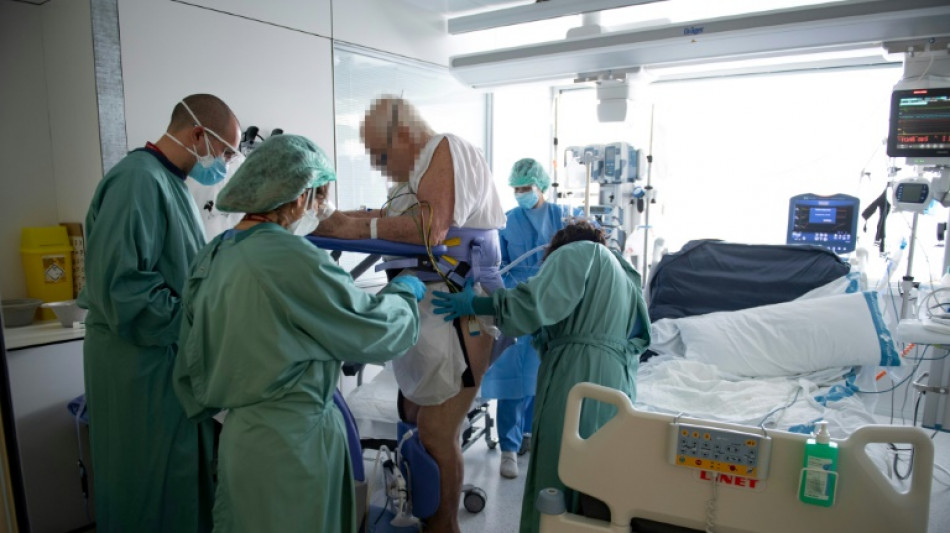
In Spain, more than 23 percent of intensive care beds are taken up by Covid patients and more than 91,000 people have died since the pandemic first took hold in March 2020.
Of that number, 2,610 died between December 17 and January 18.
Some healthcare professionals have backed the Spanish government's approach.
"Let's stop visiting and testing healthy people with mild symptoms, or tracking and testing their contacts, let's abandon self-isolation and quarantine," urged a recent article by SemFYC, which represents around 19,000 family medicine specialists.
"All these activities... have been rendered meaningless with acquired immunity (both through infection and through vaccination) and the arrival of Omicron," it said.
(M.Travkina--DTZ)