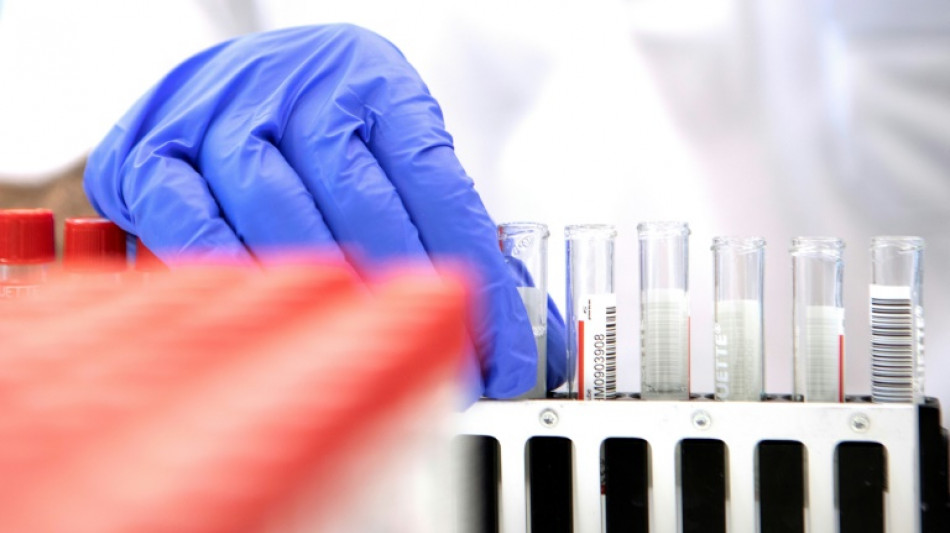
Chinese scientists say new highly accurate virus test gives results within minutes

Chinese scientists say they have developed a new coronavirus test that is accurate as a PCR lab test but gives results within four minutes.
Polymerase chain reaction (PCR) tests are widely considered the most accurate and sensitive for the virus that causes Covid-19, but they usually take several hours.
Some countries have experienced severe backlogs in the face of heavy testing demand, fuelled by the explosive spread of the highly transmissible Omicron variant.
Researchers from Fudan University in Shanghai say they have a solution.
In a peer-reviewed article published Monday in the journal Nature Biomedical Engineering, the team said their sensor -- which uses microelectronics to analyse genetic material from swabs -- can reduce the need for time-consuming Covid lab tests.
"We implemented an electromechanical biosensor for the detection of SARS-CoV-2 into an integrated and portable prototype device, and show that it detected (virus RNA) in less than four minutes," the team said in the paper, referring to the official name of the Covid pathogen.
The researchers said their method offers speed, ease of operation, high sensitivity and portability.
Their trial involved taking samples from 33 people in Shanghai who were infected with the coronavirus, with PCR tests conducted in parallel.
The results from their method were a "perfect" match with the PCR tests, according to the article.
Their study involved testing the new method on 54 samples, which included people with fever who did not have the coronavirus, those with influenza, and healthy volunteers.
Those cases did not yield any false positives, the team said.
The Fudan researchers said that once developed, their testing device can be used for quick testing in a variety of situations, including airports, health facilities and "even at home".
PCR tests are not only slow, but they also require lab infrastructure that can be limited in many countries, reducing the number of cases that can be handled each day.
And while rapid diagnostic tests have now become available in many parts of the world, they are generally less accurate.
China is one of the world's biggest makers of coronavirus test kits.
According to customs data, it exported $1.6 billion worth of test kits in December, a 144 percent increase from the previous month.
(L.Møller--DTZ)