Virus wave deepens grim conditions for Hong Kong domestic workers

Janice Obiang stifled sobs as she packed goods to send to the Philippines, gifts for loved ones she hasn't seen in years as life for domestic workers in virus-hit Hong Kong goes from bad to worse.
Few have suffered more during Hong Kong's pandemic restrictions than the hundreds of thousands of women from the Philippines and Indonesia who work as domestic helpers.
And as the city reels under its most severe coronavirus wave to date, many are now at breaking point.
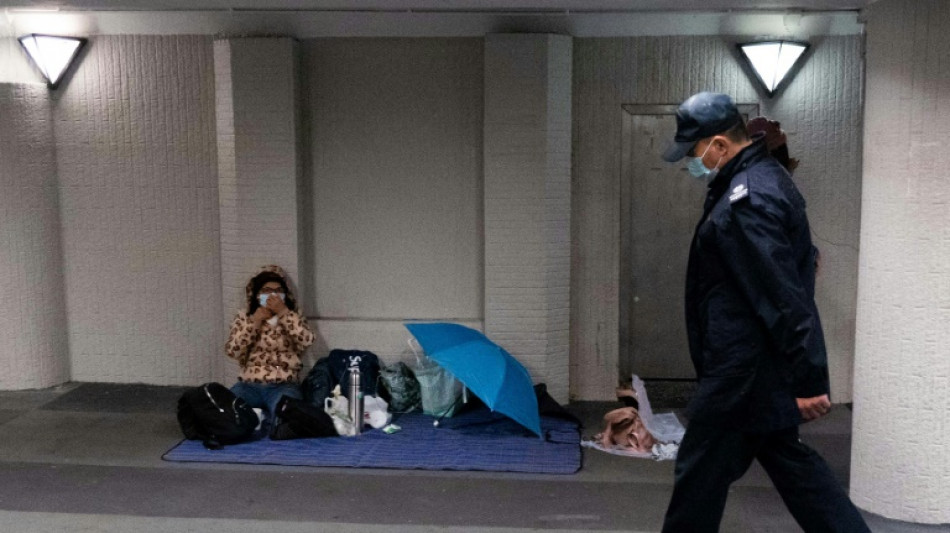
"I really want to move, I really want to have vacation," Obiang said, as a police officer with a megaphone gave regular reminders for people not to gather in groups.
"But I don't have a choice, we need to stay," the 36-year-old told AFP, adding it had been four years since she went home. "We really miss our family."
There are about 340,000 foreign domestic helpers in Hong Kong, down from 400,000 when the pandemic began.
Paid a minimum of HK$4,630 ($590) a month, they work six days a week and must live with their employers, in a city that offers some of the world's smallest apartments.
While the work is tough, it pays more than the women can earn in the Philippines, allowing them to support families as key breadwinners.
But the pandemic has made a hard job even harder.
For two years Hong Kong kept the coronavirus at bay with a strict zero-Covid policy and long quarantines, meaning most foreigners have not seen family for long periods.
The highly transmissible Omicron variant broke through at the start of the year but authorities have been ordered by China to return to zero-Covid despite the exponential caseload.
As a result, the government has taken to advising Hong Kongers to keep domestic workers inside during their one day off.
Police have also stepped up fines –- the equivalent of one to two months' salary for a domestic worker –- for breaching the current ban on any more than two people gathering in public.
- Sacked for falling sick -
Avril Rodrigues said her phone has not stopped ringing with stories of intensifying suffering and dismay.
"Imagine thinking 'I am not allowed to fall sick' out of fear of losing your job," Rodrigues, who works at the charity Help for Domestic Workers, told AFP.
But that is exactly what is happening to some.
She recalled one woman calling from outside one of Hong Kong's hospitals as they buckle under thousands of new infections each day.
"(Her employer) made her do a rapid test because she had a slight cold and when she went to the hospital, the employer told the agency to inform her 'Don't come back,'" Rodrigues said.
Multiple stories like this have emerged in local media or through press conferences arranged by increasingly infuriated charities and unions in the last fortnight.
Some had to sleep rough during an unusually cold winter snap, including one domestic helper with a young baby.
Last week Hong Kong's government issued a statement reminding employers they could not sack a domestic helper purely because they were sick, and could face fines.
- 'We need to feel like we are free' -
Lita, 34, who asked to use a pseudonym, said staying at her employer's home during her day off just meant working seven days a week given the coffin-like size of her room, which is not uncommon in Hong Kong apartments.
"You go in like a dead person, only to sleep," she said.
Jec Sernande, from the Federation of Asian Domestic Workers Unions, said many domestic helpers do not even have their own rooms.
"Sitting for the whole day in the kitchen or in the living room -- that is not a rest," she said.
Unionists like Sernande have long campaigned for better working conditions and are angered by the lack of compassion shown by authorities and some employers during the pandemic.
"They need to get more recognition, because they contribute a lot to the society and the economy," she added.
Charity services have been overwhelmed by requests for help partly because few plans were in place to deal with soaring cases when the disease eventually broke through.
Last week Philippine consul-general Raly Tejada said staff had helped dozens of nationals and that they were exploring possible legal options against those who fired helpers.
Domestic helper Bebeth, 54, described living in Hong Kong right now as "difficult and traumatic".
But she was adamant about one thing –- she will take her one day off outside.
"We need to go out, we need to feel like we are free outside, we want to inhale and exhale fresh air," she said.
(M.Dylatov--DTZ)