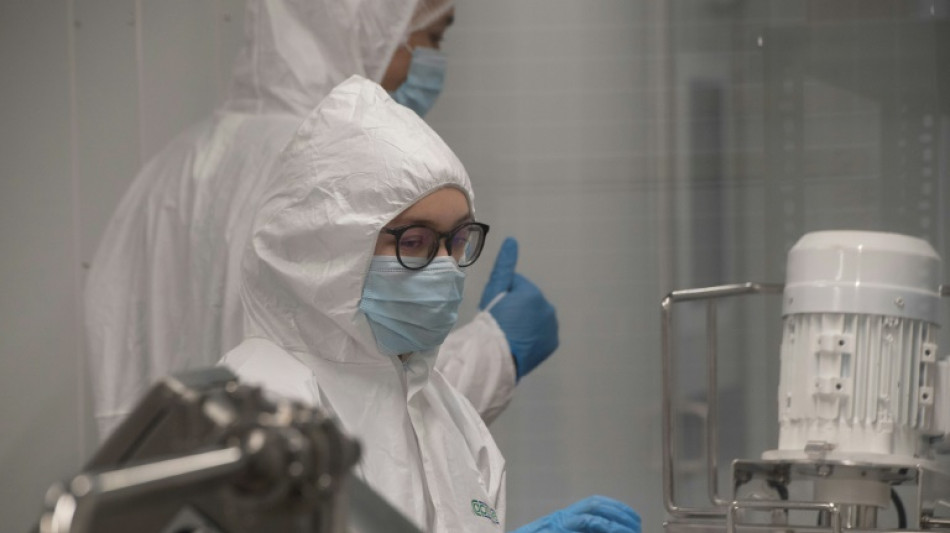
WHO hails Africa's first mRNA vaccine hub / Photo: © AFP/File

Africa's first mRNA vaccine hub was ceremonially launched on Thursday to acclaim from the UN's global health chief, who hailed it as a historic shift to help poor countries gain access to life-saving jabs.
The facility was set up in the South African city of Cape Town in 2021 on the back of the success of revolutionary anti-Covid vaccines introduced by Pfizer/BioNTech and Moderna.
"This precious project... will bring a paradigm shift in addressing the serious problem we faced, the equity problem, during the pandemic, so (that) it's not repeated again," World Health Organization (WHO) head Tedros Adhanom Ghebreyesus told a media briefing to mark the inauguration.
"At the time, South Africa and the rest of the developing world were at the back of the queue when it came to access to life-saving COVID-19 vaccines," said South Africa's science and innovation minister, Blade Nzimande.
The hub has already established mRNA vaccine production at laboratory scale and is currently scaling up and validating production of Moderna jabs at commercial scale.
The vaccine can be kept at relatively warm temperatures, making it easier to store in low- and middle-income settings where extreme refrigeration can be hard.
The hub's other role is to acts as a guide for manufacturers in poorer countries, helping them to gain the know-how to make mRNA vaccines in large quantities and in line with international standards.
The Covid-19 pandemic which erupted in early 2020 exposed Africa's huge dependence on imported vaccines.
Little more than 50 percent of the continent's 1.2 billion people are fully inoculated against coronavirus, according to the Africa Centers for Disease Control and Prevention (CDC).
Vaccines using mRNA provoke an immune response by delivering genetic molecules containing the code for key parts of a pathogen into human cells.
The Covid-19 pandemic provided a crucial testbed for the fledgling technology, demonstrating how a safe and effective vaccine could be created at lightning speed compared with years for traditional vaccines.
Set up with WHO support, the Cape Town project is run by South African bio-pharmaceutical company Biovac, biotechnology firm Afrigen and the South African Medical Research Council.
The hub has the potential to expand manufacturing capacity for other vaccines and products, such as insulin to treat diabetes, cancer medicines and, potentially, vaccines for diseases such as malaria, tuberculosis and HIV.
Funding to date stands at $117 million, with support mainly from the European Union, France, Germany and Canada.
(P.Vasilyevsky--DTZ)