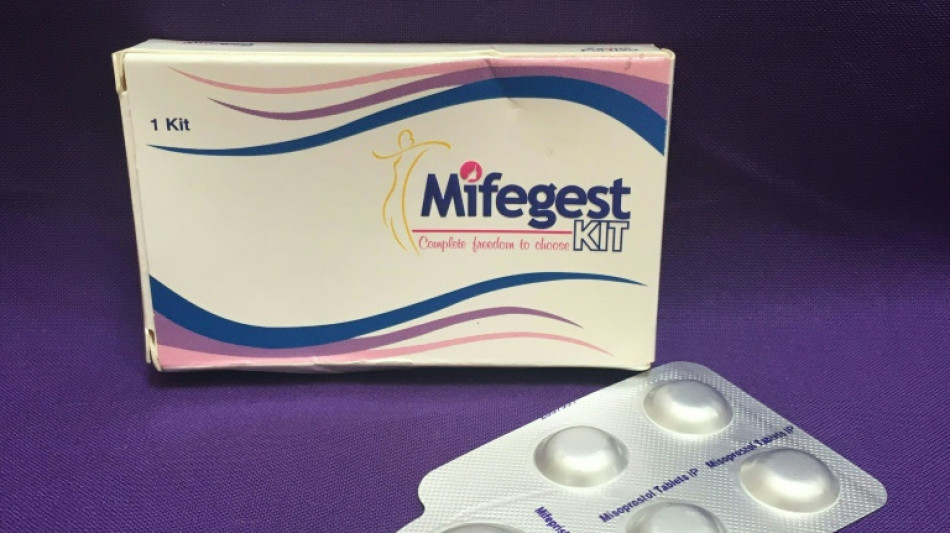
The abortion pill at the center of a US court battle / Photo: © PLAN C/AFP/File

The US Supreme Court has weighed in on the legal battle over an abortion pill that accounts for more than half of the abortions in the United States, freezing restrictions imposed on the drug by an appeals court.
Here is background on the drug, mifepristone, and its use:
- How widespread is abortion pill use? -
According to the Guttmacher Institute, the pill accounted for more than half -- 53 percent -- of the 930,160 abortions documented by the reproductive health research and policy organization in the United States in 2020.
That was up from 17 percent in 2008 and 39 percent in 2017.
While the number of so-called medication abortions has gone up dramatically in the United States in recent years, it is still not as prevalent as in several European nations.
In France, for example, medication abortions represented 70 percent of the total number of abortions in 2020.
- How does it work? -
The abortion pill is different from the "morning after" pill, which is taken by a woman after sexual intercourse to prevent becoming pregnant.
The abortion pill is taken to induce an abortion once a woman confirms that she is pregnant.
The process in fact involves more than one pill. The first, mifepristone, also known as RU 486, stops a pregnancy from proceeding normally by blocking production of the hormone progesterone.
Another drug, misoprostol, is taken up to 48 hours later and causes cramps, bleeding and the emptying of the uterus.
Abortion pills can be used at home and a medical setting is not required.
- When was the abortion pill approved? -
The US Food and Drug Administration (FDA) gave the green light to mifepristone and misoprostol in 2000 for use up to seven weeks of pregnancy.
It was later approved for use up to 10 weeks of pregnancy, after which a woman would need to undergo an abortion through other means, such as vacuum aspiration.
A group opposed to abortions has challenged the FDA's approvals of mifepristone in federal court in Texas.
The average cost of a medication abortion at Planned Parenthood is $580 but it can cost up to $800.
- Is it safe and effective? -
Use of the abortion pill during the specified time period is considered to be safe and effective by medical experts.
Pregnancies are successfully terminated in more than 95 percent of cases where the pill is used, according to studies.
Serious complications -- excessive bleeding, fever, infection or allergic reaction -- which require a medical consult, are rare.
The abortion pill does not work for ectopic pregnancies, which account for around two percent of all pregnancies and where a fertilized egg grows outside the uterus.
- Where is the pill available? -
At least 13 US states have banned most abortions, including medication abortions, since the Supreme Court's ruling in June 2022 overturning the constitutional right to an abortion.
Despite the bans, a number of organizations have mobilized to provide abortion pills to women in states where abortion is restricted.
The extent of their efforts is difficult to evaluate.
In the states where abortion is legal, the FDA recently loosened restrictions surrounding mifepristone, allowing it to be sent through the mail with a prescription or to be sold directly in pharmacies like any other drug.
(O.Zhukova--DTZ)