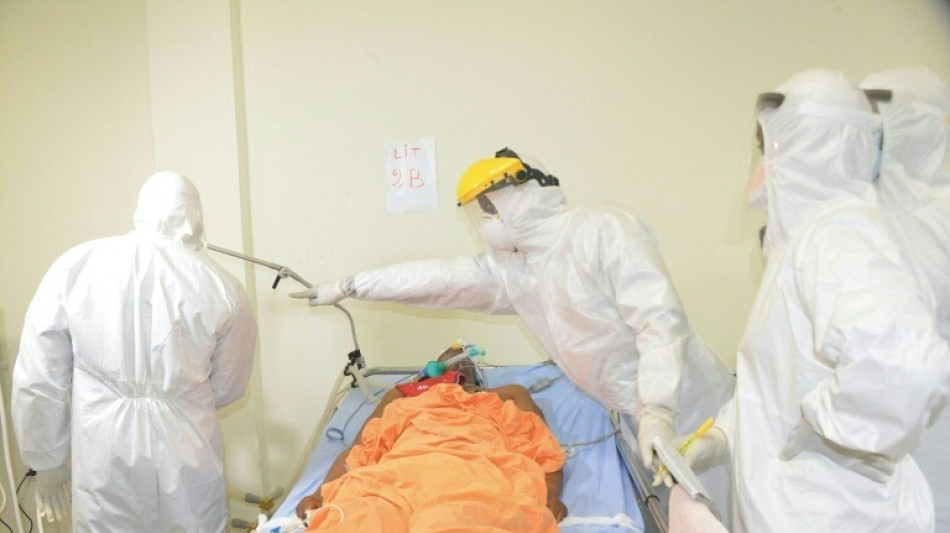
WHO declares end to Marburg virus outbreak in Equatorial Guinea / Photo: © AFP/File

The UN's health agency on Thursday declared an end to a nearly four-month epidemic of Marburg virus in Equatorial Guinea, saying the disease, a cousin of Ebola, had caused 35 confirmed or suspected deaths.
"The outbreak of Marburg Virus Disease in Equatorial Guinea ended today with no new cases reported over the past 42 days after the last patient was discharged from treatment," the World Health Organization (WHO) said in a statement.
The highly virulent microbe causes severe fever, often accompanied by bleeding and organ failure.
It is part of the so-called filovirus family that includes Ebola haemorrhagic fever, which has caused several deadly epidemics in western and central Africa.
The outbreak, declared on February 13, was the first of its kind in Equatorial Guinea, a small coastal state in central-western Africa.
"A total of 17 laboratory-confirmed cases and 12 deaths were recorded. All the 23 probable cases reported died," the WHO said.
"Four patients recovered from the virus and have been enrolled in a survivors programme to receive psychosocial and other post-recovery support," it added.
The statement paid tribute to local health workers and support by partner organizations for the "hard work" in tackling the outbreak, much of which entails tracing and isolating people in contact with patients.
- Tanzania outbreak -
The epidemic in Equatorial Guinea coincided with an outbreak of Marburg on the other side of the continent, in Tanzania. Six people died in a two-month episode, which was formally declared over on June 2.
The first outbreak of Marburg in Africa was recorded in South Africa in 1975.
Outbreaks or sporadic cases have been also reported in Kenya, Angola, Ghana, Guinea, the Democratic Republic of the Congo and Uganda, as well as Equatorial Guinea and Tanzania this year.
The suspected natural source of the virus is the African fruit bat, which carries the pathogen but does not fall sick from it.
Fatality rates in confirmed cases have ranged from 24 percent to 88 percent in previous outbreaks, depending on the virus strain and case management, according to WHO.
There are currently no vaccines or antiviral treatments, but potential treatments, including blood products, immune therapies and drug therapies, as well as early candidate vaccines, are being evaluated.
The virus takes its name from the German city of Marburg, where it was first identified in 1967, in a lab where workers had been in contact with infected green monkeys imported from Uganda.
(A.Nikiforov--DTZ)