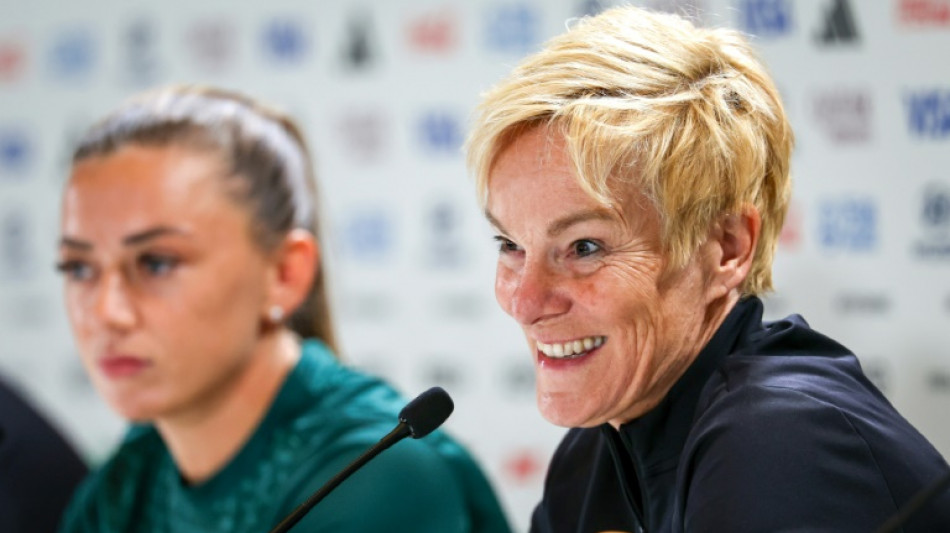
Up at 3:00 am: World Cup players in losing battle with jet lag / Photo: © AFP

Every long-distance flyer knows how debilitating jet lag can be, but now imagine you need to train right away and then play in a football World Cup.
Even the stars of the Women's World Cup are not immune to the dreaded jet lag, so teams flying over to Australia and New Zealand have come up with a variety of ways -- some novel, others less so -- to try to combat it.
"Time for the chrono glasses. Doing our best to beat the jet lag," European champions England tweeted prior to their more than 10,000-mile (16,000-km), 22-hour slog to Australia. At least they were in business.
The smiling players were pictured wearing futuristic-looking glasses with orange lenses.
The shades were light glasses designed by the Dutch-based company Propeaq and designed to trick the eyes to encourage or discourage sleep.
The Lionesses had a pre-tournament briefing on how to combat jet lag, including what steps to take before flying halfway across the globe to Australia, according to The Times.
Teams flying off for the World Cup have come up with their own methods in an effort to get their players on the training pitch and raring to go as soon as possible after touching down.
Ireland's Dutch coach Vera Pauw came up with a "jet-lag protocol".
With the Irish playing on the opening day of the World Cup on Thursday, against co-hosts Australia, they had no time to lose.
The Irish squad initially trained according to their Irish body clocks, before gradually moving the sessions towards Australian time, according to the Irish Mirror.
"We started at 11 in the middle of our night, then 12, then 2, now at 4 and then tomorrow at 6," Pauw was quoted as saying.
"And there are also light glasses, but the doctor showed there is no evidence and we want to just keep things simple," she added.
- 'Trying to hang on' -
For some players, it has just been a case of lying in bed and waiting for sleep to finally come.
French defender Sakina Karchaoui spent a week trying to adjust to the eight-hour time difference between home and Australia.
"At first we slept two or three hours, we got up at 3:00 am, it was tricky," she said.
When she finally did sleep properly, she got 10 hours, and was delighted.
The French team brought in an expert prior to the World Cup in an attempt to alleviate the problem.
Mounir Chennaoui, a researcher specialising in sleep and fatigue, said: "Eight time zones apart is eight days of adaptation."
The French players were told to start preparing one week before departure by going to bed and getting up 15-30 minutes earlier every day.
They were then told to get on Australian time as soon as they were on the plane for the long journey over.
France, one of the favourites to win the World Cup, looked far from their energetic best as they were beaten 1-0 by Australia in a Melbourne friendly on Friday.
"I'm not looking for excuses, but there are still some sleeping problems," their coach Herve Renard said, the team having arrived in the country five days earlier.
Norwegian defender Maren Mjelde has taken a more traditional approach -- attempting to stay up as long as possible and resist the temptation for an afternoon nap.
"It's about trying to hang on, find things to do, play games or read a book or solve a crossword or that kind of thing," she said soon after Norway landed in New Zealand more than 10 days ago.
Fully rested or not, Norway kick the World Cup off on Thursday when they face New Zealand in Auckland.
(W.Budayev--DTZ)