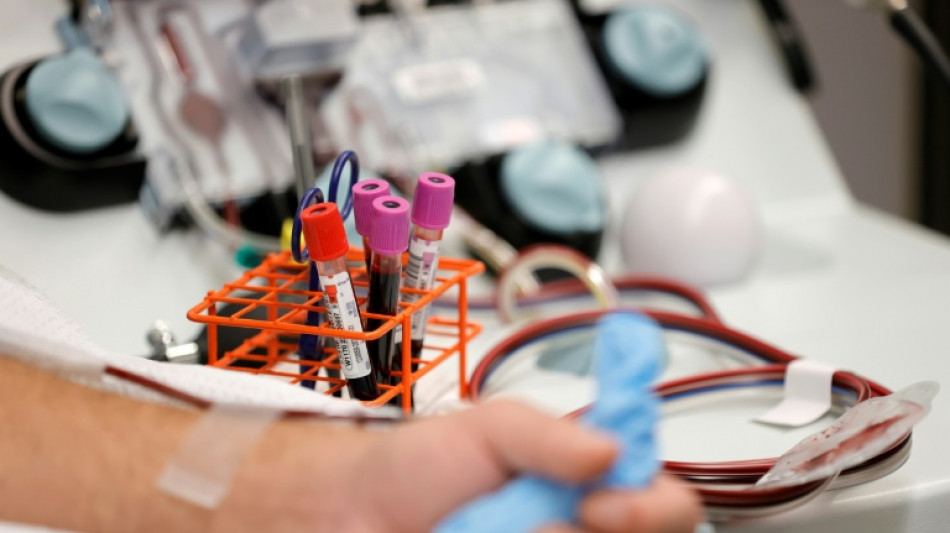
American Red Cross ends blood donation restrictions targeting gay men / Photo: © GETTY IMAGES NORTH AMERICA/AFP/File

The American Red Cross on Monday announced it will now allow gay and bisexual men to donate blood without restrictions that specifically target them over their sexual orientation.
"The Red Cross celebrates this historic move as significant progress and remains committed to achieving an inclusive blood donation process that treats all potential donors with equality and respect while maintaining the safety of the blood supply," the humanitarian organization said in a statement.
The policy change follows updated guidance announced by the US Food and Drug Administration (FDA) in May, and is set to expand the pool of people eligible to donate.
Under the FDA's new individual assessment policy, all prospective donors are asked about new or multiple sexual partners in the past three months.
If they report having a new sexual partner, or more than one sexual partner in the past three months, they would be asked if they had anal sex in the past three months. If the answer to the last question is yes, they would then be asked to defer their blood donation.
Penetrative anal sex has a higher risk of spreading many types of sexually transmitted diseases, because the thin lining of the anus is easily damaged, making it more vulnerable to infection.
The new rules replace policies that singled out men who have sex with men (MSM), or women who have sex with MSM, for time-based deferrals.
Andrew Goldstein, a cancer researcher from Los Angeles who was a regular blood donor in his younger years before the FDA's previous policies made him ineligible to donate as a gay man, welcomed the move.
"Something like giving blood feels like something so small that you can do, and it means a lot to me that I'll be able to do that again," said Goldstein, who participated in a clinical study in 2021 that paved the way for the new guidance.
Every two seconds, someone in the United States requires blood or platelets, whether for surgery, cancer treatment, chronic illness or traumatic injuries, according to the Red Cross.
"Whether a patient receives whole blood, red cells, platelets or plasma, this lifesaving care starts with one person making a generous donation," it says.
(S.A.Dudajev--DTZ)