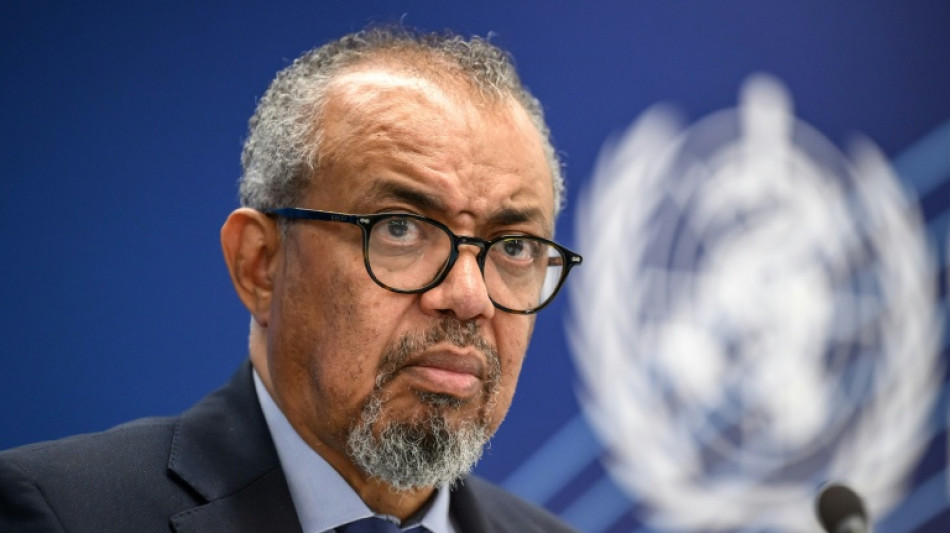
WHO says cannot conduct full risk assessment on Russia plague reports / Photo: © AFP

The World Health Organization said Wednesday it could not produce a full risk assessment as it did not have the whole picture from Russia on the suspected plague death of a laboratory technician.
The WHO, the United States and the European Union have all urged Moscow for more information after the death of the 28-year-old woman, who worked at the Irkutsk Anti-Plague Research Institute in Siberia.
"The lab worker died after being hospitalised with severe pneumonia. Initial media reports suggested pneumonic plague following an accidental lab exposure," said WHO chief Tedros Adhanom Ghebreyesus.
"WHO is aware that the Russian government held a meeting on October 2 because they suspected a resident of the Irkutsk oblast (region) had contracted a dangerous infection," he told a press conference.
Tedros said the WHO asked Moscow for more information on Saturday, in accordance with the International Health Regulations.
The IHR provide a legally binding framework defining countries' rights and obligations in handling public health events and emergencies that could cross borders -- and countries are asked to respond within 24 hours.
Russia responded -- on Tuesday -- saying no plague case had been reported in the Irkutsk region and that around 200 contacts had been quarantined.
The WHO has asked for more information on the lab tests conducted on the fatality, on the contacts, and details on their health status, said Tedros.
"We don't yet have the full picture of this event and we're not able to conduct a full risk assessment," he stressed.
"Timely, complete and transparent information sharing under the international regulations is essential to clarify conflicting reports and enable an accurate assessment of potential public and risks."
- 'What did she die from?' -
Maria Van Kerkhove, the WHO's director of epidemic and pandemic management, added: "We don't understand how she was infected."
If pneumonic plague "is ruled out, what did she actually die from?", she said.
Van Kerkhove said the UN health agency wanted to know what tests were done, the specifics of the results, and what further analysis was being done if the cause of death was not yet known.
Furthermore, "what contacts were put under quarantine or under follow-up; what did that involve; if the quarantine period is over?", she said.
As to whether Moscow should have provided more information, she said: "The simple answer is always: yes."
- 'Community-acquired' infection -
Silviu Ciobanu from the WHO Europe office's public health intelligence alerts and reponse operations unit, said that "given the timeline given in IHR is 24 hours, obviously it's not OK.
"The sooner we get information, the better the outcome."
Moscow has said the woman died from a community-acquired severe pneumonia of unknown origin, he added.
Van Kerkhove said there were people whose deaths were ascribed to unknown causes of pneumonia, but there were now laboratory methods that can determine the causative agent, such as PCR testing and genetic sequencing.
Community-acquired infection "would mean outside of the lab", she added.
Russia warned Wednesday against "false" information as reports emerged of a second suspected case of plague, with its health agency saying it had determined there were "no epidemic risks for the population".
Tedros said he wanted more clarification from Moscow following two media reports of "a second employee with pneumonia of undetermined cause".
"We asked Russia to respond to that... because any reporting that comes, we cannot ignore it," he said, adding "I hope we will get an answer to that, formally."
Between 2019 and 2025, 10 countries reported suspected human plague cases to the WHO, six of which reported confirmed cases.
Overall, 3,847 suspected cases and 423 deaths were reported, giving case fatality rate of 11 percent.
(U.Stolizkaya--DTZ)