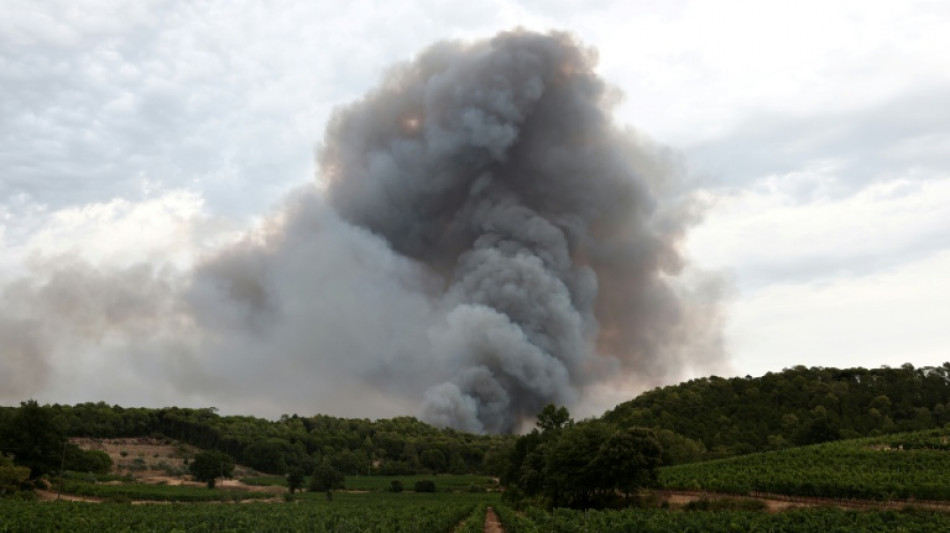
French winemakers dread 'smoky taste' after wildfires / Photo: © AFP

Brushing his hand over crackling vine leaves, French winemaker Gregory Guibergia was relieved a wildfire only scorched the edge of his vineyard but he feared its smoke would ruin this year's vintage.
In the last row of his fields in southeastern France, the wind rustled through the brown leaves of vines that overheated during a blaze that swept the region this summer.
But plants further away were largely intact, with enough green leaves for their grapes to continue to mature in time for harvest next week.
Guibergia said he was lucky after several wildfires in the surrounding Var region in recent weeks, which sent thousands of people fleeing -- including Hollywood star George Clooney and his family -- and destroyed more than 6,000 hectares (15,000 acres) of land.
But "the big question is whether or not we will have a burnt taste during the wine making", Guibergia told AFP.
"We won't know straight away."
He is one of many winemakers to be worried in France's main rosé-producing region, where flames have destroyed hundreds of some 30,000 hectares of vineyards, according to expert estimates.
Guibergia, who has been in the business for 25 years, said he planned to pick the grapes and turn them into wine in several separate batches to help limit damage from any contaminated fruit.
But he still dreads the possibility the product of his 25-hectare vineyard in the village of Correns could be declared undrinkable, and that he'd be unable to sell some 90,000 bottles.
- Lab tests -
In the surrounding region, experts have been testing grapes to see if they are still fit for wine.
"An hour or two of exposure is enough to trigger glycosylation, or the binding of smoke to the sugars in the grapes," said oenology consultant Clement Prelat, who is advising winemakers in the area.
"This smoky taste will only reveal itself after fermentation."
Lucie Demirdjian, another winemaker in the neighbouring village of Ponteves, was among those waiting for results from the laboratory before harvesting.
She said he had lost 11 of her 18 hectares in a wildfire, and didn't want to spend any money on harvesting surviving vines if the wine would be tainted.
"We know what to do for frost or hail, but not wildfires," she said.
At least, "we can detect the precursor of the smoky flavour beforehand".
- 'Smoked ham' -
Agricultural engineer Gregori Lanza said so far only vineyards that firefighting planes covered in retardant -- a chemical mixture used to stem the spread of a blaze -- have been declared unfit for winemaking so far.
The smell of burnt wood combining with grapes for smoky wine would not necessarily make it unfit for consumption, but it would likely compromise sales, he said.
"It's not a sought-after taste in wines, so even if they're still drinkable, they won't be marketed," he predicted.
Fabien Mistre, from the Correns winemaking cooperative, said winemakers in another part of southern France had tested some techniques to save their produce after a wildfire last year.
"Activated charcoal can remove the smoky taste from rosé and white wine," he said.
He said he was hoping his organic wine would emerge intact after the fires, but was waiting for the end of the winemaking process to be sure.
Even if insurance did not cover business losses linked to a change in taste, he would not sell his wine if its aroma was burnt.
"It would be like smoked ham," he said.
(M.Travkina--DTZ)