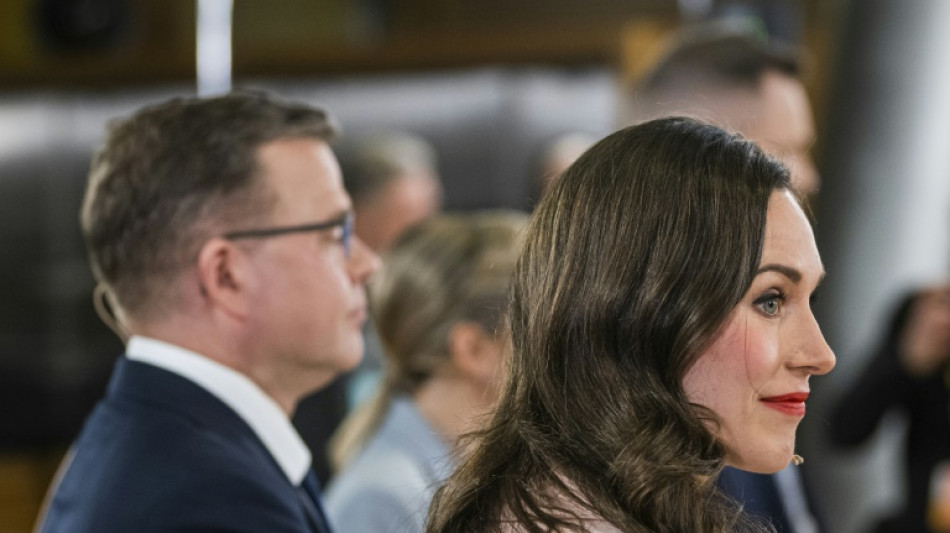
Centre-right looks set to unseat Finnish PM in close election / Photo: © AFP

Finland's centre-right looked on track to win Sunday's general election, a projection showed with 70 percent of votes counted, beating out the far-right in second and Prime Minister Sanna Marin's Social Democrats in third.
Marin, who became the world's youngest prime minister in 2019 at the age of 34, has been fighting to stay in office just days before Finland's historic accession to the NATO defence alliance.
The projection by public broadcaster Yle showed the centre-right National Coalition Party winning 48 mandates in the 200-seat parliament, ahead of the anti-immigration Finns Party's 46 seats and Marin's Social Democrats (SDP) 43.
"If this is correct, then this is a very strong victory," National Coalition leader Petteri Orpo told public broadcaster Yle.
The biggest party in parliament traditionally gets the first chance to build a government, and since the 1990s that party has always claimed the prime minister's office.
Riikka Purra, the leader of the populist Finns Party whose support has surged since last summer with the cost of living crisis following Russia's invasion of Ukraine, was meanwhile cautious.
"This is a forecast, so let's take it that way, but it's an excellent result," she said.
Marin, who has struggled to convert her overwhelming popularity into support for her SDP, said she was holding out hope for a turnaround.
"There is still an election night ahead, let's see it through until the end," she said, adding: "I am very grateful that people have voted in droves for the Social Democrats."
With 80 percent of votes counted, the Finns Party and the National Coalition were tied at 20.2 percent of the vote, slightly ahead of the Social Democrats at 20.0 percent.
- 'Rock star's days are over' -
Marin is Finland's most popular prime minister this century, according to polls, and has made headlines internationally for her hard line against Finland's eastern neighbour Russia.
She is a popular speaker at the World Economic Forum in Davos and has been featured on the cover of Time Magazine and in Vogue.
Yet while some view her as a strong leader who deftly navigated the Covid-19 pandemic and the NATO membership process, others see the rising public debt on her watch and backlash over video clips of her partying as signs of inexperience.
As a result, her SDP party has struggled to gain wider support.
"I liked Marin... but I don't personally believe that her ideas about economic policy are something she and her government can actually achieve," 29-year-old Kasper Kylmala told AFP after casting his ballot.
Antti Piispanen, a 30 year-old salesman, put it more bluntly: "The 'rock star' Marin's time is over, she did nothing good."
Finland's debt-to-GDP ratio has risen from 64 percent in 2019 to 73 percent, which Orpo's National Coalition wants to address by cutting spending by six billion euros ($6.5 billion).
Yet Marin rejuvenated her greying party, with her appeal strongest among women.
- Tough talks ahead -
A top spot for the Finns Party, and a far-right prime minister, would be a first in Finland.
The eurosceptic party, which appeals overwhelmingly to male voters, was hoping to beat its record 19.05 percent score from the 2011 election.
It wants a hard line on immigration, alleging that recent arrivals are behind a rise in street gangs and pointing to neighbouring Sweden as a cautionary tale.
Negotiations to build a government are expected to be thorny and could last several weeks.
Marin has ruled out forming a government with what she calls the "openly racist" Finns Party, while Orpo has said he will keep his options open.
His National Coalition is at odds with Marin's SDP on budget austerity, and clashes with the Finns Party on immigration, the EU and climate policy.
The Finns Party sees "Fixit" -- an exit from the European Union -- as a long-term goal and wants to postpone Finland's target of carbon neutrality for 2035.
This gives Orpo a central role in forming the next government, as both the Finns Party and the SDP would probably need him to obtain a majority.
Voter turnout was 72 percent, the same as in 2019.
(W.Uljanov--DTZ)