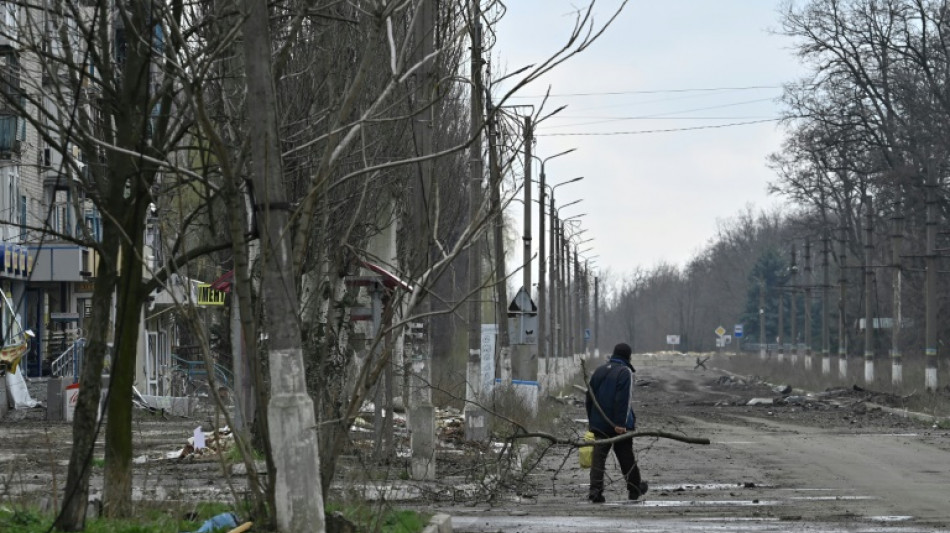
'They took my grandson': frontline Ukraine town evacuates children / Photo: © AFP

Kateryna's blue eyes fill with tears as she tells how police ordered her grandson to evacuate from the frontline town of Avdiivka in Ukraine, where she lives in a cellar.
Police are forcibly evacuating any children left as the Russians bombard the town from three sides and the mayor says not a single building remains undamaged.
"They took my grandson, he's 15," says 64-year-old Kateryna, sitting in an underground shelter recently opened for residents in the eastern town.
"They've started evacuation by order and they took him. He didn't want to leave and his mum didn't want to leave. Home is home, although they also lived in a cellar."
Kateryna says she does not know where her grandson ended up due to problems making telephone calls. He was going to a nearby town before being taken further away.
She admits he may be better off, however.
"Maybe I'm even glad. Maybe it's better there. They fire here and you can't sleep at night."
Avdiivka's mayor Vitaliy Barabash said Monday he knew of eight children still in the town, accusing parents of "hiding" them.
"We will pick them up and take them away," he vowed.
- 'Living in this hell' -
The organiser of the newly opened shelter for residents, Mykhailo Puryshev, says police evacuated two children on Monday, each accompanied by a parent.
The 37-year-old is well-known for evacuating people from his home city of Mariupol until it fell to the Russians.
He has set up similar shelters in the war's worst hotspots.
He estimates just over 2,000 people remain in Avdiivka, which is close to Russian-occupied Donetsk and encircled to the east, south and west by Moscow's forces.
He has little patience with families staying with their children, whom he calls "hostages of their parents".
He points to a missile strike that killed a five-month-old boy and his grandmother and says children living in cellars sometimes "don't see the sky for three months".
A few steps down from street level, the large shelter he runs is bustling with locals and volunteers.
Organisers dug a 40-metre well to access water for showers and washing machines. There is even a hairdressing service.
"When you turn on a tap and water flows out, it's magic for people," says Puryshev, "because they have been living in this hell for a year".
- 'Will we survive?' -
One man, Sergiy, 68, removes his fur hat and winter coat to reveal matted hair and long-unwashed clothing as he is helped into a shower.
He emerges clean and heads for a haircut.
Two retired women sit watching their clothes swirling in the washing machines.
Apart from shelling and dogs barking, Avdiivka is a ghost town and eerily quiet. There is almost no sound on the streets of the town where more than 30,000 used to live.
A few passing vehicles carry soldiers. The air smells of coal smoke from stovepipes sticking out of cellars.
One soldier likens Avdiivka to "Chernobyl", the town in northern Ukraine devastated by a nuclear accident in 1986.
Lyudmyla, 66, is busily chopping branches for the stove in the cellar where she lives with six others.
She says she is "constantly tense and afraid, not knowing what will happen: will we survive, will we not survive?"
"Everyone has got much thinner and greyer," she says.
- 'Too scary' -
"We sit in the cellar because it's too dangerous to be in a flat."
She has heard she can wash clothes at the new shelter, a 10-minute walk away, but has not yet ventured over.
"So far, it's too scary to go there," she says, as an explosion rings out.
Avdiivka no longer has state services such as an ambulance or rescuers.
In the central hospital, two remaining doctors say they can offer only basic treatment and stabilise seriously injured patients, who must be evacuated by police or volunteers.
The lone surgeon, Mykhailo Orlov, says civilians get hit by shrapnel, bullets and exploding mortars.
They suffer "open traumatic brain injury, penetrating chest and abdomen wounds (and) injuries to upper and lower limbs", he says.
Medical director Vitaliy Sytnyk opens the door of one of the abandoned wards, dislodging newly cracked glass.
"That's the latest (damage)," he comments sadly.
"And we put so much effort and money into renovations."
(S.A.Dudajev--DTZ)