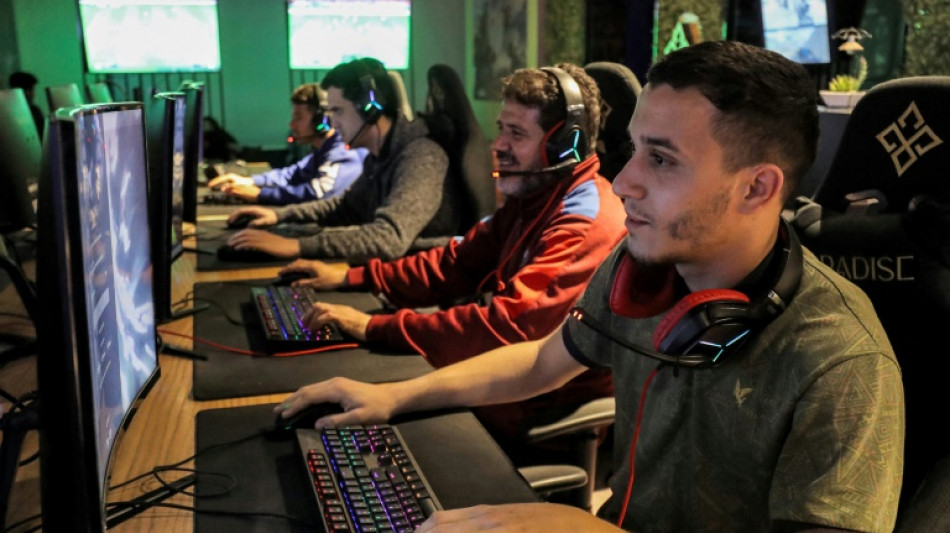
Young Libyans finally able to answer call of e-gaming / Photo: © AFP

In a Tripoli arcade, players banter amid the bleeping and music of video games. Isolated by decades of dictatorship and post-revolution chaos, Libyan gamers are finally taking on the world.
It's late at night in the Muslim holy month of Ramadan, and in the suburb of Tajoura, teenagers with headphones clamped to their ears gaze into state-of-the-art screens in the ultra-modern gaming complex.
One sits behind a steering wheel, racing a car. Others make their way through virtual worlds, huge 3D glasses covering their faces.
Such a space would have been unimaginable a few years ago in the North African country.
Unlike in other Arab states, "the gaming community was completely dead here" until recently, says Sofiane Mattouss, who runs the business set up in 2022.
Gaming industry experts say the Middle East and North Africa are high-growth regions, with Saudi Arabia, the United Arab Emirates and Egypt among the largest markets.
Libya lags behind, having seen little investment in technology or entertainment during the 42-year rule of autocrat Moamer Kadhafi, whose toppling in a 2011 revolt marked the start of a violent decade-long power struggle.
But as that isolation has ended, Libyans have shown "high demand" for places where they can finally play together and take part in tournaments, Mattouss says.
At just 18, the computer science student only recently began working at the centre, putting an end to years of frustration playing on outdated university computers.
More than a decade since Kadhafi's death, new pastimes and private sector investment are surging into Libya, which even launched an e-sport federation in 2018.
- Epic electronic battles -
Six gaming halls have already sprung up in the capital, with others in major cities such as Benghazi.
In Tajoura, comfortably installed on beanbags or perched on stools, rowdy students play football or engage in epic electronic battles.
In skinny jeans and a white jacket, Youssef Younssi trades wisecracks while playing a game on a giant screen.
The 20-year-old student was used to playing in small arcades in Tripoli and had "never seen" such modern spaces in Libya until recently.
Now back on holiday from studying in Turkey, Younssi says he regularly visits big gaming halls in Istanbul.
"In other countries, when I travel, they are everywhere but I didn't expect to see so many people interested in it here," he says.
Tripoli's mushrooming arcades have driven rapid growth in Libya's nascent gaming community, Mattouss says.
The increasingly organised community is "motivating players and pushing other young people without experience to start training".
He predicts that the sector will continue developing quickly.
While some in this conservative society criticise video games, Mattouss argues that unlike dictatorship and chaos, they have not destroyed Libya's youth.
E-sport gives them a purpose, which is better than "hanging around outside doing nothing", he says.
Player Karim Ziani, 20, puts down his headphones and declares that the growth of e-sport is "a good thing, even for the development of the country".
"I hope it grows, for the good of the youth and society."
(U.Stolizkaya--DTZ)