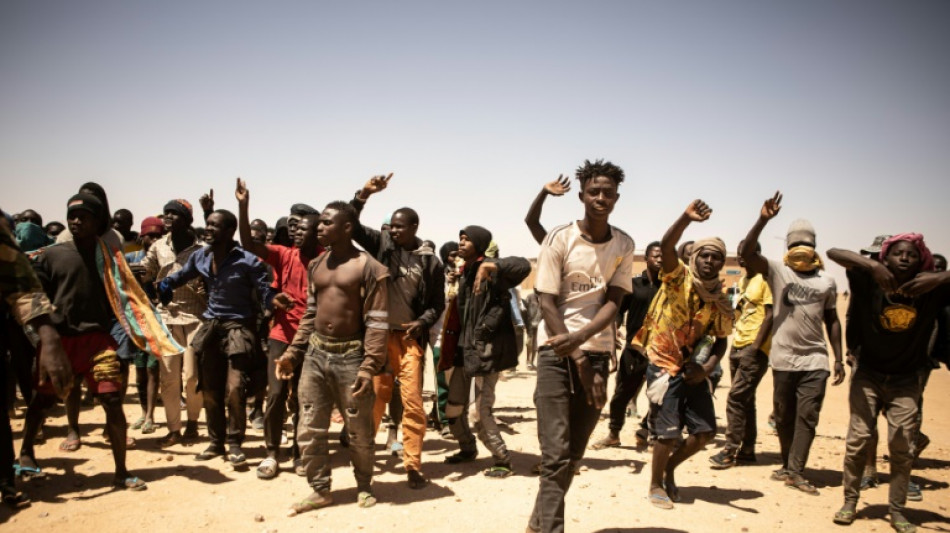
Thousands of migrants stranded in north Niger's scorching desert / Photo: © AFP

A long line of people appears in silhouette, walking along the flat desert in northern Niger.
The strong walkers are at the front. The weakest at the rear.
Every week hundreds more migrants thrown out of Algeria end up here in Assamaka, the first village on the Niger border.
More than 4,500 of them so far have washed up in this tiny windswept corner of the Sahara -- Malians, Guineans and Ivorians mainly, but also Syrians and even Bangladeshis.
They have marched across 15 kilometres (nine miles) of wasteland only to enter a new purgatory.
A transit centre run by the UN's International Organization for Migration (IOM) cannot cope with the numbers and only handles about a third of arrivals.
"When we got here we were told we were not recognised as migrants by the IOM and so we had to pay for our own transport to return home," said Abdoul Karim Bambara from the Ivory Coast.
Assamaka's water tanks are nearly dry, food rations insufficient and shelter from the cruel sun is in short supply.
In temperatures that can nudge 48 degrees Celsius (118 degrees Fahrenheit), thousands seek shade beneath walls or under tarpaulins.
The migrants say that they were stripped of their possessions in Algeria, the stepping-stone to a hoped-for new life in Europe.
They cannot afford to pay for travel home, or even to phone relatives.
They are stranded in what is an open prison in the desert, sometimes for months.
- 'Like cattle' -
Their numbers include talented and educated people -- doctors, students and traders.
But around the barbed-wire walls of the IOM compound, individual traits are forgotten as an angry crowd of needy people forms, pushing and shoving in visceral despair.
"We have become like cattle," said Herman, also from Ivory Coast.
Many of the migrants are physically ill, ravaged by scabies or suffering infected wounds. All are hungry.
"You saw that?" one man said, showing a lump of fly-infested sticky rice. "Would you eat that? We are falling sick from that."
Off to the side, two groups of hungry men are throwing stones at each other amid a cloud of dust.
Fights are common. Days earlier, the death of a Cameroonian ignited a riot that was put down with tear gas. The IOM centre was ransacked by the protesters.
"We are all traumatised. People can no longer control themselves, they are losing their minds, there's nothing here. People are dying," raged Aboubacar Cherif Cisse from Sierra Leone.
"If there was enough to eat, people wouldn't fight, but there is no food -- what can they do? If they have nothing, they will fight each other just to stay alive," said Mohamed Mambu, who represents Sierra Leoneans at another transit centre at Arlit, 200 kilometres (120 miles) away.
The 1,500 residents of Assamaka are overwhelmed by the migrant situation.
"They are everywhere in the village, near the health centre, by the walls," said Francois Ibrahim who works with an NGO called Alarme Phone Sahara, which helps migrants stranded in the desert.
Ibrahim said the migrants steal animals from residents and kill them for food.
- 'Unprecedented' -
The number of migrants pushed into Niger has been increasing since the start of the year, creating an "unprecedented situation," according to the French charity Doctors without Borders (MSF).
Niger's regional capital Agadez, 350 kms from Assamaka, has a third transit centre, but all three are overwhelmed.
The roads heading south are threatened by armed jihadist groups, which means migrants have to be flown out on charter flights for their safety.
"The flights are often cancelled... Yet every week people are expelled" from Algeria, said Ousmane Atair, a manager at the Arlit centre.
Migrants are taken by road from Assamaka to Arlit and then on to Agadez in convoys organised by IOM sub-contractors.
The region seems to be paying the price for its relative stability.
"The road from Assamaka to Arlit is the best protected and that's why the migration flow heads this way," said Arlit mayor Abdourahamane Maouli.
With demand for international aid soaring globally, the European Union, eager to keep migrants away, has become the main financial support for the IOM in the region.
"The IOM plays a key role in the policy of EU states to externalise their borders to African territory," said Alarme Phone Sahara.
Tari Dogo, secretary of the regional council, said Agadez became the "last gateway" to Europe after the Libyan crisis erupted in 2011, but the EU had failed to act decisively to tackle the migrant flow.
"The European Union bears its share of responsibility for this situation," he said.
(U.Kabuchyn--DTZ)