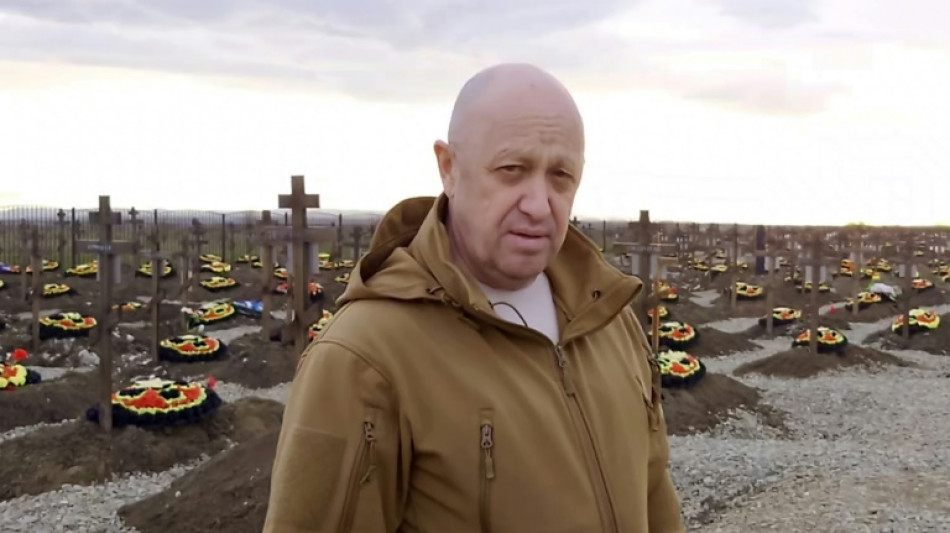
Russia takes stock after failed winter offensive / Photo: © TELEGRAM/ @concordgroup_official/AFP

Russia announced its winter offensive in Ukraine with great fanfare, but the ill-fated campaign has been another disappointment for Moscow.
As spring arrives, the two armies are deadlocked with troops stretching from the shores of the Black Sea to northeast Ukraine -- and the Kremlin has once again been forced to take the long view after failing to make a breakthrough.
Here's how Russia suffered a bitter setback, and what could happen next:
- Battle for Bakhmut -
Bakhmut has become the longest and bloodiest battle in Ukraine. Both sides have endured heavy losses in the eastern industrial city, home to around 70,000 people before the war.
They have waged a war of attrition for months, and the city has taken on huge symbolic importance even though analysts say it has little strategic value.
The Russian mercenary outfit Wagner has been spearheading the attack and claimed Monday that it had captured Bakhmut city hall -- but Wagner's chief Yevgeny Prigozhin has said his forces are still suffering losses.
"Even if Bakhmut falls, the Russian invasion will fall well short of seizing control of Donetsk Oblast, one of its main territorial objectives", the Washington-based Hudson Institute said in its latest military report.
- Stalled offensive -
Russia captured just 70 square kilometres (less than 30 square miles) across Ukraine in March, said Leo Peria-Peigne of the French Institute of International Relations (IFRI).
The Russian army "lacks trained men" and has "artillery ammunition supply problems", he told AFP.
American analyst Michael Kofman said "the Russian offensive is going about as poorly as expected".
"The question is, how much will Russian forces exhaust themselves and be forced to ration ammunition?"
Kofman warned that Russian Chief of the General Staff Valery Gerasimov is "exhausting the force with an ill-timed, feckless set of offensive operations, whose gains will not change the strategic picture for Russia, but could leave Russian forces more vulnerable".
- War of attrition -
The war has decimated forces and drained resources on both sides for more than a year.
"Ukraine has expended a lot of its forces keeping cities without much strategic importance," said Alexander Khramchikhin, an independent military analyst in Moscow.
But former Ukrainian defence minister Andriy Zagorodnyuk said he had "serious doubts that [Russian forces] can upscale their operation", arguing it would not be sustainable.
Kofman said he believed that "the Russian military likely has the manpower and reserves to mount a stubborn defence" against a Ukrainian counter-offensive, with "minefields and trenches" at its disposal.
- Western support -
Ukraine has access to Western intelligence, training and weapons, with heavy-duty tanks and long-range artillery arriving on the battlefield.
The outcome will depend "on the speed and scope of Western deliveries and the ability of Russian air defences to intercept this kind of weaponry", said Igor Korotchenko, editor of the Moscow-based National Defence journal.
Korotchenko, who is under Western sanctions, said such deliveries to Ukraine "prolong the conflict".
- No backing down -
Russian President Vladimir Putin appears to be committed for the long haul and will have to fight a "war of resources", Zagorodnyuk said, adding that Ukraine's battered economy is "not recovering".
"Rage and despair are privately noticeable" among officials in Moscow, said Tatiana Stanovaya, a senior fellow at the Carnegie Endowment for International Peace think tank.
"Russian elites are united in their conviction that since Putin started this war, he must win it," she continued.
But she said that as it stands on the battlefield, "no one understands how Putin could secure a victory".
(P.Tomczyk--DTZ)