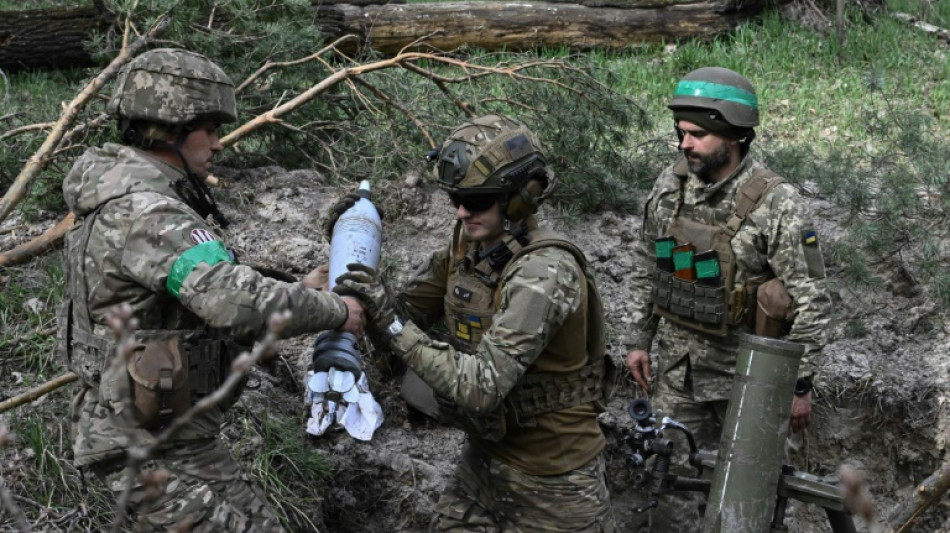
What do the leaked US documents say? / Photo: © AFP/File

A trove of highly sensitive US government documents circulating online includes secret assessments of the Ukraine conflict as well as analyses that point to surveillance of close American allies.
The Pentagon says the breach poses a "very serious risk to national security," and the Justice Department has opened a criminal investigation into the matter.
US officials have not however publicly confirmed that the materials shown in photographs posted on social media and other sites are genuine, and their authenticity could not immediately be independently verified.
These are some key points from documents reviewed by AFP:
Ukraine conflict losses
One document -- an assessment of the status of the conflict as of March 1 -- puts Russian combat deaths at between 35,500 and 43,500, and Ukraine's at 16,000 to 17,500.
Russia also lost more than 150 planes and helicopters, while Ukraine lost more than 90 aircraft.
Another version of the document -- which was apparently digitally modified -- said Ukrainian losses of troops and equipment were higher than Russia's. The Pentagon has warned that the documents "have the potential to spread disinformation."
Anti-air missile shortage
Two documents dated February 28 highlight significant issues with Ukrainian air defenses, which have been instrumental in protecting against Russian strikes and preventing Moscow's forces from gaining control of the skies.
Ukraine's ability to provide medium-range air defenses to protect the front line "will be completely reduced by May 23," the two documents say.
One of them notes that SA-10 and SA-11 Soviet-era systems make up nearly 90 percent of Ukrainian medium and high-range protection and says that -- based on munitions use at the time -- they were projected to run out of missiles by early May and late March, respectively.
Ukraine drone strike inside Russia
An undated document says Ukrainian President Volodymyr Zelensky suggested in late February targeting Moscow's forces inside Russia using drones and expressed concern to the country's top general and another official about Kyiv's lack of missiles with the range for such strikes.
The account -- which points to American surveillance of a close partner -- may help explain US reluctance to provide Ukraine with longer-range weapons it has sought, though Kyiv appears to have carried out such strikes with other means, and Washington's hesitation predates the exchange mentioned in the document.
Israel protests
Another undated document says leaders from Israel's Mossad advocated in early- to mid-February for both officials from the intelligence service and private citizens to protest against a controversial judicial reform plan that would give lawmakers substantially more control over the supreme court.
The document attributed the information to intercepted electronic signals, indicating US spying on an allied country.
South Korea ammo concerns
South Korea's National Security Council was "mired in concerns" over the possibility that the United States would give Ukraine ammunition it was seeking from Seoul, according to a document detailing March 1 communications between two Korean officials.
That would have violated South Korea's policy of not providing lethal aid to Ukraine, whose forces have faced a critical shortage of artillery ammunition. Like previous documents, this one points to American surveillance of a country with which it has close ties.
The revelation sparked criticism in South Korea about the vulnerability of sensitive locations, but President Yoon Suk Yeol's office has pushed back, saying it had "iron-clad security" and that allegations of eavesdropping were "senseless lies."
The country's opposition on Wednesday urged the government to investigate the apparent espionage.
Black Sea surveillance flights
A document dated February 27 details surveillance flights over the Black Sea by the United States, Britain, France and NATO from late September to late February, using both crewed aircraft and drones, including the MQ-9 Reaper.
Roughly two weeks after the date of the document, Washington said a Russian Su-27 jet struck a US MQ-9, requiring the drone to be brought down in the Black Sea. Moscow denied responsibility.
(T.W.Lukyanenko--DTZ)