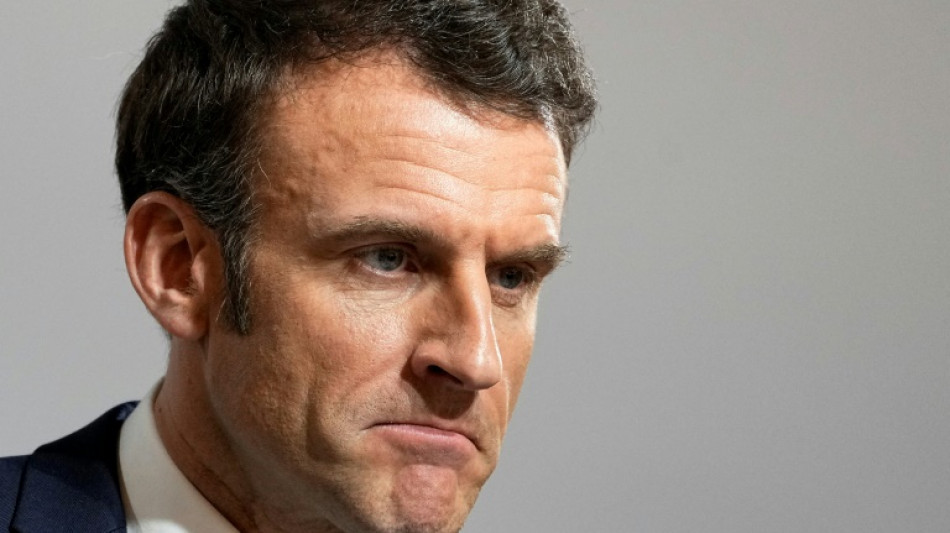
Macron secures pension victory but gloom deepens in France / Photo: © POOL/AFP

President Emmanuel Macron looks to have won his battle to push through widely unpopular pension reform, but many experts and historians believe he has deepened the gloom enveloping French democracy.
France's constitutional court approved the core parts of Macron's pension reform on Friday, paving the way for the centrist head of state to sign into law a hike in the retirement age to 64 from its current level of 62.
But the manner in which the legislation has been passed -- in the face of opposition from two out of three voters, trade unions, and a majority of MPs in the National Assembly -- has dismayed even previously sympathetic observers.
Pierre Rosanvallon, a highly respected sociologist and historian, issued a striking warning in early April that Macron needed to restore the legitimacy of his presidential office in the eyes of voters.
"Without this, the time of revolutions could come back, or else there will be an accumulation of toxic disaffection which will open the way for far-right populism," the centre-left thinker told Liberation newspaper.
Political historian Jean Garrigues also wrote that it was "all of our institutional foundations, all of our political figures which are discredited" by the way the reform had been passed.
"The link between our citizens and their national representatives has been stretched further in this crisis, as it was during the Yellow Vests," Garrigues wrote in Le Monde newspaper, referring to fierce anti-Macron protests in 2018.
Criticism has focused in particular on how the president's minority government rammed the legislation through parliament on March 16 without a vote.
The move -- legal but controversial -- came after other constitutional measures were used to keep parliamentary debate to a minimum, deepening the sense of outrage felt by protesters who have taken to the streets almost every week since January.
The sometimes violent protests peaked at 1.28 million people on March 7, according to official statistics, the biggest in a generation.
"This protest movement will leave a mark in the history our country, through its size and the new people who have joined in," the leader of the moderate CFDT union, Laurent Berger, told reporters as he marched -- for the 12th time since January -- on Thursday.
He repeated his belief that the country faced a "democratic crisis."
- 'No crisis' -
In his only media interview on the subject of pensions since his election to a second term last April, Macron conceded that he and his government had failed to win the battle for public opinion.
Asked if he had any regrets, he told the TF1 channel: "If I have any, it's that we haven't always succeeded in convincing people of the necessity of this reform, which I don't take pleasure in."
But he remained convinced that it was "necessary" and for the greater good of the country -- to avoid pension deficits forecast to hit 13.5 billion euros by 2030, and to bring the country into line with its EU neighbours.
Furthermore, he saw it as legitimate given that he had been re-elected on a platform that included the pension reform and a pledge to make France "work more" to pay for one of the most expensive welfare systems in the world.
Some allies had warned him beforehand, however, about the risks of hiking the retirement age in the middle of a cost-of-living crisis and so soon after Covid-19.
Speaking in China last week, he shot back at critics.
"You can't call it a democratic crisis when an elected president... seeks to implement a policy that has been proposed democratically," he told reporters in off-the-record remarks that were published in the French media.
"If people wanted to retire at 60, then they shouldn't have elected me as president."
- A new republic? -
The talk of crisis and revolution comes amid gathering evidence that confidence in French democracy is waning.
A widely watched annual poll published by the Cevipof political institute at Sciences Po university in Paris showed in February that two out of three people (64 percent) thought French democracy was functioning "not well".
An even higher proportion had negative feelings about politicians (72 percent) and still more (82 percent) thought politicians did not share their priorities.
The pensions reform has also revived debate about whether the current constitution, the foundation of the modern Fifth Republic, is fit for purpose.
Approved during a national emergency and shaped by war-time hero Charles de Gaulle, it created an executive presidency with powers superior to any other western European chancellory or prime minister's office.
"This constitution which hands extremely brutal, authoritarian powers to the governing power is crashing into a society that no longer tolerates decisions seen as too top-down," said constitutional expert Bastian Francois.
"What was acceptable in the 60s, even in the 80s, is less and less acceptable today," the historian at the Sorbonne university in Paris told AFP.
(W.Novokshonov--DTZ)