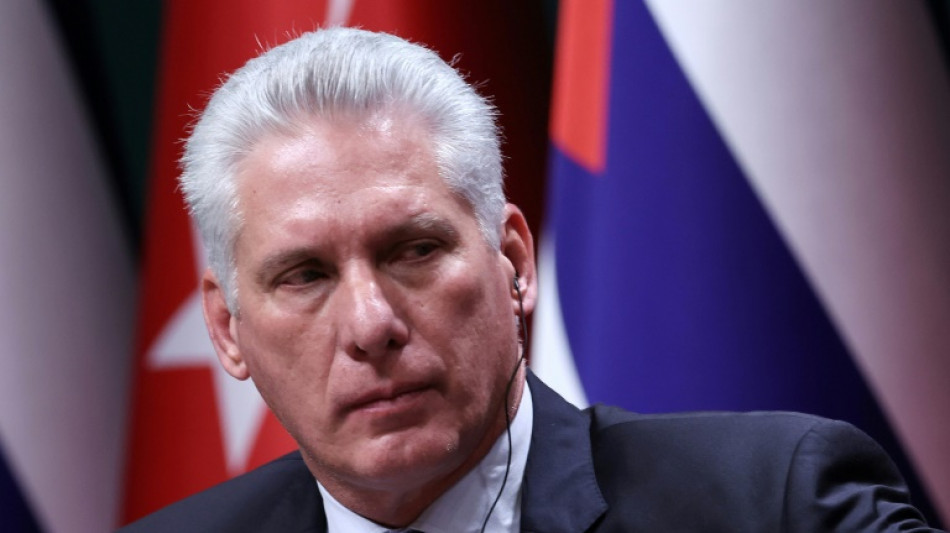
Cuban President Diaz-Canel wins second five-year term in sewn-up vote / Photo: © AFP/File

Cuba's President Miguel Diaz-Canel clinched a second five-year term Wednesday in a parliamentary vote for which he was the sole candidate in a country where political opposition is illegal.
Diaz-Canel's bid was confirmed by 97.66 percent of votes cast in the Communist Party of Cuba-aligned National Assembly, its president Esteban Lazo announced in the chamber.
"Taking into account the announced results, I declare lawmaker Miguel Mario Diaz-Canel Bermudez the elected president of the Republic," said Lazo.
Diaz-Canel, 62, took over the reins in 2018 as Cuba's first civilian leader after nearly 60 years of hegemony by the Castro brothers, vowing to "always defend the party" even as he set out in pursuit of cautious economic liberalization.
His first five years in office were marked by the worst economic crisis in three decades and a widely criticized response to historic anti-government protests which triggered a tightening of US sanctions.
Diaz-Canel will be keen for another stab at reform, recently telling the pan-Arab television channel Al Mayadeen he was "dissatisfied" that his efforts at addressing Cuba's economic woes had not been "more efficient, more effective."
Under Diaz-Canel, an electronic engineer by training, Cuba sought to accelerate the opening of the economy to small businesses in hundreds of sectors previously under exclusive state control.
Two years ago, he initiated a monetary reform that ended artificial parity with the US dollar but fueled inflation and sharply devalued the local currency -- another blow to an ailing economy hard hit by US sanctions in place since 1962 and a tourism dip brought on by the coronavirus pandemic.
The reforms under Diaz-Canel "have not meant a complete and comprehensive transition to a mixed economy" of private and public enterprises, analyst Arturo Lopez-Levy, of the Autonomous University of Madrid, told AFP.
Most companies in Cuba are still state-controlled.
"Some economic changes have not taken place, and others that have taken place, have left much skepticism," said Lopez-Levy.
- No more Castro -
Long-suffering Cubans face daily shortages of food, medicine and fuel, and since the arrival of mobile internet in 2018 have increasingly taken to social media to voice their dissatisfaction.
But in 2021, the largest protests since the 1959 Castro-led revolution was met with a harsh response that left one dead, dozens injured and more than 1,300 imprisoned, according to rights observers.
Since then, Cuba has experienced an unprecedented exodus, with more than 300,000 of its nationals leaving for other shores in 2022 alone.
Under Cuban law, a president can serve no more than two successive terms.
Since 2021, Diaz-Canel has also served as first secretary of the communist party -- the country's most powerful position long held by revolutionary leader Fidel Castro and then his brother Raul.
(I.Beryonev--DTZ)