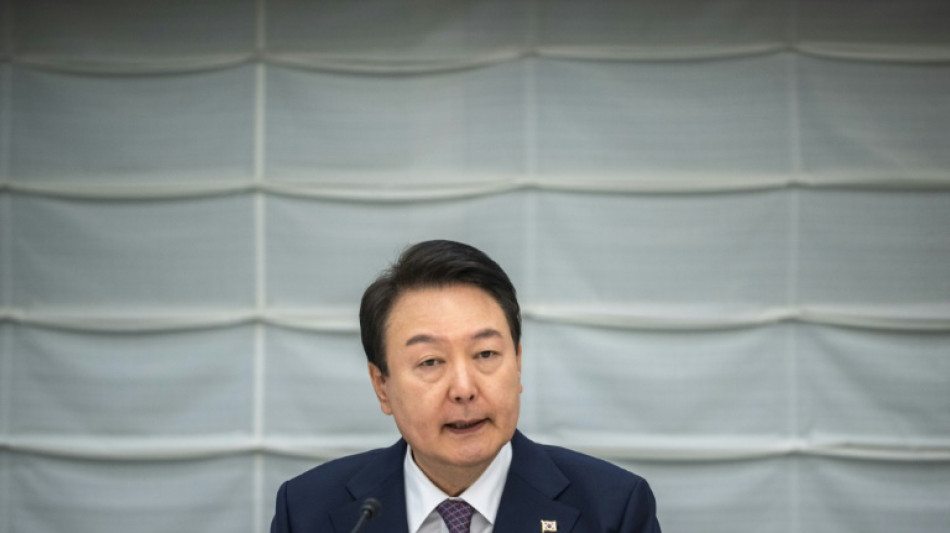
Military cooperation in spotlight as S. Korea's president heads to US / Photo: © POOL/AFP/File

South Korea's President Yoon Suk Yeol heads to Washington Monday, as the allies bolster military cooperation -- including with US regional partner Japan -- over North Korea's expanding nuclear weapons programme.
Pyongyang has conducted another record-breaking string of sanctions-defying launches this year, including test-firing the country's first solid-fuel ballistic missile this month -- a key technical breakthrough for Kim Jong Un's military.
In response, Yoon has pulled South Korea closer to long-standing ally Washington, and even sought to bury the hatchet with former colonial power Japan in a bid to contain North Korea.
But the South Korean president has seen his domestic approval ratings dive, hit hard by public disapproval over his handling of a recent US intelligence leak that appeared to reveal Washington was spying on Seoul.
He is also struggling to reassure the South's increasingly nervous public about the US commitment to so-called extended deterrence, where US assets -- including nuclear weapons -- serve to prevent attacks on allies.
A majority of South Koreans now believe the country should develop its own nuclear weapons, multiple surveys show. Yoon has hinted Seoul could pursue this option.
All this "reflects not only growing concerns regarding nuclear North Korea but also an erosion of trust in the US security umbrella", Gi-Wook Shin, a Korea expert and sociology professor at Stanford University, told AFP.
Shin said Yoon was one of South Korea's "most pro-alliance" presidents, "but recent events such as the allegations about the US spying on South Korean officials have not helped him gain domestic support".
- Domestic backlash -
Yoon has also faced domestic backlash over a March summit with Japanese PM Fumio Kishida, with critics accusing him of prioritising diplomacy over resolving disputes over Tokyo's wartime treatment of Koreans, including forced labour and sexual slavery.
US President Joe Biden is eager for two of Washington's major regional allies to work more closely over North Korea.
A key outcome of the Biden-Yoon summit could be "any advance in intelligence sharing that includes Japan", Karl Friedhoff at the Chicago Council on Global Affairs said.
"That kind of coordinated response is important to South Korean security... but it also puts Yoon at odds with his political opponents at home."
The White House said the visit showed how the "ironclad" alliance "has grown far beyond the Korean Peninsula, and is now a force for good in the Indo-Pacific and around the world".
Yoon is also likely to come under pressure to do more to help the US support Ukraine, as Washington looks to South Korea -- the world's ninth-largest arms exporter -- to help secure ammunition and weapons for Kyiv.
South Korea has sent humanitarian assistance to Ukraine, and has sold tanks and howitzers to Poland, but Seoul has a longstanding policy of not providing weapons to active conflict zones.
- 'Battleground ally' -
Yoon needs some kind of "tangible outcome" from the US state visit, or he risks further tanking both his own public support and "South Korea's trust in the US", Stanford University's Shin said.
The six-day trip has a packed schedule, including a state dinner with the Bidens, visits to the US Chamber of Commerce and NASA, and a speech at Harvard University.
Local reports say Yoon will be accompanied by soldiers wounded on the frontline between the two Koreas, who remain technically at war since the 1950s conflict ended with a ceasefire, not a peace treaty.
This serves to emphasise "Seoul's quality of being America's battleground ally, and the sacrifices South Koreans make in the process", Vladimir Tikhonov, professor of Korean Studies at the University of Oslo, told AFP.
Yoon will also be accompanied by more than 120 South Korean business leaders, including Samsung chairman Lee Jae-yong -- and the visit could address their concerns over Biden's Inflation Reduction Act.
The legislation, which Seoul has complained about to Washington before, "will adversely affect South Korean companies and their (Electric Vehicle) batteries exports to the US," said Minseon Ku, a political science scholar.
The trip going well is particularly important for Yoon as it is "a way to boost (his) approval ratings especially in the realm of foreign policy", Ku said.
(V.Korablyov--DTZ)