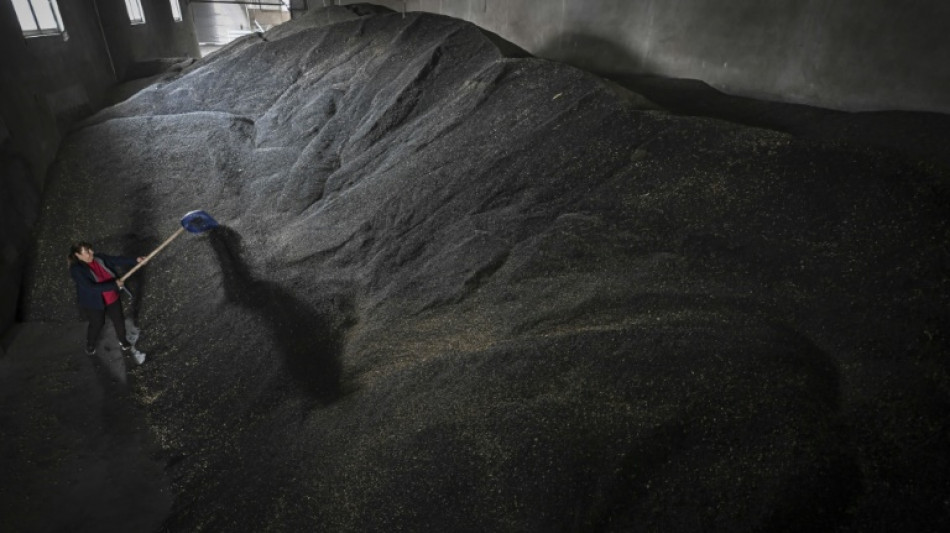
Eastern EU farmers fume over Ukraine grain influx / Photo: © AFP

Angel Vukodinov fumes over the piles of unsold sunflower seeds in his granary in central Bulgaria. Like other farmers in eastern EU nations, he blames an influx of Ukrainian grain for the mess.
The European Union has allowed Ukraine to export agricultural goods through the bloc after Russia's invasion disrupted the country's traditional Black Sea shipping lanes last year.
Farmers in eastern EU states have protested in recent months, saying the move saturated the market and led to a massive drop in prices in their countries.
In response, the EU has offered financial aid for farmers impacted by the influx.
"We have nothing against the Ukrainian people... But the compensation offered by the EU for our losses is a joke," said Vukodinov, 61, who has been a farmer for more than 30 years in the central Bulgarian town of Saedinenie.
Following protests, authorities in Bulgaria, Hungary, Poland and Slovakia announced over the past week that they would temporarily ban Ukrainian grains, though goods are still allowed to transit through amid EU talks to find a solution.
Following Russia's Black Sea blockade last year, EU member states agreed to import certain products from Ukraine without quantitative restrictions and customs inspection.
The goods were destined for Africa and the Middle East, but they got stuck, partially due to logistical problems, including the poor infrastructure in Bulgaria.
"The granaries are full, there is no market at all, no demand for any farm produce... on top of the price dumping," said Danka Marincheshka, production chief at Vukodinov's family farm.
- 'Unfair to us' -
Bulgarian farming ministry data show that some 940,000 tonnes of Ukrainian sunflower seeds were imported into the EU's poorest member last year, or half of Ukraine's total sunflower seeds exports to the bloc.
Neighbouring Romania came second with nearly 360,000 tonnes.
"Romanian and EU authorities were unfair to us, because, contrary to what they promised, a big part of the grain, which was due to only transit Romania, was left here," said Florentin Bercu, a Romanian union representative.
The sunflower seeds market in Bulgaria has become "oversaturated," said Marin Iliev, management board member of the Plovdiv Union of Grain Producers.
"Nobody cared to notice what was happening. So these streams that started trickling in became full-flowing rivers, the market overflowed and prices tumbled down," the farmer added.
Prices had topped some 870 euros ($950) per tonne in March 2022, right after Russia's invasion of Ukraine, but have since fallen to around 360 euros per tonne, which does not cover production expenses including increased fertiliser prices, according to Iliev.
- 'Aristocracy of big farmers' -
Nikolay Valkanov, director of the Sofia-based think-tank InteliAgro, however, accused an "aristocracy of big farmers" of holding the country "hostage" by not selling produce last year while hoping for prices to go up.
"The average price of Ukrainian sunflower seeds sold in Bulgaria last year was $690 per tonne. You tell me if these are dumping prices. Why didn't the Bulgarian farmers sell back then?" he told AFP.
Faced with protests and roadblocks by farmers over the past months, the European Commission offered in February a 56-million-euro package for farmers.
This week, Brussels added an extra 100 million euros of support and proposed emergency measures to ensure grain could enter Poland, Slovakia, Hungary, Romania and Bulgaria only for export.
So far no permanent solution has been found with more discussions to be held in the coming days.
"Brussels is trying to contain the row but the uncertainty continues," Iliev, the Bulgarian farmer, said. "What would reassure us is for solidarity corridors to remain solidarity corridors in practice."
burs-ds/jza/lth/fb
(U.Kabuchyn--DTZ)